




Daimler Showcases Safety System Intelligence
During an industry event, company researchers highlight progress in developing camera-based systems that can recognize and understand a range of driving scenarios.
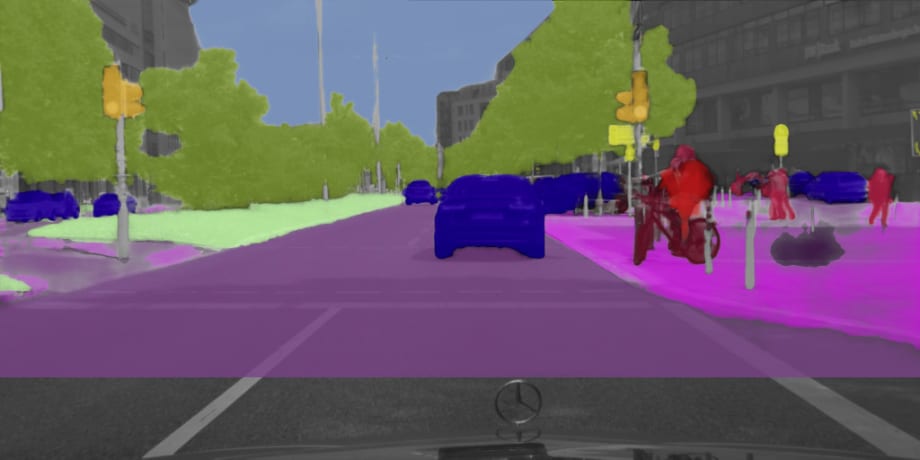
Image of scene labeling courtesy of Daimler AG.
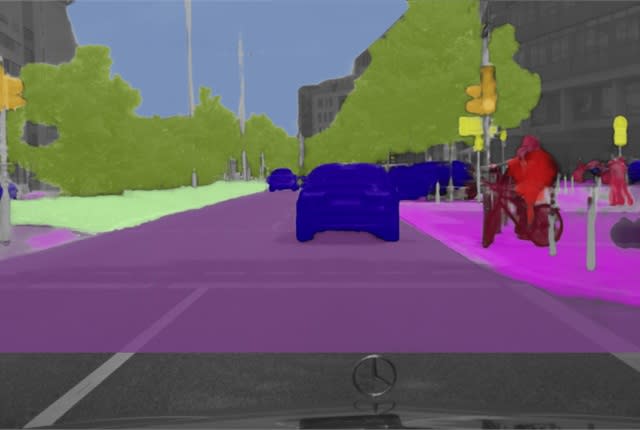
Image of scene labeling courtesy of Daimler AG.
Daimler researchers are making major strides in developing camera-based systems that can automatically recognize and classify different categories of people, objects and driving situations.
Such “scene labeling” capabilities represent a breakthrough, aided in part by the UR:BAN initiative -- shorthand for the Urban Space: User-friendly Assistance Systems and Network Management project. At the project’s closing event, Daimler presented results from five different test vehicles.
“The tremendous increase in computing power in recent years has brought closer the day when vehicles will be able to see their surroundings in the same way as humans and also correctly understand complex situations in city traffic,” said Professor Ralf Guido Herrtwich, head of driver assistance and chassis systems for group research and advanced development at Daimler AG.
Scene labeling transforms the camera “from a mere measuring system into an interpretive system, as multifunctional as the interplay between eye and brain,” Daimler explained in a press release.
One Daimler test vehicle demonstrated scene labeling, while another showcased imaging radar systems and their potential in urban environments. Radar sensors can now resolve and visualize not just dynamic objects but also static environments. Additionally, properties of radar waves allow the system to function in fog and inclement weather. Environment models can be generated using data from radar and camera sensors.
The third test vehicle included a system for detecting, classifying and identifying the intent of pedestrians and cyclists. This system, for example, analyzed head posture, body position and curbside position to predict whether a pedestrian was likely to stay on the sidewalk or cross the road. “In dangerous situations, this allows an accident-preventing system response to be triggered up to one second earlier than with currently available systems,” Daimler said.
Another highlight was the demonstration of how radar- and camera-based systems can make lane changing in city traffic safer and less stressful. Following a command from the driver, this system provides assisted lane changing in a speed range of 18-37 mph. The driver at all times has the option of overruling the system by intervening with the steering, accelerator or brakes.
The fifth test vehicle showed the potential for predicting driver behavior in relation to planned lane changes or changes of direction.
“With regard to an imminent change of lane, for example, glances over the shoulder are linked with driving parameters that have already been sensed,” Daimler explained. “A likely change of direction can be predicted from the interplay between steering movement, reduction of speed and map information. In the demonstration, the direction indicator was then automatically activated to inform other road users as early as possible.”
To advance such technology, Daimler continues to conduct research with its partners.
More Safety

Nexar-Nauto Merger Aims to Give Fleets Better Safety Intelligence Through Larger Driving Dataset
Stefan Heck tells Automotive Fleet that combining more than 10 billion miles of driving history with Nexar's AI models will give fleets deeper insights into driver risk and roadway conditions than either company could provide independently.
Read More →
Don't Wait for a Crisis: 5 Ways to Build Mental Health Into Your Fleet Safety Program
For Suicide Prevention Month, fleet and safety leaders have an opportunity to put mental health where it belongs: at the center of workplace safety.
Read More →
How Camera Data Can Strengthen a Fleet’s Insurance Renewal
Insights from a commercial insurance carrier and a broker show how fleets can turn video telematic data, driver coaching, and improved claims results into a stronger case at insurance renewal.
Read More →
The Safest Fleets Aren’t the Ones with the Most Technology
You’ve made the telematics investment. Here’s how to capture the other half of its value and build the safest fleet on the road.
Read More →
Hidden in Plain Sight: Fleet Compliance Risks
Fleet compliance isn't just about having policies — it's about consistently enforcing them. This practical guide reveals six hidden compliance risks common in public sector and shared fleet operations and outlines proven strategies to improve visibility, accountability, and audit readiness
Read More →
NETS Sets 2026 Fleet Safety Benchmark Conference for Indianapolis
The Sept. 15–17 program will feature fleet benchmarking data, case studies, emerging technologies, and implementation strategies while running alongside the NSC Safety Congress & Expo.
Read More →
Off-the-Job Crashes Account for 43% of Employers’ $61.7 Billion Crash Burden
NETS quantifies costs dispersed across fleet, risk, HR, and other departments while providing new per-crash benchmarks for employers.
Read More →
Ram Recalls More Than 1.27 Million 1500 Pickups for Seat Belt Anchor Issue
The recall affects certain 2019-2026 Ram 1500 pickups that may have improperly attached second-row seat belt buckle anchors.
Read More →
How Better Visibility Cut Speeding Violations by 48%
Fleet leaders don't need more data, they need clearer visibility into what the data is saying. This case study explores how one utility replaced speeding-event counts with a single metric — miles driven in violation — to strengthen safety and significantly reduce speeding violations.
Read More →
Operation Safe Driver Week: Why the Industry's Oldest Safety Campaign Still Matters to Fleets
A look at how a 2007 enforcement initiative became one of the most consequential weeks on the fleet safety calendar, and what it means for your drivers in 2026.
Read More →