




Buick Offers New Safety Technologies
DETROIT --- Buick will offer two new safety-enhancing technologies to help drivers avoid a collision caused either by an inadvertent lane change or by colliding with a vehicle in the side blind spot while changing lanes.

DETROIT --- Buick will offer two new safety-enhancing technologies to help drivers avoid a collision caused either by an inadvertent lane change or by colliding with a vehicle in the side blind spot while changing lanes. The technologies will be available on all 2008 Buick Lucerne sedan models this summer. The General Motors Lane Departure Warning (LDW) and Side Blind Zone Alert (SBZA) systems continue Buick's mission of adding advanced but easy-to-use technologies. The lane departure system uses a camera, located between the inside rearview mirror and the windshield, to detect lane markings on the road and alert drivers when they inadvertently stray from the lane. The side blind zone system uses radar sensors behind the rear fascia on both sides of the vehicle. It is designed to help drivers avoid lane-change crashes with vehicles in the side blind zone. The same technology behind the Buick systems will be featured on the 2008 Cadillac STS and DTS sedans. "GM's Lane Departure Warning and Side Blind Zone Alert systems aren't a substitute for safe, careful driving, but they show tremendous potential to reduce certain kinds of crashes," said Buick-Pontiac-GMC General Manager John Larson. "They have been tested extensively with great success." When GM's Lane Departure Warning System is engaged, a driver traveling at 35 mph or more who crosses a detected lane marking without signaling is alerted in two ways: The system flashes an amber indicator light located in the fuel gauge of the Lucerne’s instrument panel, and an alerting chime of three beeps is played. The system does not steer the vehicle; it is designed only to alert drivers so they can take appropriate action to move the vehicle back into the lane. According to the National Highway Traffic Safety Administration, nearly 200,000 car crashes a year happen due to automobiles leaving their lanes. The causes range from driver distraction to driver fatigue. A Lane Departure Warning system alerts a driver when he's leaving his lane without signaling. A recent University of Michigan Transportation Research Institute-led study also revealed that lane departure warning systems can help drivers do a better job of staying in their lanes and promote greater use of turn signals. "Active safety is one of the emerging automotive technologies we see in vehicles today," said Charlie Vogelheim, vice president of J.D. Power and Associates. "Active safety are products that prevent crashes or minimize damage to the vehicles and increase safety to the passenger in unavoidable crashes." Larson said a distinguishing feature of Buick's lane departure system over competitive systems is an indicator light with the LDW symbol that indicates whether the system is ready to assist the driver. If the light is green, the system is able to detect lane markings and provide alerts. If the light is off, it will not. To avoid nuisance alerts, the system is deigned to not provide an alert if the turn signal is on or if the driver makes a sharp maneuver. For many reasons, it often can be difficult for a driver to see vehicles in the side blind zone. Alternating radar beams in GM's Side Blind Zone Alert System sweep adjacent lanes of traffic, covering a zone of about one lane over from both sides of the vehicle, or 11 feet (3.5 m). The zone starts at each side mirror and goes back about 16 feet (5 m). When the system is engaged, a driver will know that following vehicles in the adjacent lanes are entering their side blind zone when an amber symbol, located in the outside rearview mirror, is illuminated. The system is not designed to detect vehicles outside of the side blind zone that may be rapidly approaching, or detect pedestrians, bicyclists or animals. It's designed to ignore infrastructure such as fire hydrants or parked cars. In addition, the system displays do not come on while the vehicle is approaching or passing other vehicles. Both the LDW and SBZA systems can be turned on and off by the driver. "These are easy-to-use, easy-to understand technologies that will benefit our customers and the driving public, and you won't have to spend thousands of dollars on a high-end luxury car to benefit from these technologies," Larson said. Lane Departure Warning and Side Blind Zone Alert systems join the Lucerne's growing list of safety technologies to help protect occupants before, during and after a crash. Some include a front passenger dual depth air bag that deploys in two shapes and pressures based on the severity of the crash, seat position and seat belt use; Magnetic Ride Control for increased vehicle control and tire contact with the road surface; StabiliTrak electronic stability control with brake assist, which senses emergency braking situations and boosts the power as needed; and OnStar's Advanced Automatic Crash Notification (AACN) system, making crash data available to participating 911 centers to help them dispatch the appropriate life-saving personnel and equipment to crash scenes faster. Lane Departure Warning and Side Blind Zone Alert systems are available together as an optional upgrade to Lucerne's Driver Confidence Package, which includes remote start, rear park assist, heated washer fluid, StabiliTrak and rain-sensing windshield wipers. Both technologies are available in the U.S. and Canada. Pricing for each has not been announced.
More Safety

Nexar-Nauto Merger Aims to Give Fleets Better Safety Intelligence Through Larger Driving Dataset
Stefan Heck tells Automotive Fleet that combining more than 10 billion miles of driving history with Nexar's AI models will give fleets deeper insights into driver risk and roadway conditions than either company could provide independently.
Read More →
Don't Wait for a Crisis: 5 Ways to Build Mental Health Into Your Fleet Safety Program
For Suicide Prevention Month, fleet and safety leaders have an opportunity to put mental health where it belongs: at the center of workplace safety.
Read More →
How Camera Data Can Strengthen a Fleet’s Insurance Renewal
Insights from a commercial insurance carrier and a broker show how fleets can turn video telematic data, driver coaching, and improved claims results into a stronger case at insurance renewal.
Read More →
The Safest Fleets Aren’t the Ones with the Most Technology
You’ve made the telematics investment. Here’s how to capture the other half of its value and build the safest fleet on the road.
Read More →
Hidden in Plain Sight: Fleet Compliance Risks
Fleet compliance isn't just about having policies — it's about consistently enforcing them. This practical guide reveals six hidden compliance risks common in public sector and shared fleet operations and outlines proven strategies to improve visibility, accountability, and audit readiness
Read More →
NETS Sets 2026 Fleet Safety Benchmark Conference for Indianapolis
The Sept. 15–17 program will feature fleet benchmarking data, case studies, emerging technologies, and implementation strategies while running alongside the NSC Safety Congress & Expo.
Read More →
Off-the-Job Crashes Account for 43% of Employers’ $61.7 Billion Crash Burden
NETS quantifies costs dispersed across fleet, risk, HR, and other departments while providing new per-crash benchmarks for employers.
Read More →
Ram Recalls More Than 1.27 Million 1500 Pickups for Seat Belt Anchor Issue
The recall affects certain 2019-2026 Ram 1500 pickups that may have improperly attached second-row seat belt buckle anchors.
Read More →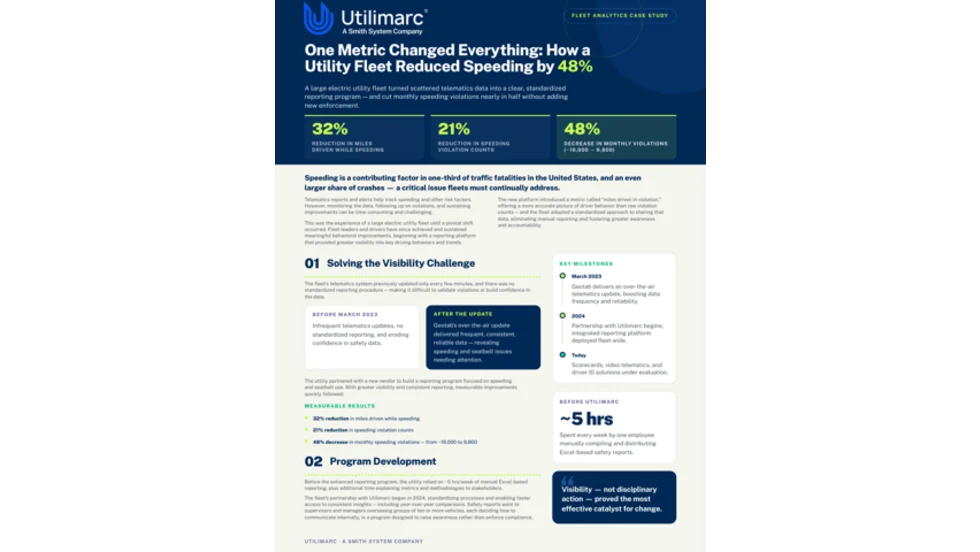
How Better Visibility Cut Speeding Violations by 48%
Fleet leaders don't need more data, they need clearer visibility into what the data is saying. This case study explores how one utility replaced speeding-event counts with a single metric — miles driven in violation — to strengthen safety and significantly reduce speeding violations.
Read More →
Operation Safe Driver Week: Why the Industry's Oldest Safety Campaign Still Matters to Fleets
A look at how a 2007 enforcement initiative became one of the most consequential weeks on the fleet safety calendar, and what it means for your drivers in 2026.
Read More →