





Related: Sergio Marchionne, Who Turned Around Fiat Chrysler, Dies
Automotive Legend Lee Iacocca Passes Away
Lee Iacocca, who led Chrysler out of near bankruptcy by introducing the K-car platform, has died. The automotive icon, 94, died of natural causes.
July 3, 2019
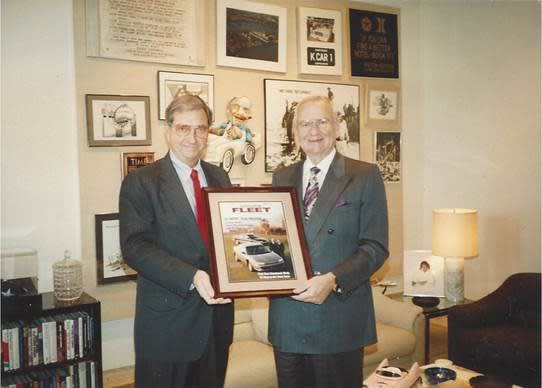
Bob Brown (left), Great Lakes sales manager, presents a framed Automotive Fleet cover to Lee Iacocca in 1981 around the launch of the K-car platform.
File photo
3 min to read
Lee Iacocca, who led Chrysler out of near bankruptcy by introducing the K-car platform, has died. The automotive icon, 94, died of natural causes.
Iacocca, who was born Oct. 15, 1924, worked for Ford Motor Co. (1946 to 1978) where he led development of the Mustang, and Chrysler (1978 to 1992).
While Iacocca had a tumultuous career, he will be remembered by many for the roles he played in the industry.
He was named president of Ford Motor Co. in 1970 and fired in 1978 by Henry Ford Jr. In 1979, he was named CEO of Chrysler. After several years at the automaker and his retirement in 1992, he sued Chrysler in 1995, with the lawsuit settled in 1996.
As Chrysler was struggling financially in the early 1980s, the company was ramping up production of the K car, which ultimately helped Chrysler regain financial stability. "If you can find a better car, buy it," Iacocca said in a blitz of TV commercials in which he starred.
"The period until the K cars achieved full production was precarious," said Mike Antich, Automotive Fleet editor. "What helped Chrysler bridge the gap was a significant fleet sale of Caravan minivans to Xerox. This sales agreement was consummated by Chrysler Fleet Director Hal Barton, who reported to Iacocca, and Ron Pink, who managed the Xerox fleet. As these fleet sales were being fulfilled, it allowed Chrysler the time it needed to start shipping Chrysler K cars in volume to its dealers and fleets."
According to Iacocca's website, he was a first-generation American. His father, Nicola, came from Italy when he was just 12 years old. He grew up in the steel-making belt of Pennsylvania. His father opened a hot dog restaurant, Yocco's. Iacocca went to school in Pennsylvania, obtaining a degree in industrial engineering. He received a fellowship to Princeton and got his first job at Ford as an engineer after graduation.
"It didn't take long for me to realize that I was better suited to the sales and marketing side of the car business. The bosses agreed and soon I made the move. After leading several successful initiatives, I began to move up the ranks, ultimately finding my true calling in product development. It was also during this period that I married my beautiful wife, Mary, with whom I would have two amazing daughters, Kathryn and Lia. With my family by my side, I continued my ascent within the Ford company," Iacocca noted.
Iacocca's wife, passed away in 1983 of diabetes. He founded The Iacocca Foundation to support diabetes research. He also authored several books, including his most recent, "Where Have All the Leaders Gone?"
"Lee Iacocca was truly bigger than life and he left an indelible mark on Ford, the auto industry, and our country," said Bill Ford, executive chairman. "Lee played a central role in the creation of Mustang. On a personal note, I will always appreciate how encouraging he was to me at the beginning of my career. He was one of a kind and will be dearly missed."
Fiat Chrysler Automobiles, which lost its leader Sergio Marchionne a year ago, also released a statement.
"Fiat Chrysler Automobiles is saddened by the news of Lee Iacocca's passing. He played a historic role in steering Chrysler through crisis and making it a true competitive force. He was one of the great leaders of our company and the auto industry as a whole," according to the statement. "He also played a profound and tireless role on the national stage as a business statesman and philanthropist. Lee gave us a mindset that still drives us today — one that is characterized by hard work, dedication and grit.
Originally posted on Work Truck Online
More Operations

Company Vehicle or Reimbursement? How Fleets Are Rethinking Assignments
As fleet costs and insurance pressures rise, fleet managers are taking a closer look at which employees need company-provided vehicles and when a reimbursement program may make more sense.

Fleetio, ASE Launch Scholarship Program for Automotive Technicians
The second annual program will award 15 scholarships totaling $35,000 to support ASE certification, testing fees, and equipment costs.

Reading the Global Signals: What AI and the Energy Transition Mean for Fleets Now
In this opening keynote of the 2026 Fleet Forward Conference, John Rossant, founder of CoMotion, How can fleet managers navigate a never-ending, changing industry landscape?

90% Use Telematics. Are Fleets Getting Safer? | AF News Recap
This week, we're breaking down which industries have the highest rates, how Jamie McKay manages 2,400 vehicles, what's happening with the 2027 fleet awards, and why software-defined vehicles could introduce new costs.

What's Best Handled by an FMC, and What's Better Done Directly?
Fleet managers continue to rely on FMCs for essential services but are taking a closer look at where working directly with suppliers can improve efficiency and responsiveness.

Fleet Meets: Erin Gilchrist
Meet Erin Gilchrist, the inaugural Mike Antich Spirit of Fleet Award winner, as she shares insights on leadership, mentorship, the power of industry connections, and why people remain at the heart of fleet's future.

How 2026 Fleet Visionary Jamie McKay Manages 2,400 Vehicles Across 37 States
How do you keep 2,400 vehicles running across 37 states? Fleet Visionary Award winner Jamie McKay shares how collaboration, flexibility, and a few simple strategies help her tackle fleet management challenges at Aptive Pest Control.

Managing Fleet Costs in an Era of Permanent Volatility
Fleet operating costs have risen more than 20% since 2020, raising a key question: When does extending a vehicle's service life stop making financial sense?

The Next Evolution of Fleet Management: Autonomous Operations
This opening keynote session at the Fleet Forward Conference highlights the future of autonomous driving for fleets.

How to Reduce the Total Cost of Risk From Catalytic Converter Theft
A stolen catalytic converter can cost fleets far more in downtime and lost productivity than in repairs. A total-cost-of-risk approach can help fleet managers quantify their exposure and prioritize theft prevention.