




Automatic Emergency Braking Systems Vary Widely
AAA tests underscore performance differences between systems designed to mitigate crash severity and systems designed to prevent a crash altogether whenever possible.
Graphic courtesy of AAA.
Graphic courtesy of AAA.
New test results from AAA reveal that automatic emergency braking systems — the safety technology that will soon be standard equipment on 99% of vehicles — vary widely in design and performance.
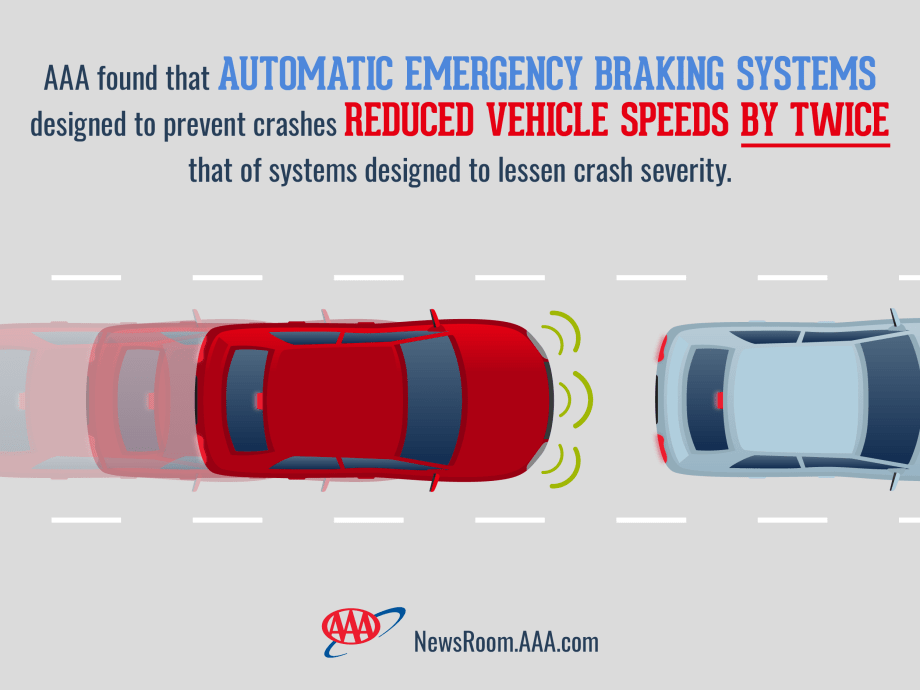
All the systems tested by AAA are designed to apply the brakes when a driver fails to engage them. But those that are designed to prevent crashes reduced vehicle speeds by nearly twice that of those designed to lessen crash severity, according to AAA.
While any reduction in speed offers a significant safety benefit to drivers, AAA warns that automatic braking systems are not all designed to prevent collisions and recommends that drivers fully understand system limitations before getting behind the wheel.
“AAA found that two-thirds of Americans familiar with the technology believe that automatic emergency braking systems are designed to avoid crashes without driver intervention,” said John Nielsen, AAA’s managing director of automotive engineering and repair. “The reality is that today’s systems vary greatly in performance, and many are not designed to stop a moving car.”
In partnership with the Automobile Club of Southern California’s Automotive Research Center, AAA evaluated five 2016 model-year vehicles equipped with automatic emergency braking systems. Researchers looked at performance within system limitations and in real-world driving scenarios designed to push the technology’s limits.
Researchers tested and compared systems based on the capabilities and limitations stated in the owner’s manuals. Systems fell into two categories — those designed to slow or stop the vehicle enough to prevent crashes, and those designed to slow the vehicle to lessen crash severity. More than 70 trials were conducted.
In terms of overall speed reduction, the systems designed to prevent crashes reduced vehicle speeds by twice that of systems designed to only lessen crash severity (79% speed reduction vs. 40% speed reduction), according to AAA. With speed differentials of under 30 mph, systems designed to prevent crashes successfully avoided collisions in 60% of test scenarios. Surprisingly, the systems designed to only lessen crash severity were able to completely avoid crashes in nearly one-third (33%) of test scenarios.
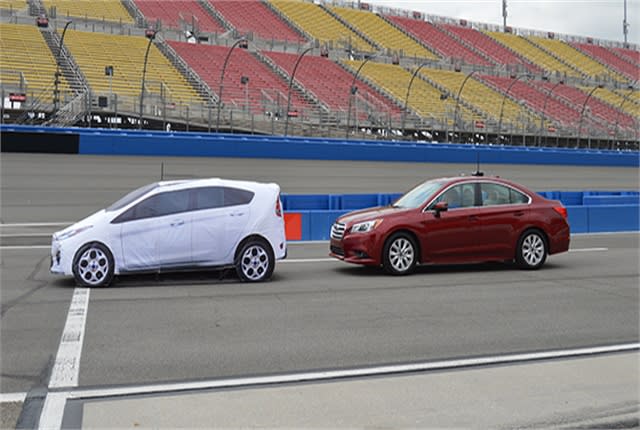
AAA conducted testing of automatic emergency braking systems on a closed course at the Auto Club Speedway in Fontana, Calif. Photo courtesy of AAA.
When pushed beyond stated system limitations and proposed federal requirements, the variation among systems became more pronounced, researchers discovered. When traveling at 45 mph and approaching a static vehicle, the systems designed to prevent crashes reduced speeds by 74% overall and avoided crashes in 40% of scenarios. In contrast, systems designed to lessen crash severity were only able to reduce vehicle speed by 9% overall, AAA reported.
“Automatic emergency braking systems have the potential to drastically reduce the risk of injury from a crash,” said Megan McKernan, manager of the Automobile Club of Southern California’s Automotive Research Center. “When traveling at 30 mph, a speed reduction of just 10 mph can reduce the energy of crash impact by more than 50 percent.”
In addition to the independent testing, AAA surveyed U.S. drivers to gauge attitudes about the technology. Survey results revealed that 9% of U.S. drivers currently have automatic emergency braking on their vehicle. Nearly 40% percent of drivers want automatic emergency braking on their next vehicle.
The survey also found that men are more likely to want an automatic emergency braking system in their next vehicle (42%) than female drivers (35%). Two out of five U.S. drivers trust automatic emergency braking to work. Additionally, drivers who currently own a vehicle equipped with such a braking system are more likely to trust it to work (71%) compared to drivers who have no experience with the technology (41%).
“When shopping for a new vehicle, AAA recommends considering one equipped with an automatic emergency braking system,” Nielsen said. But he cautioned drivers to fully understand their vehicle’s capabilities and limitations before hitting the road.
For the technology’s potential to reduce crash severity, 20 automakers representing 99% of vehicle sales have committed to making automatic emergency braking systems standard on all new vehicles by 2022. The U.S. Department of Transportation said this voluntary agreement will make the safety feature available on new cars up to three years sooner than could be achieved through the formal regulatory process.
According to the National Highway Traffic Safety Administration, rear-end collisions, which automatic emergency braking systems are designed to mitigate, result in nearly 2,000 fatalities and more than 500,000 injuries annually. Currently, 10% of new vehicles have automatic emergency braking as standard equipment, and more than half of new vehicles offer the feature as an option.
AAA conducted its testing of automatic emergency braking systems on a closed course at the Auto Club Speedway in Fontana, Calif. Testers used instrumented vehicles and a robotic “soft car” that allowed for collisions without vehicle damage. This permitted AAA to collect vehicle separation, speed, and deceleration data in a variety of crash scenarios designed to mirror real-world driving conditions.
The testing was designed to build on previous research by the Insurance Institute for Highway Safety.
More Safety

Nexar-Nauto Merger Aims to Give Fleets Better Safety Intelligence Through Larger Driving Dataset
Stefan Heck tells Automotive Fleet that combining more than 10 billion miles of driving history with Nexar's AI models will give fleets deeper insights into driver risk and roadway conditions than either company could provide independently.
Read More →
Don't Wait for a Crisis: 5 Ways to Build Mental Health Into Your Fleet Safety Program
For Suicide Prevention Month, fleet and safety leaders have an opportunity to put mental health where it belongs: at the center of workplace safety.
Read More →
How Camera Data Can Strengthen a Fleet’s Insurance Renewal
Insights from a commercial insurance carrier and a broker show how fleets can turn video telematic data, driver coaching, and improved claims results into a stronger case at insurance renewal.
Read More →
The Safest Fleets Aren’t the Ones with the Most Technology
You’ve made the telematics investment. Here’s how to capture the other half of its value and build the safest fleet on the road.
Read More →
Hidden in Plain Sight: Fleet Compliance Risks
Fleet compliance isn't just about having policies — it's about consistently enforcing them. This practical guide reveals six hidden compliance risks common in public sector and shared fleet operations and outlines proven strategies to improve visibility, accountability, and audit readiness
Read More →
NETS Sets 2026 Fleet Safety Benchmark Conference for Indianapolis
The Sept. 15–17 program will feature fleet benchmarking data, case studies, emerging technologies, and implementation strategies while running alongside the NSC Safety Congress & Expo.
Read More →
Off-the-Job Crashes Account for 43% of Employers’ $61.7 Billion Crash Burden
NETS quantifies costs dispersed across fleet, risk, HR, and other departments while providing new per-crash benchmarks for employers.
Read More →
Ram Recalls More Than 1.27 Million 1500 Pickups for Seat Belt Anchor Issue
The recall affects certain 2019-2026 Ram 1500 pickups that may have improperly attached second-row seat belt buckle anchors.
Read More →
How Better Visibility Cut Speeding Violations by 48%
Fleet leaders don't need more data, they need clearer visibility into what the data is saying. This case study explores how one utility replaced speeding-event counts with a single metric — miles driven in violation — to strengthen safety and significantly reduce speeding violations.
Read More →
Operation Safe Driver Week: Why the Industry's Oldest Safety Campaign Still Matters to Fleets
A look at how a 2007 enforcement initiative became one of the most consequential weeks on the fleet safety calendar, and what it means for your drivers in 2026.
Read More →