




Further Reading: U.K. Electrification Under The Spotlight With The Global Fleet Advisory Board
Auto Industry Body Calls for Regulator to Oversee Public Chargepoint Rollout
The Society of Motor Manufacturers and Traders (SMMT) says the new office would monitor the public charging market with the ability to enforce regulated minimum standards.
by Ralph Morton
February 16, 2022
A new report from Eurelectric says its grid will be stable.
Eurelectric-EY
3 min to read
The U.K.’s auto industry body is calling for the creation of a new regulatory body named Ofcharge (the Office of Charging).
The Society of Motor Manufacturers and Traders (SMMT) says that Ofcharge would monitor the public charging market, with a remit that included price levels and affordability, and with the ability to enforce regulated minimum standards.
The auto body wants mandated targets for infrastructure rollout to ensure that chargepoints keep pace with the mainly fleet-driven increase in plug-in sales.
Last year it says that electric vehicles accounted for one in six new cars, but chargepoint stock had failed to keep pace. The SMMT says it wants every region in the U.K. to be ready for the end of sale of new petrol and diesel cars in 2030 and full zero-emission vehicles by 2035.
“The automotive industry is up for the challenge of a zero-emission new car and van market by 2035,” commented Mike Hawes, SMMT chief executive. “Delivering this ambition – an ambition that would put the U.K. ahead of every major market in the world – needs more than automotive investment. It needs the commensurate commitment of all other stakeholders, especially the charging industry as surveys show that range anxiety has been replaced by charging anxiety.
“Our plan puts the consumer at the heart of this transition, assuring them of the best possible experience backed by an independent regulator. With clear, equivalent targets and support for operators and local authorities that match consumer needs, government can ensure the U.K. has a chargepoint network that makes electric mobility a reality for all, cutting emissions, driving growth and supporting consumers across the U.K.”
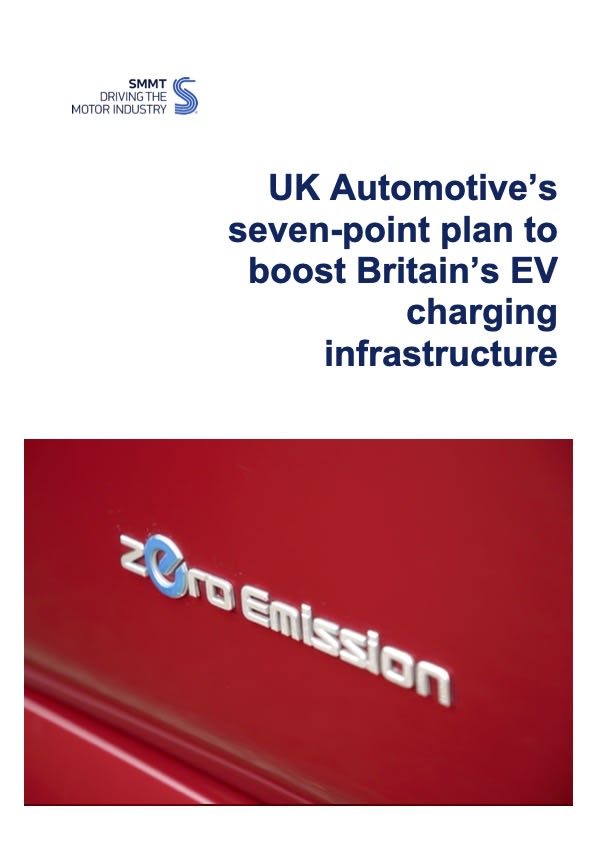
SMMT
To support its proposition, the SMMT has produced a seven-point plan for delivering a consumer-centric charging infrastructure:
Embed consumer-centricity in policy and a national plan on charging infrastructure
Develop and implement a nationally coordinated but locally delivered infrastructure plan
Invest significantly to uplift all types of charging infrastructure, particularly public chargers, ahead of need
Set binding targets to ensure adequate public chargepoint provision and social equity
Enact proportionate regulation to deliver the best outcomes for consumer experience and expansion of provision
Provide adequate enabling support to incentivise and facilitate delivery of charging infrastructure
Ensure electricity networks are future-proofed and fit for purpose for zero emission mobility
The rollout of such a program would unlock the full environmental and socio-economic benefits of the transition to zero-emission mobility provided there was collaboration involving industry, government and key sectors, such as fleets, infrastructure, and energy.
Meanwhile, a new report from Eurelectric, which represents the interests of the European electricity industry and authored by consultants EY, says that 130 million electric vehicles (up from 3.3 million today) will hit European roads by 2035.
In order to service those vehicles, it says that 65 million chargers are required to unlock a seamless user experience. Of those, 85% will be residential, while 4% will be on public highways.
Jean-Bernard Lévy, Eurelectric's president commented:
"Electrification is now an irreversible megatrend in road transport. The challenge ahead is speeding up infrastructure rollout in a well-coordinated manner to respond to growing charging needs while ensuring the optimal use of the electricity network."
Levy added that the grid would remain stable with the EV increase but recommended the following steps: digitizing the grid to understand, anticipate, and optimize customer behavior, grid impacts, and network needs; installing smart chargers to manage capacity and prevent the grid from buckling under the pressure of millions of EVs plugging in simultaneously; and integrating energy storage solutions in the charging infrastructure for situations when demand for rapid and high-power charging is heightened.
More Global Fleet

GeoFencing Adds to Your Truck Security Arsenal
Geofencing is a familiar fleet tool today, but its early adoption marked a major shift in vehicle tracking, route monitoring, and the debate over employee privacy.
Read More →
Holman Takes Full Ownership of ARIZA in Mexico
Holman is bringing its Mexican fleet management operation fully under its own brand after more than 30 years as a joint venture. The change gives multinational fleet customers a single Holman operation across the U.S., Canada, and Mexico.
Read More →
5 Tire Maintenance Tips to Help Prevent Work Truck Downtime
Regular tire checks can do more than extend tread life. These five maintenance practices can help work truck fleets catch problems early, reduce costs, and prevent downtime.
Read More →

Proven Ways to Reduce Work Truck Downtime
The age-old problem of downtime will always be a reality, but with new strategies at hand, fleets have more ways to keep trucks on the road longer.
Read More →


Cameras, Safety and Insurance: From Reactive Claims to Real-Time Prevention (Part 2 of 2)
Part Two: Commercial auto remains one of the most challenging and costly lines of coverage for fleet operators and insurers alike. Continue learning more about how to effectively address these issues from Onur Aksan, Enterprise Business Development Executive, Geotab
Read More →
Cameras, Safety and Insurance: From Reactive Claims to Real-time Prevention
Commercial auto remains one of the most challenging and costly lines of coverage for fleet operators and insurers alike. Learn more about how to effectively address these issues from Onur Aksan, Enterprise Business Development Executive, Geotab.
Read More →
Fleet Costs Are Rising: Here’s How Leaders Are Responding
Fleet leaders are under pressure to reduce costs, adapt to economic uncertainty, and make smarter decisions. See how peers across North America are responding with real data, proven strategies, and forward-looking insights. Download the 2026 Market Pulse Report to benchmark your strategy and uncover where you can gain an edge.
Read More →
Enterprise Fleet Management Surpasses 900,000 Vehicles in U.S. & Canada
Enterprise Mobility connects with mobility solutions around the globe
Read More →