




Audi Approves Some V6 Diesel Engines for Use with Renewable Fuels
The automaker is expanding compatibility of combustion engines with hydrotreated vegetable oil to help reach climate targets.

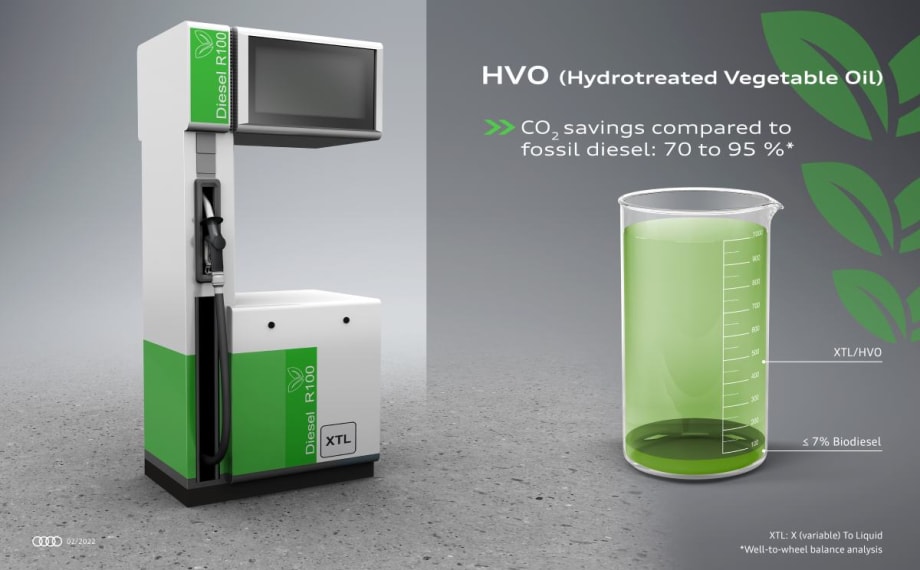
2033 will be the last year combustion engine-Audis are produced. The most popular engine variants were prioritized for the renewable fuels.
Photo: Audi
In its pursuit of carbon-neutral mobility and 2050 goals, Audi announced a focus on vehicles with electric batteries as well as new alt-fuels in a Feb. 23 news release. The brand is increasing the environmental sustainability of its combustion engines by approving many of its current 6-cylinder diesel engines for use with the renewable fuel hydrotreated vegetable oil (HVO).
"With our 'Vorsprung 2030' strategy, we're pursuing the clearly defined goal that all new models we launch worldwide as of 2026 will be all-electric only. In this way, we're making an essential contribution on the road to carbon-neutral mobility," said Oliver Hoffmann, chief development officer at Audi. "At the same time, we're optimizing our existing combustion engine portfolio for more efficiency and lower emissions. One way we're doing this is by creating the requisite technical foundations for the use of sustainable fuels such as HVO."
Renewable fuels make it possible to operate combustion engines in a more climate-friendly manner, the announcement reads, noting its effective means of defossilization. In 2033, the last Audi with a combustion engine will roll off the production line in Europe.
Audi models with V6 diesel engines up to and including 210 kW (286 PS) that are leaving the company's factories as of the middle of February can be filled up with the HVO fuel in accordance with the European standard EN 15940. Hydrotreated vegetable oil (HVO) is a sustainable fuel that enables CO2 reductions of between 70% and 95% compared to fossil diesel. Another advantage of HVO is its significantly higher cetane rating, which means more efficient and cleaner combustion in comparison to conventional diesel.
"As the cetane rating of HVO is around 30% higher, the combustibility of the engines is enhanced. The positive effects of this are particularly noticeable when cold starting. We tested the effects on various components, the performance, and exhaust emissions in specific validation runs before granting approval," said Matthias Schober, head of powertrain development for V-TFSI, TDI, and PHEV at Audi.
The most popular engine variants were prioritized to allow the maximum possible number of customers to use renewable fuels.
Residual and waste materials for HVO residual and waste materials, such as waste cooking oil from the food industry or residues from agriculture, are used in the manufacture of HVO. By incorporating hydrogen (hydrogenation), the oils are converted into aliphatic hydrocarbons. This modifies the properties of the vegetable oils to make them suitable for use in diesel engines. They can be added to conventional diesel, replacing fossil components, or used unmixed as 100% pure fuel.
HVO is a so-called BTL (biomass-to-liquid) fuel. In addition to BTL, there are other manufacturing methods for synthetic diesel fuels, such as GTL (gas-to-liquid) and PTL (power-to-liquid). The latter can be obtained sustainably from renewable electricity, water, and CO2 from the atmosphere. As a collective noun for these fuels governed by EN 15940, the term XTL (X-to-liquid) is used, with the "X" standing for the original component. Fuel pumps containing these fuels are duly indicated using this symbol. Approved Audi models have an XTL sticker in the fuel tank cap.
All V6 diesel engines with power up to and including 210 kW (286 PS) in the series A4, A5, A6, A7, A8, Q7, and Q8 that are manufactured as of mid-February 2022, can be filled up with HVO fuel. The HVO release for the Q5 will follow at the beginning of March, and then the A6 allroad in the expansion stage up to 180 kW (245 PS) (Combined fuel consumption in l/100 km*: 6.2 – 6.1 (37.9 – 38.6 US mpg); combined CO2 emissions in g/km: 164 –160 (263.9 –257.5 g/mi)) in the summer. At Volkswagen, the Touareg in performance classes 170 kW (231 PS) (Combined fuel consumption in l/100 km*: 7.0 (33.6 US mpg); combined CO2 emissions in g/km: 184 (296.1 g/mi)) and 210 kW (286 PS) can run on the sustainable diesel fuel.
In addition, HVO has been approved in Europe for the 4-cylinder diesel engines in the Audi A3, Q2, and Q3, which have been built since June 2021. In the models based on the modular longitudinal platform, the R4 TDI in the A4, A5, A6, A7 and Q5 series have been HVO-capable since the middle of last year in Sweden, Denmark, and Italy, as market demand has been greatest in these countries to date.
HVO diesel is already available at over 600 filling stations in Europe – with most of them located in Scandinavia, where environmental requirements are particularly stringent. In Germany, only a few filling stations here and there offer HVO at present, although the trend is moving in the right direction. The reason for this is that the fuel standard EN 15940 has not yet been incorporated into German fuel-quality regulations – in contrast to other EU countries.
With various pilot projects, such as the power-to-gas plant in Werlte, Audi has acquired insights into the manufacture of sustainable fuels, which are being utilized throughout the Volkswagen Group. These experiences are an important basis for developing concepts for a general sustainable energy system. The VW Group is cooperating with mineral oil manufacturers and other energy suppliers and is contributing its technical expertise to ensure the compatibility of existing engines with renewable fuels.
More Green Fleet
New Propane Autogas Program Offers Fleet Compensation
Qualified commercial fleets can receive $7,500 per eligible propane autogas vehicle and up to $10,000 for new refueling site prep. Learn how the program works and see whether your fleet qualifies.
Read More →
EV Charging Use Is Outpacing Infrastructure Growth
ChargePoint’s 2026 Charging Forward Report points to rising charger use, higher-powered charging, commercial vehicle electrification, and energy-management technology. Here’s what fleets should know.
Read More →
Merchants Fleet Reports 290M EV Miles as Fleets Navigate Changing Electrification Market
From millions in operating savings to hundreds of millions of EV miles, Merchants Fleet’s latest report reveals what’s working and what’s changing in fleet electrification.
Read More →

The EV Breakdown Nobody's Talking About: Why Most Electric Vehicle Roadside Calls Aren't Mechanical Failures
Here's why EV breakdowns are widely misunderstood.
Read More →
ChargePoint Now Available in Energy Pass
ChargePoint and additional planned charging network integrations were added to GM's Energy Pass.
Read More →

First Look: Slate Auto's Electric Fleet Pickup
Could an affordable, modular EV pickup make electrification more practical for fleets?
Read More →
Slate Debuts Colorful, Unique EV Models
A recent media and client event, studded with electric vehicles dressed up on platforms, planted a new position for the manufacturer in the wider EV market. Fleets will find cost-saving advantages.
Read More →
Slate Electric SUV, Pickup Switchable Model Aims For Light-Duty Fleets
Everything about this EV is counterintuitive and understated, making it stand out from the crowd.
Read More →
Inspiration Mobility Acquires Key Electrada Assets
Inspiration Mobility Group has acquired select assets of Electrada, adding the fleet electrification provider's team, technology, and charging infrastructure development capabilities to its energy management business.
Read More →