




APCOA To Roll Out 100,000 EV Charge Points
APCOA says it plans to invest in charging stations offering 11 to 22 kW in over 12,000 locations while partners will be invited to install 350-kW ultra rapid chargers at 1,000 of its parking facilities, and that it will take until 2035 to reach its target—13 years, or roughly 7,700 chargers per year.

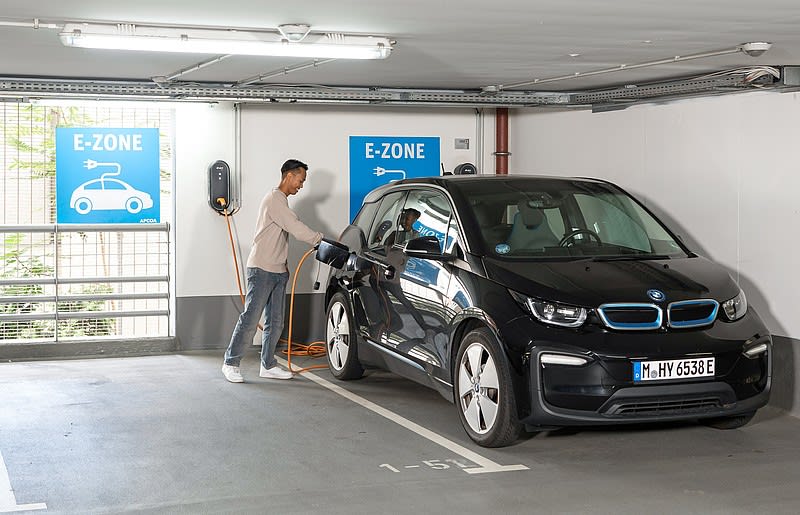
A total of 100,000 EV chargers is the aim for the parking firm across its parking lots in 13 European countries, including Denmark, Germany, Italy, the Netherlands, Norway, and the United Kingdom.
Photo: APCOA
Business and fleet drivers throughout Europe will benefit from an extensive rollout of EV charging facilities at one of Europe’s leading car park operators. APCOA says it plans to invest in charging stations offering 11 to 22 kW in over 12,000 locations while partners will be invited to install 350-kW ultra rapid chargers at 1,000 of its parking facilities.
A total of 100,000 EV chargers is the aim for the parking firm across its parking lots in 13 European countries, including Denmark, Germany, Italy, the Netherlands, Norway, and the United Kingdom. While a substantial number averaging eight chargers per parking facility, APCOA has said it will take until 2035 to reach its target—13 years, or roughly 7,700 chargers per year.
Philippe Op de Beeck, CEO of APCOA PARKING Group commented:
“The transition to electric mobility as the dominant technical solution in road traffic is an irreversible trend. EV charging infrastructure thus represents a major component of the transformation of APCOA’s car parks into ‘Urban Hubs’. For customers, the extended service infrastructure will increase the attractiveness of our locations.”
APCOA said a digital platform would enable booking and use of the charge points and was proprietary agnostic allowing the charging stations to be operated independent of charge point ownership. In addition, all its sites would use green energy.
There are 2,500 EV charging stations available in APCOA car parks to date, while data from their usage suggested that demand from charge points would grow significantly in the near future as fleets and consumers switched to electric vehicles, according to APCOA.
“We firmly believe in the future of electric mobility, which stands to make an important contribution on the net zero journey. Therefore, we are creating the necessary infrastructure to play our part in meeting the international decarbonization targets. All measures are aligned with the UN Global Compact agreement to which APCOA is a signatory,” added Op de Beeck.
The European Parliament has banned the sale of new diesel and gasoline engined cars from 2035; in the UK it’s 2030, with a requirement that all new vehicles must be zero emission by 2035.
Further Reading:
More Global Fleet

John Rossant: Don’t Make a Ten-Year Bet on a Two-Year Policy
At the 2026 Fleet Forward Conference, Rossant brought transportation insights from Europe, China, and the Middle East to a discussion of fleet management's changing role.
GeoFencing Adds to Your Truck Security Arsenal
Geofencing is a familiar fleet tool today, but its early adoption marked a major shift in vehicle tracking, route monitoring, and the debate over employee privacy.

Holman Takes Full Ownership of ARIZA in Mexico
Holman is bringing its Mexican fleet management operation fully under its own brand after more than 30 years as a joint venture. The change gives multinational fleet customers a single Holman operation across the U.S., Canada, and Mexico.

5 Tire Maintenance Tips to Help Prevent Work Truck Downtime
Regular tire checks can do more than extend tread life. These five maintenance practices can help work truck fleets catch problems early, reduce costs, and prevent downtime.

Proven Ways to Reduce Work Truck Downtime
The age-old problem of downtime will always be a reality, but with new strategies at hand, fleets have more ways to keep trucks on the road longer.

The Top 300 Commercial Fleets
The Top 300 Commercial Fleets: See the List


Cameras, Safety and Insurance: From Reactive Claims to Real-Time Prevention (Part 2 of 2)
Part Two: Commercial auto remains one of the most challenging and costly lines of coverage for fleet operators and insurers alike. Continue learning more about how to effectively address these issues from Onur Aksan, Enterprise Business Development Executive, Geotab
Cameras, Safety and Insurance: From Reactive Claims to Real-time Prevention
Commercial auto remains one of the most challenging and costly lines of coverage for fleet operators and insurers alike. Learn more about how to effectively address these issues from Onur Aksan, Enterprise Business Development Executive, Geotab.

Enterprise Fleet Management Surpasses 900,000 Vehicles in U.S. & Canada
Enterprise Mobility connects with mobility solutions around the globe