




Aerodynamic Features Boost MPG by 2.5 on 2013-MY Malibu
DETROIT - General Motors has steadily been releasing details about the 2013-MY Malibu, and here we cover the exterior and interior features of this new model.

Chevrolet Malibu aerodynamic engineer Suzy Cody tests the 2013 Malibu ECO with a smoke wand at the General Motors wind tunnel Friday, June 24, 2011 in Warren, Michigan.
DETROIT –General Motors has recently posted a few articles that provide an inside look at the development and design for the upcoming 2013-MY Chevrolet Malibu. Based on the number of Malibus in the fleet world, it’s likely to be an important vehicle for many in the industry, so we wanted to give readers an overview of some of the features in the new model.

Chevrolet Malibu aerodynamic engineer Suzy Cody tests the 2013 Malibu ECO with a smoke wand at the General Motors wind tunnel Friday, June 24, 2011 in Warren, Michigan.
First, aerodynamic improvements to the Malibu’s exterior allowed the automaker to improve fuel economy by 2.5 mpg on the highway. Improvements include outside rearview mirrors designed to deflect wind without causing more turbulent airflow, rounded front corners from the bottom of the fascia up through the headlamps, and shutters that open and close in the lower grille opening on select models. The shutters reduce drag at higher speeds and provide extra cooling when open.
GM measures aerodynamic improvements in “counts,” at 0.001 coefficient of drag (Cd). The new Malibu has a Cd of .28, which the automaker says is nearly as efficient as the Volt.
The new Malibu features an Ecotec 2.5L DOHC I-4 variable valve timing direct injection engine, but the automaker hasn’t released official mpg numbers (GM has only announced mpg figures for the ECO version of the new Malibu).
For the interior of the Malibu, GM engineers were able to add nearly 4 cu. ft. of interior volume when compared to the previous edition of the Malibu. The 2013-MY Malibu features an additional 1.5 inches of front shoulder room, 3.5 inches more rear shoulder room, 2.7 inches of front hip room, and 2.8 inches of rear hip room. GM also added an additional cubic foot of luggage space.
To improve seat comfort, the automaker took snapshots of a seated individual’s pressure distribution on a seat’s surface. They also used a machine that simulates the effects of seat force and deflection. The automaker uses this data to aid in seating materials selection. Seating features include available four-way lumbar adjustment, the ability to raise the seat cushions by up to 2.5 inches, and three levels of seating trim. Trim options include flat-woven fabric, leatherette and Meridian leather with a “tipped” grain finish.
In addition to interior comfort, the Malibu engineers focused on ways to make the cabin quieter. GM engineers used a device called an Aachen HEAD, which is a digital recording tool that is designed to match how human ears process sound. GM engineers test a range of sounds using this device, rating the sounds via different criteria.
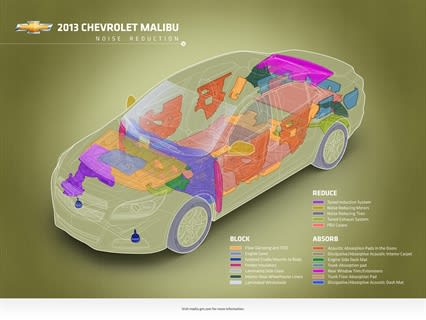
The all-new 2013 Chevrolet Malibu has a number of vehicle components that reduce, block and absorb noise from entering the cabin to improve overall sound quality inside.
Interior noise reduction measures include outside rear-view mirrors designed to reduce noise, laminated side glass, and noise-absorption pads. All doors are triple sealed, and fully sealed, acoustic perimeter water deflectors are in all four doors. GM also uses a noise baffle barrier in the trunk to reduce noise generated around the wheel houses.
For more on the 2013-MY Chevrolet Malibu, you can check out our initial coverage here.
By Greg Basich
More Operations

Fleet Has a Talent Pipeline Problem. What Comes Next? | AF News Recap
Where will fleet’s next generation of leaders come from? This week, we’re looking at the industry’s talent pipeline, what certification can add to a fleet career, how to build an award-worthy track record, and the return of Automotive Fleet’s Personal Use Survey.
Read More →
Smith System Launches Driver Risk Management Program
Fleets have more driver data than ever, but identifying risky behavior doesn't necessarily correct it. Smith System's new Driver Risk Management program combines monitoring, training, and follow-up coaching to help fleets connect risk signals with driver intervention.
Read More →
Automotive Fleet Opens 2026 Personal Use Survey for Commercial Fleet Managers
Less than two weeks left! Commercial and corporate fleet managers are invited to share how their organizations handle company vehicle personal-use policies, charges, and driver eligibility.
Read More →
From AI Prompts to AI-Generated Safety Songs | AF News Recap
Can better prompts make AI more useful for fleet managers? This week, we’re breaking down smarter fleet analysis, an AI-assisted experiment that turned safety training into music, and what happened to fuel prices in August.
Read More →
How to Write Better AI Prompts for Fleet Analysis
Include these six elements in your fleet prompts to generate more relevant analysis and accurate answers.
Read More →
Fleet Meets: Eric Kilgore
This edition of the Fleet Meets series features one of the industry's best leaders driving multi-market and national operations.
Read More →
Why Reactive Fleet Management Is Becoming Too Expensive to Sustain
Research highlights a growing need for proactive management strategies to address rising costs in fleet operations effectively.
Read More →
What Your Fleet KPIs Aren’t Telling You
Tracking fleet metrics is only useful when the data leads to better decisions. This guide helps fleet leaders assess cost, utilization, and downtime more accurately, identify performance gaps, and prioritize the actions that can improve operational results.
Read More →
Hidden in Plain Sight: Fleet Compliance Risks
Fleet compliance isn't just about having policies — it's about consistently enforcing them. This practical guide reveals six hidden compliance risks common in public sector and shared fleet operations and outlines proven strategies to improve visibility, accountability, and audit readiness
Read More →
Turning Fleet Payment Data into Executive Insights
Does data alone drive results in operations?
Read More →