




Advanced Driver Monitoring Tech Gaining Wider Acceptance
Almost half of the respondents to a survey (46%) agreed that a driver monitoring system should be required by law in vehicles. The younger the driver, the more likely they believe that these systems make a vehicle safer.

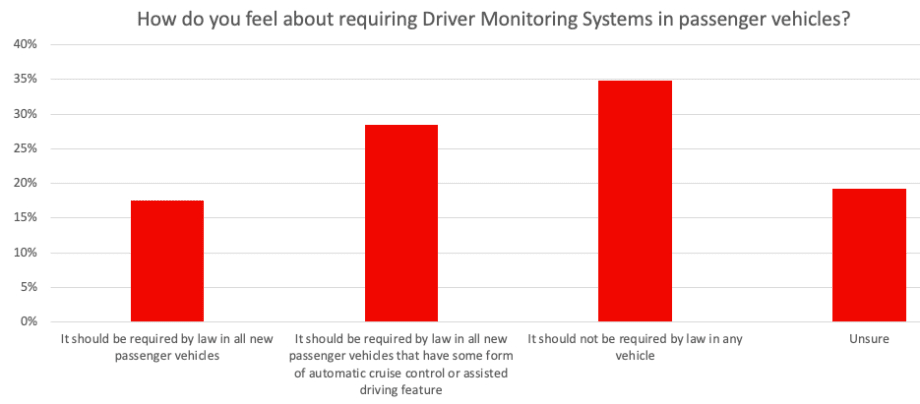
More intrusive driver monitoring systems that go behond advanced driver assistance systems have begun to gain wider acceptance.
Chart courtesy of Autolist.
Almost half of the respondents to a survey (46%) agreed that a driver monitoring system should be required by law in vehicles. The younger the driver, the more likely they believe that these systems make a vehicle safer, according to Autolist.
While 19% said they were unsure, 35% said a monitoring system should not be required by law, indicating that public awareness and acceptance is still emerging.
Examples of these systems include Cadillac's SuperCruise, Tesla's Autopilot, Subaru's DriverFocus, and Audi's Traffic Jam Pilot.
Interestingly, consumers' inclination toward making such systems legal was more for the safety of other vehicles on the road rather than to increase the safety of the vehicle with the technology. For example, 57% of respondents thought a system made the vehicle safer on the road for other cars while just 53% thought a vehicle with a system was itself safer.
Active driver monitoring systems are now only available on a small number of vehicles. Designed to prevent the misuse of advanced driver assistance systems and enhance safety, these systems use optical or infrared cameras to monitor a driver's focus and fatigue.
The respondents were divided about whether these systems make people better drivers with 42% saying they don't and 40% saying they do.
As for the type of technology preferred, younger respondents were more likely to trust passive rather than active systems. Across all age groups, 61% of consumers felt that a passive system was the most effective type.
Finally, the survey examined financial concerns. Despite the safety benefits, car shoppers in Autolist's survey indicated they were reluctant to pay much for the technology. Two-thirds of respondents (66%) said they would not pay more than $500 for such a feature on their next vehicle.
For the study, Autolist surveyed 1,272 current car shoppers in July.
More Safety

Fleet Manager’s Ultimate Playbook: Navigating the New Standard in OEM Connectivity
Rising operating costs, driver safety concerns, and unplanned downtime are putting unprecedented pressure on modern fleets. Discover how fleet managers use embedded OEM connectivity and real-time vehicle data to cut TCO, prevent downtime, and protect drivers without aftermarket telematics hardware.
Read More →
From Driver Well-Being to EV Charging | AF News Recap
Mental health belongs in the fleet safety conversation. This week, we’re looking at five ways fleets can support employee well-being before a crisis, plus Holman’s expansion in Mexico, new one-day Fleet Forward passes, and why EV charging demand is outpacing infrastructure growth.
Read More →
Nexar-Nauto Merger Aims to Give Fleets Better Safety Intelligence Through Larger Driving Dataset
Stefan Heck tells Automotive Fleet that combining more than 10 billion miles of driving history with Nexar's AI models will give fleets deeper insights into driver risk and roadway conditions than either company could provide independently.
Read More →
Don't Wait for a Crisis: 5 Ways to Build Mental Health Into Your Fleet Safety Program
For Suicide Prevention Month, fleet and safety leaders have an opportunity to put mental health where it belongs: at the center of workplace safety.
Read More →
How Camera Data Can Strengthen a Fleet’s Insurance Renewal
Insights from a commercial insurance carrier and a broker show how fleets can turn video telematic data, driver coaching, and improved claims results into a stronger case at insurance renewal.
Read More →
The Safest Fleets Aren’t the Ones with the Most Technology
You’ve made the telematics investment. Here’s how to capture the other half of its value and build the safest fleet on the road.
Read More →
Hidden in Plain Sight: Fleet Compliance Risks
Fleet compliance isn't just about having policies — it's about consistently enforcing them. This practical guide reveals six hidden compliance risks common in public sector and shared fleet operations and outlines proven strategies to improve visibility, accountability, and audit readiness
Read More →
NETS Sets 2026 Fleet Safety Benchmark Conference for Indianapolis
The Sept. 15–17 program will feature fleet benchmarking data, case studies, emerging technologies, and implementation strategies while running alongside the NSC Safety Congress & Expo.
Read More →
Off-the-Job Crashes Account for 43% of Employers’ $61.7 Billion Crash Burden
NETS quantifies costs dispersed across fleet, risk, HR, and other departments while providing new per-crash benchmarks for employers.
Read More →
Ram Recalls More Than 1.27 Million 1500 Pickups for Seat Belt Anchor Issue
The recall affects certain 2019-2026 Ram 1500 pickups that may have improperly attached second-row seat belt buckle anchors.
Read More →