





Further Reading: EU General Safety Regulations Now in Force
ACEA 2022 Progress Report: Europe Continues Transition to Zero-Emission Mobility
Now in its fifth edition, the research tracks progress on the key “enabling factors” for zero-emission cars and vans over time, according to the ACEA. The report indicates the auto industry’s investments in alternatively-powered vehicles are “paying off.”
August 1, 2022
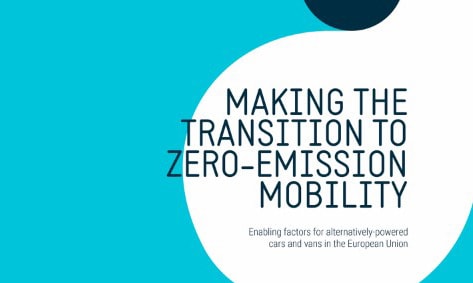
The publication specifically addresses market adoption of alternatively-powered vehicles, affordability, and infrastructure availability.
Photo: ACEA
2 min to read
Europe continues its transition to zero-emission mobility, according to the recently released 2022 Progress Report, published by the European Automobile Manufacturers’ Association (ACEA), representing the continent’s 16 major car, truck, van and bus makers.
Updated annually, the statistical Progress Report is based on latest full-year available data, drawing from all available data sources, including ACEA, European Alternative Fuels Observatory, European Economic Area, Eurostat and information/analysis provider IHS Markit.
Now in its fifth edition, the research tracks progress on the key “enabling factors” for zero-emission cars and vans over time, according to the ACEA. The report indicates the auto industry’s investments in alternatively-powered vehicles are “paying off.”
“Against last year’s backdrop of a contracting vehicle market, electrically-chargeable cars continued to gain overall market share, accounting for almost one in every five new cars sold across the European Union.” However, the report points out, the trend is sustainable only with government investments in infrastructure and meaningful and sustainable incentives.
The publication specifically addresses market adoption of alternatively-powered vehicles, affordability, and infrastructure availability. In addition, the report contains a comprehensive glossary explaining the various types of alternative-powered and the infrastructure each requires.
Among the Progress Report findings are:
Electrically-chargeable car sales – battery electric and plug-in hybrids combined – account for 18% of all new car sales in the EU.
Hybrid vehicles made up almost 20% of total EU passenger car registrations in 2021.
Fuel cell and natural gas-powered cars still only account for a small share of EU sales –less than 1%.
Almost 3% of all vans sold in 2021 were battery electric, less than 2% were hybrid electric, and 0.1% were plug-in hybrids.
The market uptake of electrically-chargeable vehicles is largely linked to a country’s GDP per capita, indicating affordability remains an issue for consumers.
While electric charger infrastructure has grown 180% since 2017, the total number of charging points available across the entire EU – 307,000 – falls far short of what is needed, according to the ACEA report. Nearly 7 million public charging points would be required EU-wide by 2030 to reach the proposed 55% CO2 reduction for passenger cars.
Furthermore, the publication states, “Almost 50% of all charging points for electric cars are concentrated in only two EU countries – the Netherlands (90,000 chargers) and Germany (60,000). These countries make up less than 10% of the entire EU surface area.”
A full copy of the Mobility Progress Report is available on the ACEA website.
More Global Fleet

GeoFencing Adds to Your Truck Security Arsenal
Geofencing is a familiar fleet tool today, but its early adoption marked a major shift in vehicle tracking, route monitoring, and the debate over employee privacy.
Read More →
Holman Takes Full Ownership of ARIZA in Mexico
Holman is bringing its Mexican fleet management operation fully under its own brand after more than 30 years as a joint venture. The change gives multinational fleet customers a single Holman operation across the U.S., Canada, and Mexico.
Read More →
5 Tire Maintenance Tips to Help Prevent Work Truck Downtime
Regular tire checks can do more than extend tread life. These five maintenance practices can help work truck fleets catch problems early, reduce costs, and prevent downtime.
Read More →

Proven Ways to Reduce Work Truck Downtime
The age-old problem of downtime will always be a reality, but with new strategies at hand, fleets have more ways to keep trucks on the road longer.
Read More →


Cameras, Safety and Insurance: From Reactive Claims to Real-Time Prevention (Part 2 of 2)
Part Two: Commercial auto remains one of the most challenging and costly lines of coverage for fleet operators and insurers alike. Continue learning more about how to effectively address these issues from Onur Aksan, Enterprise Business Development Executive, Geotab
Read More →
Cameras, Safety and Insurance: From Reactive Claims to Real-time Prevention
Commercial auto remains one of the most challenging and costly lines of coverage for fleet operators and insurers alike. Learn more about how to effectively address these issues from Onur Aksan, Enterprise Business Development Executive, Geotab.
Read More →
Fleet Costs Are Rising: Here’s How Leaders Are Responding
Fleet leaders are under pressure to reduce costs, adapt to economic uncertainty, and make smarter decisions. See how peers across North America are responding with real data, proven strategies, and forward-looking insights. Download the 2026 Market Pulse Report to benchmark your strategy and uncover where you can gain an edge.
Read More →
Enterprise Fleet Management Surpasses 900,000 Vehicles in U.S. & Canada
Enterprise Mobility connects with mobility solutions around the globe
Read More →