




AAA Offers Advice for Transporting Christmas Trees
To promote safer roads this holiday season, AAA provides tips on how to properly secure a Christmas tree to ensure it doesn’t cause vehicle damage or fall from the vehicle.
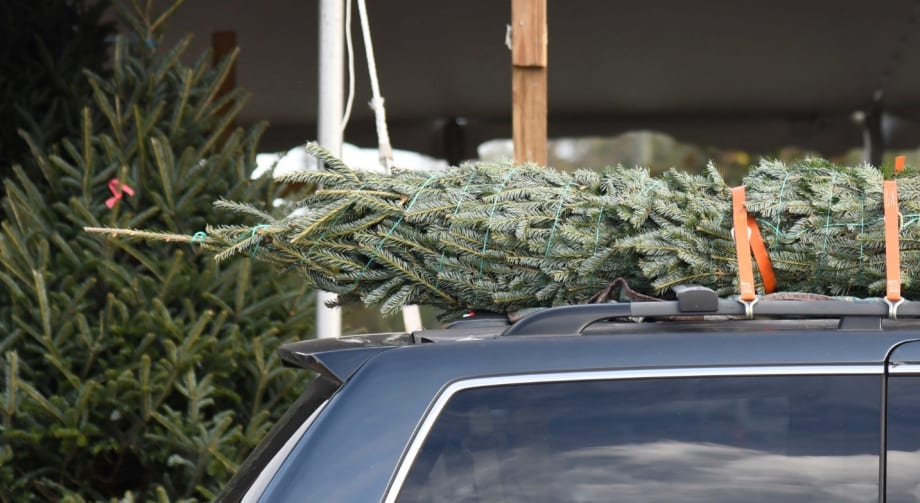
Photo courtesy of AAA.
Photo courtesy of AAA.
An estimated 20 million Americans who purchased a real Christmas tree in the past three years failed to properly secure it to their vehicle during the ride home, according to a new AAA survey.
As a result, drivers risked creating serious vehicle damage and dangerous road debris. Vehicle damage that results from an improperly secured Christmas tree — such as scratched paint, torn door seals and distorted window frames — might cost up to $1,500 to repair. In addition to vehicle damage, Christmas trees that aren’t properly secured are a safety hazard for other drivers.
AAA said it’s urging all drivers to transport their Christmas trees safely this holiday season.
“Twine that is wrapped around trees and looped through door jambs or open windows can cause serious damage to door seals and window frames,” said Greg Brannon, director of automotive engineering and industry relations at AAA. “Drivers should never secure a Christmas tree to the top of a vehicle without a roof rack.”
And according to the AAA Foundation for Traffic Safety, road debris — which could include objects like improperly secured Christmas trees that fly off cars — was responsible for more than 200,000 crashes that resulted in 39,000 injuries and 500 deaths over the past four years.
About two-thirds of debris-related crashes are the result of improperly secured items falling from a vehicle.
AAA offers the following advice for transporting Christmas trees safely:
Use the right vehicle. It’s best to transport a Christmas tree on top of a vehicle equipped with a roof rack. However, if you don’t have a roof rack, use the bed of a pickup truck -- or an SUV, van or minivan that can fit the tree inside with all doors closed.
Use quality tie-downs. Bring strong rope or nylon ratchet straps to secure the tree to your vehicle’s roof rack. Avoid the lightweight twine offered by many tree lots.
Protect the tree. Have the tree wrapped in netting before loading it. If netting is unavailable, secure loose branches with rope or twine.
Protect your vehicle. Use an old blanket to prevent paint scratches and protect the vehicle finish.
Point the trunk towards the front. Always place the tree on a roof rack or in a pickup bed with the bottom of the trunk facing the front of the vehicle.
Tie it down. Secure the tree at its bottom, center and top. At the bottom, use fixed vehicle tie-down points and loop around the trunk above a lower branch. This prevents any side-to-side or front-to-rear movement. The center and top tie-downs should be installed in a similar manner.
Give it the tug test. Before you leave the lot, give the tree several strong tugs from various directions to make sure it’s secured in place and will not blow away.
Drive slowly and easily. Take the back roads, if possible. Higher speeds create significant airflow that can damage your Christmas tree and challenge even the best tie-down methods.
Drivers can face hefty fines and penalties as well as jail time if an unsecured tree falls off their vehicle. Currently, every state has laws that make it illegal for items to fall from a vehicle while on the road.
Most states’ penalties result in fines ranging from $10 and $5,000, with at least 16 states listing jail as a possible punishment for offenders. Drivers can prevent injuries and avoid penalties by properly securing their loads to prevent items from falling off the vehicle, AAA advised.
More Safety

How Better Visibility Cut Speeding Violations by 48%
Fleet leaders don't need more data, they need clearer visibility into what the data is saying. This case study explores how one utility replaced speeding-event counts with a single metric — miles driven in violation — to strengthen safety and significantly reduce speeding violations.
Read More →
Operation Safe Driver Week: Why the Industry's Oldest Safety Campaign Still Matters to Fleets
A look at how a 2007 enforcement initiative became one of the most consequential weeks on the fleet safety calendar, and what it means for your drivers in 2026.
Read More →
Nexar-Nauto Merger Aims to Give Fleets Better Safety Intelligence Through Larger Driving Dataset
Stefan Heck tells Automotive Fleet that combining more than 10 billion miles of driving history with Nexar's AI models will give fleets deeper insights into driver risk and roadway conditions than either company could provide independently.
Read More →
From Silos to Solutions: Relationship Management for Safer Fleets
From telematics adoption and driver accountability to policy consistency and risk mitigation, this episode breaks down what it really takes to build a safer fleet culture without slowing business down.
Read More →
IIHS Launches First Commercial Vehicle Safety Evaluations
The Insurance Institute for Highway Safety has begun evaluating heavy-duty pickups and cargo vans for driver protection. Which models earned top marks?
Read More →
Reducing Risk by Eliminating Phone Use Behind the Wheel
Hosted with the cofounder of Lifesaver Mobile, this episode addresses phone use behind the wheel and how to design a driving environment that actually helps prevents accidents.
Read More →
Cameras, Safety and Insurance: From Reactive Claims to Real-Time Prevention (Part 2 of 2)
Part Two: Commercial auto remains one of the most challenging and costly lines of coverage for fleet operators and insurers alike. Continue learning more about how to effectively address these issues from Onur Aksan, Enterprise Business Development Executive, Geotab
Read More →
How 5-Second Telematics Data Is Changing Fleet Safety
This episode connects with Steve Santostasi of Ford Pro and covers how a few seconds of data can make a difference in fleet safety.
Read More →
Managing Road Risk at Scale: Why Fleet Safety Needs a Data-Driven Framework
Insights from the FIA Road and Driver Safety Indexes reveal how to manage road risk on a larger scale.
Read More →
Stellantis Recalls 1.3 Million Jeep Vehicles Worldwide Over Fire Risk
Stellantis is recalling more than 1.3 million Jeep Wrangler and Gladiator models worldwide over a fire risk linked to power steering pump wiring.
Read More →