




RELATED: Renault Trucks to Expand Electric Truck Offerings for European Fleets
2020 Commercial Vehicles & Electrification in Europe
With the increased amount of packages and groceries being delivered to European homes, the need for clean commercial vehicles is increasing. Also, the fact that a lot of cities must improve inner city emissions to comply with emission regulations is adding to the pressure.
by Julian de Groot, Head of Product & Marketing for Dataforce
March 26, 2021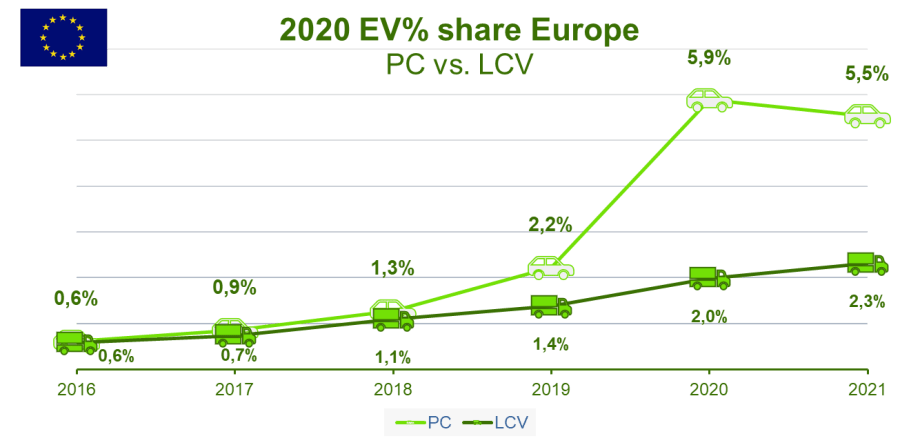
Source: Dataforce
2 min to read
In Europe the ratio of commercial vehicles sold with electrical propulsion is trailing behind passenger cars with a 2,0% share vs their 5.9% share over 2020.

Source: Dataforce
The focus of the manufacturers has been on developing electrified passenger cars. Also, from a subsidy point of view, emphasis has also been on passenger cars.
However, with the predominant road occupation transport during the daytime in cities comprises of commercial vehicles you could argue that more focus should or could be put in commercial vehicles. The net impact of an electrical commercial vehicle could well be more than that of a passenger car, which is standing still most of the day.
Some other factors that are potentially influencing the lower penetration of electrical commercial vehicles
Battery cost vs. weight. To move a full truck, you need a lot of energy, which requires a lot of batteries. And a lot of batteries are still expensive, resulting in a relatively higher cost of ownership vs. the regular diesel vehicles.
Range vs. usage. Commercial vehicles might be used all day. The range of an electric vehicle might not make it through the whole day, which would result in idling time because of charging. Or an increased number of vehicles so the drivers can swap vehicles.
Number of vehicles on offer. While in the beginning of the year there were more than 50 (and growing) different passenger cars models on offer, this is not the case for commercial vehicles, which has around 20 different models on offer.

Source: Dataforce
Which models are leading the pack? Both and Renault and Nissan were early out of the gate, just as with passenger cars. This has resulted in the top position for the Renault Kangoo EV with 26% share in 2020, followed by the Nissan e-NV200 with 17%. The Mercedes Vito is 3rd with 6% of the market. Worth mentioning is that in 2019 number 3 was StreetScooter, part of Deutsche Post/DHL, but they decided to discontinue production last year.

Source: Dataforce
The predominant segment for the electrical Vans is the small van segment. As these Vans are more fit for last mile delivery, specifically in older city-centres this trend will most probably not change in the near future.
Although with a trend behind passenger cars, the commercial vehicles are also starting their transitional journey from ICE to EV. All major OEM’s have and will increase their proposition in the markets over the coming years, with the mandatory requirements to keep up with environmental targets. It also opens the door for new players, such as Maxus, which is a brand of the Chinese SAIC group. In the beginning of this 2021 they already achieved a market share of 5.4% among electrical commercial vehicles!
More Global Fleet

GeoFencing Adds to Your Truck Security Arsenal
Geofencing is a familiar fleet tool today, but its early adoption marked a major shift in vehicle tracking, route monitoring, and the debate over employee privacy.
Read More →
Holman Takes Full Ownership of ARIZA in Mexico
Holman is bringing its Mexican fleet management operation fully under its own brand after more than 30 years as a joint venture. The change gives multinational fleet customers a single Holman operation across the U.S., Canada, and Mexico.
Read More →
5 Tire Maintenance Tips to Help Prevent Work Truck Downtime
Regular tire checks can do more than extend tread life. These five maintenance practices can help work truck fleets catch problems early, reduce costs, and prevent downtime.
Read More →

Proven Ways to Reduce Work Truck Downtime
The age-old problem of downtime will always be a reality, but with new strategies at hand, fleets have more ways to keep trucks on the road longer.
Read More →


Cameras, Safety and Insurance: From Reactive Claims to Real-Time Prevention (Part 2 of 2)
Part Two: Commercial auto remains one of the most challenging and costly lines of coverage for fleet operators and insurers alike. Continue learning more about how to effectively address these issues from Onur Aksan, Enterprise Business Development Executive, Geotab
Read More →
Cameras, Safety and Insurance: From Reactive Claims to Real-time Prevention
Commercial auto remains one of the most challenging and costly lines of coverage for fleet operators and insurers alike. Learn more about how to effectively address these issues from Onur Aksan, Enterprise Business Development Executive, Geotab.
Read More →
Fleet Costs Are Rising: Here’s How Leaders Are Responding
Fleet leaders are under pressure to reduce costs, adapt to economic uncertainty, and make smarter decisions. See how peers across North America are responding with real data, proven strategies, and forward-looking insights. Download the 2026 Market Pulse Report to benchmark your strategy and uncover where you can gain an edge.
Read More →
Enterprise Fleet Management Surpasses 900,000 Vehicles in U.S. & Canada
Enterprise Mobility connects with mobility solutions around the globe
Read More →