




2013 Ford Escape to Get 5 Better MPG Than Previous Model
LOS ANGELES - The automaker said the new model will offer 11 new exclusive features and fuel economy that Ford said will be 5 mpg better than previous Escape models.
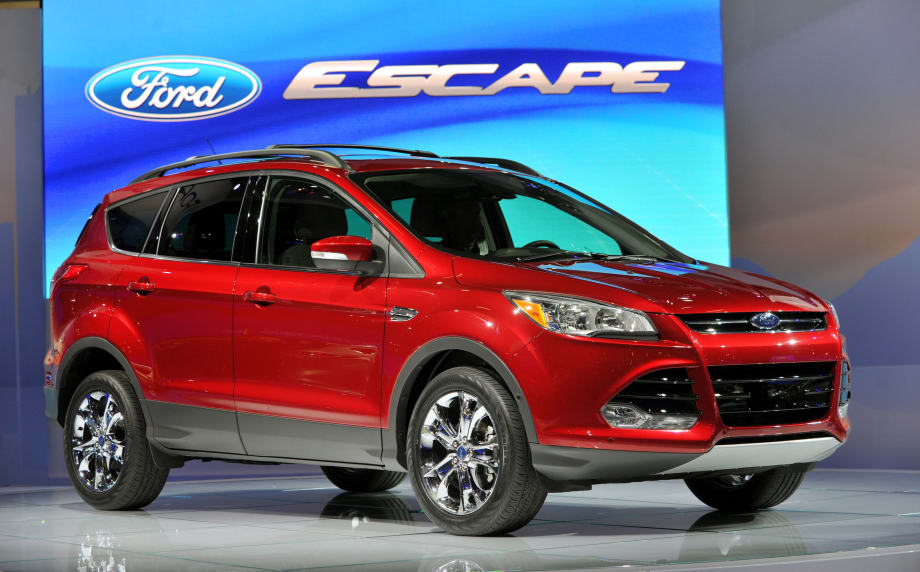
LOS ANGELES – At the 2011 Los Angeles Auto Show, Ford revealed its all-new 2013-MY Escape for the first time. The automaker said the new model will offer 11 new exclusive features.
Performance
Under the hood, the new Escape will offer three powertrain choices, a 2.5L engine as standard and two EcoBoost engines as optional. Ford expects the 2.0L EcoBoost four-cylinder to deliver 250 lb.-ft. of torque and 237 horsepower. The automaker said it expects the 1.6L EcoBoost four-cylinder to deliver 177 lb.-ft. of torque and 173 horsepower. The EcoBoost engine options, and the standard 2.5L engine, are mated to a SelectShift Automatic six-speed transmission.
In terms of fuel economy, Ford said it will achieve 5 better mpg when compared with the previous model, though the automaker hasn’t officially announced fuel economy figures yet. The Escape’s gearbox features a new torque converter for improved driving feel, smoother shifting, and better fuel economy, according to Ford.
The vehicle features an active park assist system, which (via a button press), detects an open parallel parking spot and then automatically maneuvers the vehicle into that space. The driver controls the gas and brake pedals.
The new Escape offers a trailer tow rating of 3,500 pounds (when equipped properly).
You can check out a video from Ford here that shows the Escape on the road, plus its interior and other features.
Exterior
The Escape has a new look and comes in a number of new exterior colors. They include Ginger Ale, Ruby Red, White Platinum Tricoat, Frosted Glass Metallic, Deep Impact Blue, and Kodiak Brown, along with Tuxedo Black, Sterling Gray Metallic, Ingot Silver Metallic, and Oxford White.
Interior
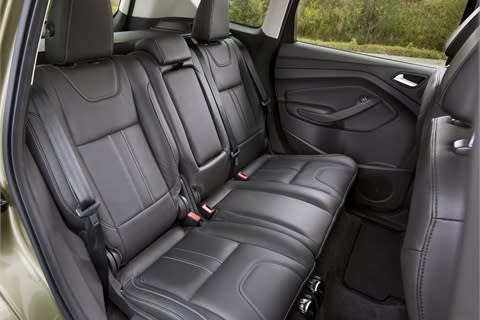
The new Escape has more cargo volume than the previous model, with 68.1 cubic feet of space behind the first row and 34.3 cubic feet behind the second row. The vehicle’s seats feature two-way power recline, two-way power lumbar support, and six-way adjustability. A sport seat, with higher bolsters and a distinct thread pattern in the stitching, also is available. The new Escape’s rear seats are designed to fold flat easily.
The front head restraint offers four-way adjustability. Ford also upgraded the head restraints and rear seats to allow for easier folding. Interior color choices include Charcoal Black on Charcoal Black or Charcoal Black on Medium Light Stone or Medium Dark Stone.
Interior materials include a soft-touch instrument panel, wrapped, padded and stitched door armrests, deep padding on console armrests, and soft upper roll on the doors.
The new vehicle offers SYNC with MyFord Touch. Ford recently announced it is rolling out an upgrade to the software, which includes a new look and menus that Ford said are easier to navigate.
Safety
The new version of the Escape adds roughly four times as much high-strength, and ultra-high-strength, steel compared to the previous model. The new Escape also features an enhanced Personal Safety System with new safety belt technologies (the inflatable seat belt) and seven airbags.
According to Ford, the Personal Safety System is a network of components that work together to tailor the activation of the front airbags in frontal collisions. The new side airbags deploy lower in the pelvis area for vehicle occupants, in addition to the chest, and incorporate new venting technology. The side airbag’s venting technology takes into account the size of the occupant, varying the pressure so smaller occupants withstand a lower pressure.
The new vehicle features the Blind Spot Information System (BLIS), which displays an alert in the side mirror when it detects a vehicle entering a blind spot. A cross-traffic alert warns the driver if it detects traffic coming from the sides. The Escape also features the Curve Control and Torque Vectoring Control technologies, which automatically slow the vehicle when it’s cornering too fast or help it accelerate through a turn. Also, a new Intelligent 4WD system improves performance in adverse road conditions and helps provide traction in off-road conditions.
Other Features
One of the new features the automaker touted at the Auto Show was the new hands-free power liftgate, which allows a user to wave their foot under the rear bumper to unlock and open or close it. Ford said the hands-free liftgate technology uses two sensors integrated into the Intelligent Access system are located in the rear bumper.
The hands-free liftgate builds off Ford’s Intelligent Access with push-button start, which allows customers to unlock and start their vehicles without ever having to take out the key. When the key fob is in their possession – kept in a pocket, coat, purse or briefcase – a simple pull on the door handle unlocks the vehicle. Once inside, the driver simply holds down the brake pedal and presses the power button to start the vehicle. The liftgate opens from about 4 feet to a maximum of about 7 feet above the ground. The system detects the key fob on a user in addition to the shin and leg motion, which prevents the liftgate from accidentally opening.
You can see the vehicle's complete specs here.
More Operations

Company Vehicle or Reimbursement? How Fleets Are Rethinking Assignments
As fleet costs and insurance pressures rise, fleet managers are taking a closer look at which employees need company-provided vehicles and when a reimbursement program may make more sense.

Fleetio, ASE Launch Scholarship Program for Automotive Technicians
The second annual program will award 15 scholarships totaling $35,000 to support ASE certification, testing fees, and equipment costs.

Reading the Global Signals: What AI and the Energy Transition Mean for Fleets Now
In this opening keynote of the 2026 Fleet Forward Conference, John Rossant, founder of CoMotion, How can fleet managers navigate a never-ending, changing industry landscape?

90% Use Telematics. Are Fleets Getting Safer? | AF News Recap
This week, we're breaking down which industries have the highest rates, how Jamie McKay manages 2,400 vehicles, what's happening with the 2027 fleet awards, and why software-defined vehicles could introduce new costs.

What's Best Handled by an FMC, and What's Better Done Directly?
Fleet managers continue to rely on FMCs for essential services but are taking a closer look at where working directly with suppliers can improve efficiency and responsiveness.

Fleet Meets: Erin Gilchrist
Meet Erin Gilchrist, the inaugural Mike Antich Spirit of Fleet Award winner, as she shares insights on leadership, mentorship, the power of industry connections, and why people remain at the heart of fleet's future.

How 2026 Fleet Visionary Jamie McKay Manages 2,400 Vehicles Across 37 States
How do you keep 2,400 vehicles running across 37 states? Fleet Visionary Award winner Jamie McKay shares how collaboration, flexibility, and a few simple strategies help her tackle fleet management challenges at Aptive Pest Control.

Managing Fleet Costs in an Era of Permanent Volatility
Fleet operating costs have risen more than 20% since 2020, raising a key question: When does extending a vehicle's service life stop making financial sense?

The Next Evolution of Fleet Management: Autonomous Operations
This opening keynote session at the Fleet Forward Conference highlights the future of autonomous driving for fleets.

How to Reduce the Total Cost of Risk From Catalytic Converter Theft
A stolen catalytic converter can cost fleets far more in downtime and lost productivity than in repairs. A total-cost-of-risk approach can help fleet managers quantify their exposure and prioritize theft prevention.