




2011 Ford Super Duty Fire Truck Aids Families Of Fallen Los Angeles Firefighters
LOS ANGELES - For those who rely on their trucks 24/7 for emergency rescue work, the new 2011 Ford F-550 Super Duty XLT chassis cab - which can be upfitted as a fire department first-responder vehicle - was showcased at the Los Angeles Auto Show.
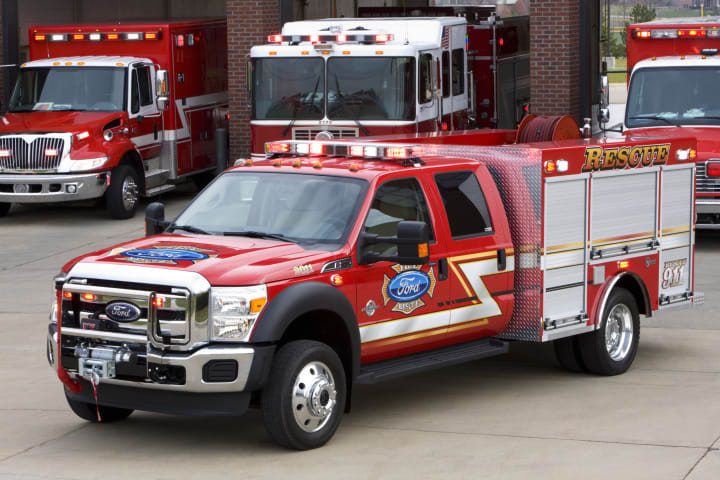
2011 Ford First-Responder Vehicle
LOS ANGELES - For more than 60 years, dependability and reliability have been the hallmark of Ford's F-Series trucks. For those who rely on their trucks 24/7 for emergency rescue work, the new 2011 Ford F-550 Super Duty XLT chassis cab - which can be upfitted as a fire department first-responder vehicle - was showcased at the Los Angeles Auto Show.
The 2011 F-550 Super Duty is the cornerstone of a program enabling auto show attendees to aid the Los Angeles County Firefighters Widows and Orphans Fund. Ford will donate $10,000 to the fund at the outset, then $10 for those who visit the Ford display and $20 for those who test drive a Ford vehicle at the show to a maximum of $6,000 a day throughout the entire run of the show.
"This is one small way we can give back to the families of these heroes and honor those who have made the ultimate sacrifice for their fellow citizens," said Doug Scott, Truck Group marketing manager.
Two key additions to the redesigned truck - the new 6.7-liter Power Stroke® V-8 turbocharged diesel engine and the new heavy-duty six-speed TorqShift automatic transmission - underscore why more municipalities count on Ford trucks than any other to perform their most demanding and critical jobs. Ford is ranked No. 1 in the Emergency Vehicle Segment based on R.L. Polk & Co. Class 2-7 emergency Vehicle Vocation registrations.
"The Los Angeles County Fire Department is grateful to Ford for remembering the family members of our fallen firefighters," said Fire Chief P. Michael Freeman. "We support their efforts to raise funds for the Los Angeles County Firefighters Memorial Committee."
The all-new 6.7L Power Stroke V-8 turbocharged diesel was designed, engineered and manufactured by Ford and will deliver significantly improved torque and horsepower as well as class-leading fuel economy.
It features a block made of compacted graphite iron, which is stronger than cast iron to withstand the increased firing pressures of the new combustion system. The single turbocharger is engineered to provide the benefits of a small turbocharger (faster response) and a large turbocharger (compressing more air to create more power) in one package. The new engine also can run on biodiesel blends of up to B20.
The increased power is especially important on applications such as fire fighting. The apparatus on the F-550 chassis cab first-responder unit includes:
300-gallon water tank
8-gallon foam cell
Two pumps
Electric rewind hose reel with 150 feet of hose
Three-stage winch with 8,000-pound capacity
100 feet of wire rope
The all-new heavy-duty TorqShift six-speed automatic transmission offers available Live Drive Power Take Off (PTO) for diesel customers. This application allows the transmission to power auxiliary equipment, and the power is available any time the engine is running - and the truck is moving.
The Live Drive PTO is critical in fire-fighting applications because it allows the truck to spray water onto a brush fire or grass fire, for example, while the truck is stationary or moving. This is the first time Live Drive PTO has been offered in this segment.
The 2011 Super Duty will be built at the Kentucky Truck Plant in Louisville, and goes on sale next spring.
More Operations

90% Use Telematics. Are Fleets Getting Safer? | AF News Recap
This week, we're breaking down which industries have the highest rates, how Jamie McKay manages 2,400 vehicles, what's happening with the 2027 fleet awards, and why software-defined vehicles could introduce new costs.
Read More →
What's Best Handled by an FMC, and What's Better Done Directly?
Fleet managers continue to rely on FMCs for essential services but are taking a closer look at where working directly with suppliers can improve efficiency and responsiveness.
Read More →
Fleet Meets: Erin Gilchrist
Meet Erin Gilchrist, the inaugural Mike Antich Spirit of Fleet Award winner, as she shares insights on leadership, mentorship, the power of industry connections, and why people remain at the heart of fleet's future.
Read More →

How 2026 Fleet Visionary Jamie McKay Manages 2,400 Vehicles Across 37 States
How do you keep 2,400 vehicles running across 37 states? Fleet Visionary Award winner Jamie McKay shares how collaboration, flexibility, and a few simple strategies help her tackle fleet management challenges at Aptive Pest Control.
Read More →
Managing Fleet Costs in an Era of Permanent Volatility
Fleet operating costs have risen more than 20% since 2020, raising a key question: When does extending a vehicle's service life stop making financial sense?
Read More →
The Next Evolution of Fleet Management: Autonomous Operations
This opening keynote session at the Fleet Forward Conference highlights the future of autonomous driving for fleets.
Read More →
How to Reduce the Total Cost of Risk From Catalytic Converter Theft
A stolen catalytic converter can cost fleets far more in downtime and lost productivity than in repairs. A total-cost-of-risk approach can help fleet managers quantify their exposure and prioritize theft prevention.
Read More →
Personal-Use Charges Rise as Vehicle Values Fall | AF News Recap
Personal-use charges are climbing, wholesale used-vehicle values are declining, and commercial fleet sales growth is slowing. This week, we're breaking down the latest fleet data, plus how Element Fleet Management is helping Waymo prepare for its first Canadian robotaxi market.
Read More →
Here's When You Should Make an Exception to Fleet Policy
Fleet policies are designed to create consistency, but not every driver or situation fits neatly within standard rules.
Read More →
AI-Native or AI-Acquired: What Should Fleet Managers Look for in an AI Platform?
Six questions can help fleet managers look beyond AI marketing claims to evaluate integration, data access, and real-world operational performance.
Read More →