




Safety, Sustainability, and Fuel Efficiency Are Synergistic
Three challenges consistently high on the list for many fleet managers — improving driver safety, mitigating the high cost of fuel, and complying with corporate pressures to reduce fleet’s contribution to the company’s global carbon footprint.

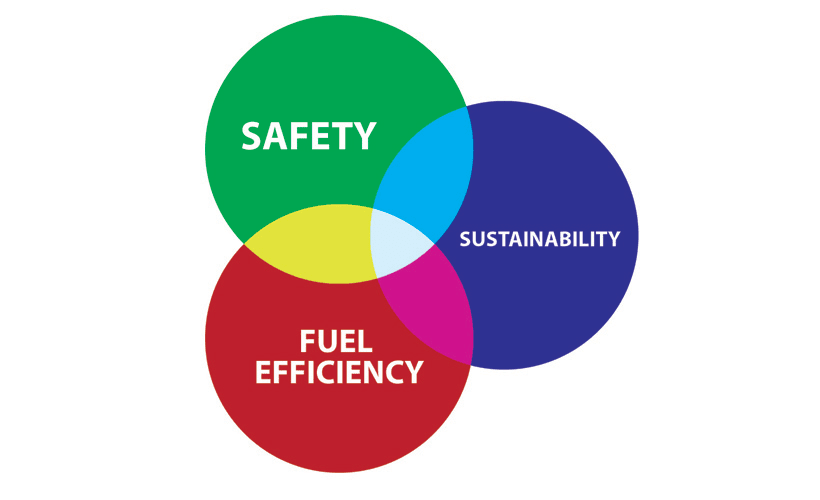
Three challenges consistently high on the list for many fleet managers — improving driver safety, mitigating the high cost of fuel, and complying with corporate pressures to reduce fleet’s contribution to the company’s global carbon footprint.
Graphic by Armie Bautista.
I am in regular contact with commercial fleet managers around the country, which allows me to stay current with the multitude of challenges, opportunities, and trends impacting our industry. Recently, while surveying commercial fleet managers about their buying inclinations for the 2019 model-year, I asked fleet managers to identify the greatest challenge facing their fleet operations.
Recognizing that I was surveying a broad cross-section of corporate America, I was not surprised to receive a diverse list of numerous challenges; however, three challenges were consistently high on the list for many fleet managers — improving driver safety, mitigating the high cost of fuel, and complying with corporate pressures to reduce fleet’s contribution to the company’s global carbon footprint. The good news is that all three of these challenges are interrelated and represent an excellent opportunity for fleet managers to demonstrate their value to senior management by synergistically addressing all three simultaneously.
Changing Driver Behavior
The biggest obstacle to fuel efficiency, fleet safety, and sustainability initiatives is often company drivers themselves. By training drivers to practice safe driving techniques, you will also contribute to reduced fuel consumption and decreased emissions. A safe driving program allows a company to leverage constrained resources and reduce liability exposure by lowering the incidence of preventable accidents.
One fleet best practice is to meld eco-driving and safe-driving techniques into a single program. In many ways, safe driving and eco-driving are one and the same, with both focused on modifying driver behavior. By making drivers safer and more fuel conscious, you will also decrease fuel consumption and the incident of preventable accidents.
Most company drivers average 20,000 miles per year and driver behavior is a major influence in both the incident of a preventable accident and fuel consumption. There’s a direct correlation between safe driving and greenhouse gas (GHG) emissions. The safer the driver, the fewer preventable accidents, the greater the fuel efficiency and the lower the GHG emissions.
How employees drive a company vehicle determines how safe they will be on the road. The same is true in terms of sustainability. How an employee drives a vehicle can improve (or decrease) fuel economy and decrease (or increase) emissions. In fact, up to 30% of a vehicle’s fuel efficiency is impacted by driver behavior. The way an employee drives makes a significant difference in the volume of GHG emissions emitted by a company vehicle, regardless of vehicle size or engine displacement. For example, every unnecessary gallon of gasoline burned by a car creates 19.5 lbs. of CO2. The same is true for trucks — every unnecessary gallon of diesel burned creates 22.1 lbs. of CO2.
If fuel efficiency potential is constrained by equipment requirements, the alternate strategy to achieving corporate sustainability objectives is modifying driver behavior. This represents the greatest opportunity for fleet managers to green their fleets. The way an employee drives determines the volume of greenhouse gas emissions (GHG) emissions produced by a company vehicle. Even if a vehicle’s EPA fuel economy is rated high, aggressive and inefficient driving can substantially degrade a vehicle’s fuel economy.
If you change driving behavior, you have a direct impact on the safety-consciousness of your drivers, the amount of fuel consumed, and the volume of emissions. Changing driver behavior can result in a 5% to 30% reduction in annual fuel consumption and help reduce preventable accidents. The net result of making employees safer drivers is a reduction in GHG emissions.
To illustrate, consider that the greatest amount of GHG emissions occurs during aggressive driving. Less than a minute of high-powered driving produces the same volume of GHG as a half hour of normal driving. Speeding, rapid acceleration, and hard braking can lower fuel economy by 33% in highway driving and 5% in urban driving. Even small increases in mpg can yield substantial savings when extrapolated across the entire fleet.
By limiting acceleration and fast braking, a driver can increase fuel economy and minimize the potential of a preventable accident. Route planning is an important component of eco-safe driving. Stop-and-go driving burns fuel more quickly, increases emissions, and, from a safety perspective, increases the probability of being involved in a rear-end collision.
By pre-planning trips to minimize stop-and-go driving, you can reduce emissions. It is important to remember the highest volume of emissions occurs when starting a cold engine. Eco-safe driving encourages combining several short trips into one. Since a catalytic converter must be heated to a certain temperature to work, fewer emissions are produced during longer trips because the engine is warmed up.
Accomplishing Three Goals Simultaneously
Driver distraction accounts for 25-30% of all fleet-related accidents. Eco-safe driving teaches drivers to avoid distractions and focus on driving. These driving habits likewise contribute to reduced fuel consumption and emissions. An eco-safe driving program allows a company to leverage constrained resources to simultaneously green its fleet and reduce its liability exposure by lowering the incident of preventable accidents.
In addition, fleet managers are feeling pressure from other corporate departments to increase fleet driver safety. For instance, corporate risk management is becoming more influential in the types of vehicles added to fleet selectors. Some corporate risk management departments dictate that only models with NHTSA 5-Star ratings can be added to a fleet selector.
Another department with a growing influence on fleet safety is Environment, Health & Safety (EHS) because drivers are one of the largest sources of Workers’ Comp claims. Under OSHA regs, an employer must provide a workplace free from hazards and company vehicles are considered a workplace. Good ergonomics contributes to accident avoidance. Poor ergonomics reduces driver comfort, which increases fatigue, a key contributor to preventable accidents.
More Blog Posts

Fleets Want Trust Restored with Suppliers
During this period of ongoing supply constraints, the trust that fleet managers had with OEMs, upfitters, and dealers has been strained. Fleet managers say they have had too many experiences over the past three years coping with erroneous information, adjusting to multiple price increases, and feeling betrayed by inadequate transparency from suppliers.
Read More →
Scheduled Replacement Cycles Are Becoming a Distant Memory
The ongoing difficulty in sourcing replacement vehicles is forcing companies to extend the service lives of vehicles that are unable to be replaced, which, inevitably, increases unscheduled maintenance expenses.
Read More →
Fleet Simplification is the Antidote to Asset Variability
Fleet simplification identifies asset functions to uncover commonality among the equipment and assets. Simplification increases operational efficiency as end-users become accustomed to the controls, displays, and operation of less diverse units.
Read More →
The Dangers of Static Fleet Policies
A fleet policy is a living document, flexible enough to adapt to evolving business priorities, developing industry trends, and changing industry best practices and standards.
Read More →
Short-Term vs. Long-Term Cost Reductions
Corporate procurement staff are often driven by short-term, immediate cost reductions. However, a longer perspective to soft cost savings is critical because fixating on short-term results will hurt a company in the long run.
Read More →
Uptick in Unscheduled Maintenance Increasing Vehicle Downtime
Fleet data analysis can identify recurring downtime issues. It’s important to determine the root causes of downtime so procedures can be developed to minimize such problems.
Read More →
Eliminate Needless Curb Weight to Maximize ICE & EV Efficiencies
Vehicle weight relates directly to fuel economy. In today’s era of electrification, there is also a direct correlation between vehicle weight and battery range.
Read More →
Tech Dependence Risks Dumbing Down Fleet Manager Expertise
The line between creative thinking and problem solving and doing what the data indicates is thin. To lead in fleet management, you need to balance understanding the fundamentals and embracing what smart technology offers.
Read More →
Leverage the Synergy of Safe Driving to Achieve Sustainability and Cost Goals
Safe driving, emission reductions, and cost containment can all be achieved at the same time.
Read More →
The Playbook for Fleet Manager Success
There are many paths to success — most of them involve being flexible, open-minded, and willing to learn.
Read More →