




Fleet Operating Costs Remain Stable for Fourth Consecutive Year
The stability of fuel pricing over the past 36 months, along with ongoing improvements in vehicle fuel economy, have been the key factors keeping fleet operating costs relatively flat.

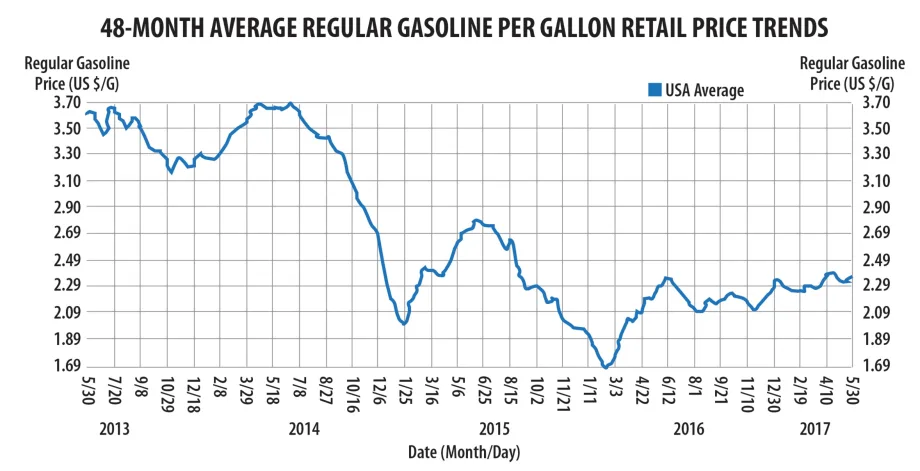
The stability of fuel pricing over the past 36 months, along with ongoing improvements in vehicle fuel economy, have been the key factors keeping fleet operating costs relatively flat. Since fuel spend makes up, on average, approximately 60% of a fleet’s total operating costs, the trajectory of the price per gallon of fuel has a huge impact on overall operating costs. Chart courtesy of Gasbuddy.
The stability of fuel pricing over the past 36 months, along with ongoing improvements in vehicle fuel economy, have been the key factors keeping fleet operating costs relatively flat. Since fuel spend makes up, on average, approximately 60% of a fleet’s total operating costs, the trajectory of the price per gallon of fuel has a huge impact on overall operating costs. Chart courtesy of Gasbuddy.
During the course of assembling the data for the 2017-2018 Automotive Fleet Fact Book, the top story, in my mind, is that calendar-year 2017 starts the fourth consecutive year that overall fleet operating costs have remained stable when compared to the preceding year. The stability of fuel pricing over the past 36 months, along with ongoing improvements in vehicle fuel economy, have been the key factors keeping fleet operating costs relatively flat. Since fuel spend makes up, on average, approximately 60% of a fleet’s total operating costs, the trajectory of the price per gallon of fuel has a huge impact on overall operating costs.
The second highest fleet operating expense is the cost for replacement tires. Replacement tire pricing for CY-2016 were flat compared to CY-2015. A key reason was less volatility in the price of commodities used to manufacture tires, namely oil, rubber, and steel. These lower materials prices kept replacement tire costs flat. With commodity prices remaining low – particularly oil – material costs have not shown much fluctuation. In addition, increased imports of low-cost replacement tires from abroad has helped keep average prices down.
The third highest operating expense, fleet maintenance costs, has also remained flat due to increased overall vehicle quality. Also, contributing to this decline has been increased engine protection by new motor oils, improved component engineering for engines and transmissions, onboard diagnostics, and faster OEM response time to component failures.
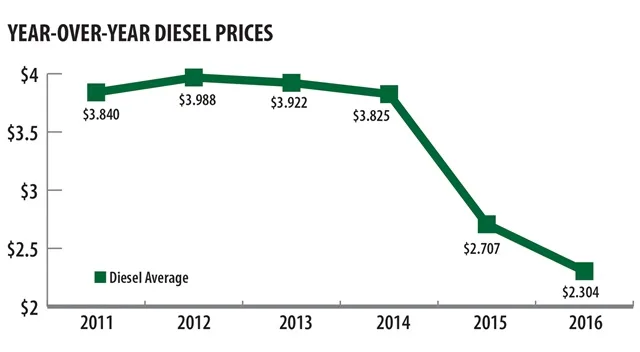
Data courtesy of the U.S. Energy Information Administration.
Impact of Fuel Prices on Vehicle Acquisitions
It is well documented that fuel prices influence vehicle acquisition decisions. Buyers in the new- and used-vehicle markets base their acquisition decisions on fluctuations in fuel prices. When fuel prices are high, there is increased interest in hybrids and smaller vehicles. Likewise, when fuel prices are low, buyers are more willing to consider larger, less fuel-efficient vehicles. In recent years, lower fuel costs have created an upward pressure on truck and compact SUV resale values, resulting in a lower cost per mile and making these vehicle classifications more affordable to operate. Conversely, lower fuel prices have impacted the sales of hybrids and alternative-fueled vehicles by decreasing demand for these types of vehicles.
The commercial fleet market is very diverse covering all segments of the U.S. economy, which sometimes creates contradictory market forces. For instance, one factor driving acquisition decisions, especially at multinationals, is corporate sustainability initiatives. Since higher fuel efficiency translates into lower emissions, meeting sustainability mandates forces acquisition decisions to focus on smaller displacement, more efficient engines. These acquisition decisions have contributed to increased average fleet fuel economy and a reduction in overall fuel consumption. For instance, fleets are rightsizing their vehicle selectors to take advantage of more fuel-efficient engine technologies, weight reduction measures, and higher-speed transmissions to meet sustainability initiatives. The use of data analytics is helping to further refine fuel management and sustainability strategies.
But, there is a limit as to how much fuel savings can be wrung from the types of vehicles acquired without impacting the fleet application. Once asset limitations are reached, the best way to reduce fuel expenditures is to modify employee driving behavior.
Beware of Complacency
Most fleet management companies use the U.S. Energy Information Administration (EIA) of the U.S. Department of Energy forecasts for internal planning and external fuel price forecast dissemination. The EIA forecasts an uptick in gasoline prices in CY-2018 to an average of $2.45 per gallon, compared to an anticipated average of $2.34 in CY-2017. The biggest danger from today’s lower fuel prices is complacency, on the part of both drivers and fleet managers, and the mistaken belief that fuel reduction initiatives do not require the same emphasis as in the past.
Despite the actual price of a gallon of fuel – whether it is high or low – minimizing your fuel spend should remain a top priority.
Let me know what you think.
mike.antich@bobit.com
More Blog Posts

Fleets Want Trust Restored with Suppliers
During this period of ongoing supply constraints, the trust that fleet managers had with OEMs, upfitters, and dealers has been strained. Fleet managers say they have had too many experiences over the past three years coping with erroneous information, adjusting to multiple price increases, and feeling betrayed by inadequate transparency from suppliers.
Read More →
Scheduled Replacement Cycles Are Becoming a Distant Memory
The ongoing difficulty in sourcing replacement vehicles is forcing companies to extend the service lives of vehicles that are unable to be replaced, which, inevitably, increases unscheduled maintenance expenses.
Read More →
Fleet Simplification is the Antidote to Asset Variability
Fleet simplification identifies asset functions to uncover commonality among the equipment and assets. Simplification increases operational efficiency as end-users become accustomed to the controls, displays, and operation of less diverse units.
Read More →
The Dangers of Static Fleet Policies
A fleet policy is a living document, flexible enough to adapt to evolving business priorities, developing industry trends, and changing industry best practices and standards.
Read More →
Short-Term vs. Long-Term Cost Reductions
Corporate procurement staff are often driven by short-term, immediate cost reductions. However, a longer perspective to soft cost savings is critical because fixating on short-term results will hurt a company in the long run.
Read More →
Uptick in Unscheduled Maintenance Increasing Vehicle Downtime
Fleet data analysis can identify recurring downtime issues. It’s important to determine the root causes of downtime so procedures can be developed to minimize such problems.
Read More →
Eliminate Needless Curb Weight to Maximize ICE & EV Efficiencies
Vehicle weight relates directly to fuel economy. In today’s era of electrification, there is also a direct correlation between vehicle weight and battery range.
Read More →
Tech Dependence Risks Dumbing Down Fleet Manager Expertise
The line between creative thinking and problem solving and doing what the data indicates is thin. To lead in fleet management, you need to balance understanding the fundamentals and embracing what smart technology offers.
Read More →
Leverage the Synergy of Safe Driving to Achieve Sustainability and Cost Goals
Safe driving, emission reductions, and cost containment can all be achieved at the same time.
Read More →
The Playbook for Fleet Manager Success
There are many paths to success — most of them involve being flexible, open-minded, and willing to learn.
Read More →