




ZAP Xebra Electric Trucks Deliver in Urban Settings
The ultra-compact Xebra trucks allow the Coca-Cola Company, Domino’s Pizza, and UPS to get closer to customers while saving fuel and helping the environment.

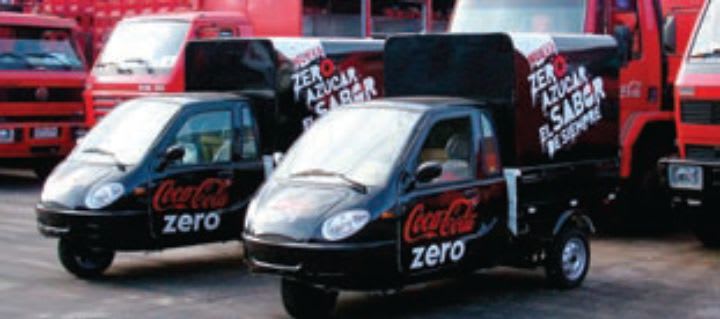
The Xebra trucks are fitted with a lockable cargo box for the Coca-Cola delivery service.
Photo: Zap
The Coca-Cola Company and alternative transportation pioneer ZAP announced a project to use 30 Zap Xebra compact electric trucks for a new beverage distribution system in Montevideo, Uruguay.
Coca-Cola recently announced a pledge to the environment as part of its policy of corporate social responsibility. The beverage company will focus on three areas of great impact: water use, packaging, and energy use and climate protection. Jorge Apesetche, distribution manager for Monresa (Uruguay) says the project with ZAP is the kind of initiative Coca-Cola wants to make to do its part in good environmental policy.
New Distribution Model Created
As cities become more and more congested, making door-to-door deliveries becomes more difficult. Parking is more difficult, especially in older cities that do not have service alleys to keep delivery vehicles out of street traffic. And the alternative, double-parking, simply magnifies the problem.
Around the world, rising fuel prices, traffic congestion, pollution, and parking shortages restrict the use of large delivery trucks. Coca-Cola officials say the new distribution model using the Zap electric trucks averages about 20 percent of the fuel consumption of the former model.
Coca-Cola subsidiary Monresa has received its initial order of 30 ZAP Xebras and is now placing them into service to deliver beverages throughout Montevideo, the capital of Uruguay. The Xebras will be incorporated into a mobile distribution hub model where larger delivery trucks will no longer be used throughout the city, but will transfer beverages into ZAP trucks at distribution hubs.
Modified with enclosed, lockable cargo boxes, the ZAP Xebras can easily navigate narrower, inner-city streets, making deliveries to smaller retail locations. Because the ZAP trucks operate more easily in this environment, officials from Coca-Cola say their drivers can deliver goods and collect payment at the same time, whereas collections were not practical when using the larger trucks.
UPS Uses a Similar Model
Coca-Cola’s new distribution model is similar to the one set up recently by United Parcel Service (UPS) in Northern California. A fleet of 42 ZAP trucks and sedans were used to expand small parcel deliveries during peak holiday demand. After UPS delivery vans transfer smaller packages to a locked storage unit, a Xebra transports the packages into dense urban and residential areas where parking and traffic are easier for the smaller vehicles.
Originally posted on Work Truck Online
More Global Fleet
GeoFencing Adds to Your Truck Security Arsenal
Geofencing is a familiar fleet tool today, but its early adoption marked a major shift in vehicle tracking, route monitoring, and the debate over employee privacy.
Read More →
Holman Takes Full Ownership of ARIZA in Mexico
Holman is bringing its Mexican fleet management operation fully under its own brand after more than 30 years as a joint venture. The change gives multinational fleet customers a single Holman operation across the U.S., Canada, and Mexico.
Read More →
5 Tire Maintenance Tips to Help Prevent Work Truck Downtime
Regular tire checks can do more than extend tread life. These five maintenance practices can help work truck fleets catch problems early, reduce costs, and prevent downtime.
Read More →

Proven Ways to Reduce Work Truck Downtime
The age-old problem of downtime will always be a reality, but with new strategies at hand, fleets have more ways to keep trucks on the road longer.
Read More →


Cameras, Safety and Insurance: From Reactive Claims to Real-Time Prevention (Part 2 of 2)
Part Two: Commercial auto remains one of the most challenging and costly lines of coverage for fleet operators and insurers alike. Continue learning more about how to effectively address these issues from Onur Aksan, Enterprise Business Development Executive, Geotab
Read More →
Cameras, Safety and Insurance: From Reactive Claims to Real-time Prevention
Commercial auto remains one of the most challenging and costly lines of coverage for fleet operators and insurers alike. Learn more about how to effectively address these issues from Onur Aksan, Enterprise Business Development Executive, Geotab.
Read More →
Fleet Costs Are Rising: Here’s How Leaders Are Responding
Fleet leaders are under pressure to reduce costs, adapt to economic uncertainty, and make smarter decisions. See how peers across North America are responding with real data, proven strategies, and forward-looking insights. Download the 2026 Market Pulse Report to benchmark your strategy and uncover where you can gain an edge.
Read More →
Enterprise Fleet Management Surpasses 900,000 Vehicles in U.S. & Canada
Enterprise Mobility connects with mobility solutions around the globe
Read More →