




What’s Driving Operating Costs in 2025? New Challenges Emerge
Fleet operators are facing rising costs in acquisition, insurance, maintenance, and repairs — even as fuel prices dip — forcing a rethink of budgeting and vehicle strategies.
June 11, 2025

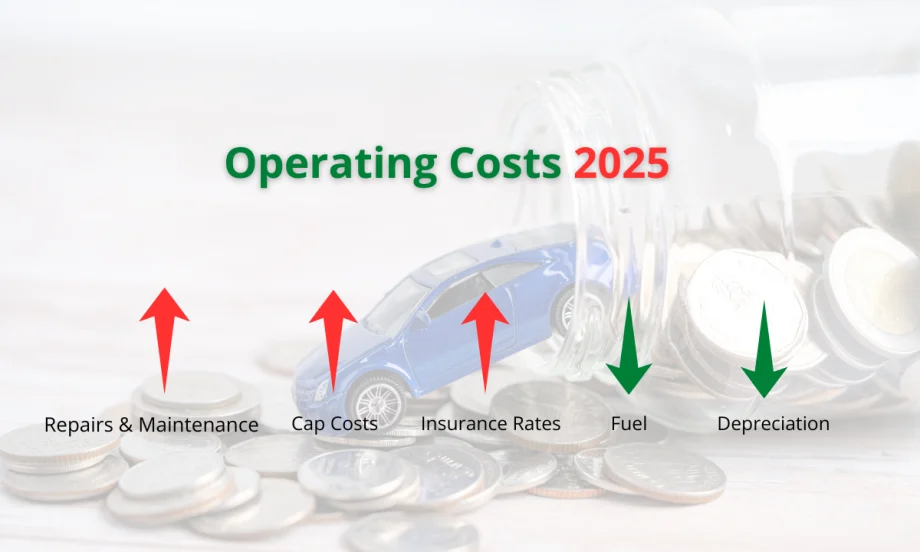
Fuel and buoyant used car values are the operating cost bright spots for 2025.
Photo: Automotive Fleet
6 min to read
If you thought the worst of the supply chain chaos and cost surges were behind us, think again. In 2025, fleet managers are navigating a new wave of financial pressures. Aging vehicles are racking up maintenance bills, parts and repair costs are climbing under the weight of new tariffs, and acquisition budgets are stretched thinner than ever.
While fuel prices have moderated, other areas — maintenance, repairs, insurance rates, and vehicle acquisition — are moving in the opposite direction.
Through data and perspective, fleet managers, fleet management company representatives, and market watchers weigh in on how the industry is adapting to stay ahead.
Tariff Volatility Pressures Vehicle Acquisitions
Vehicle acquisition costs have been a challenge in recent years, and 2025 offers no reprieve. According to Kelley Blue Book data, new-vehicle average transaction prices (ATP) increased in April to $48,699, a sharp 2.5% increase over March.
Element Fleet Management's Strategic Advisory Team reported that light truck prices rose more than other vehicle segments. Some clients are still waiting for delivery of MY-24 and MY-25 vehicles, and pickups and vans face particularly long order-to-delivery (OTD) times, said Sharlin Sebastian, strategic advisor at Element.
Mike Albert Fleet Solutions echoed these pressures, noting that hybrid and plug-in hybrid models command higher prices, while ICE compact and mid-size cars, along with most EV configurations, are priced more competitively. Other segments, such as cargo vans and pick-ups, remain in between.
These dynamics are prompting some clients to reevaluate their vehicle classes entirely, Kraus said, with many shifting from ½-ton to mid-size pickups or from mid-size to compact SUVs.
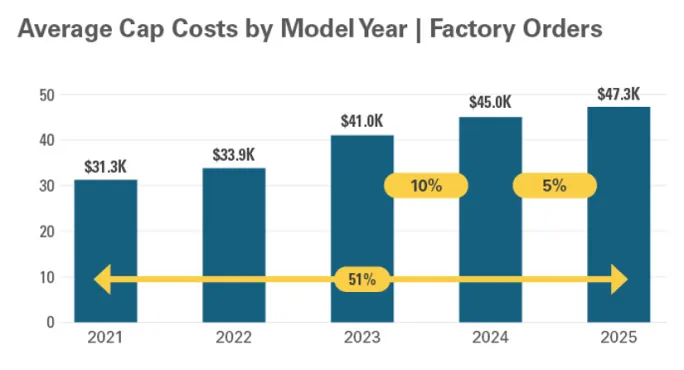
Vehicle cap costs for factory orders have risen an astounding 51% since 2021.
Chart: Element’s Strategic Advisory Team
Residual Values: Easing, But Still Elevated
After years of post-pandemic volatility, residual values for vehicles appear to be finding a new normal, albeit at elevated levels compared to the pre-2020 market.
According to Black Book’s March 2025 forecast, the average residual value for three-year-old vehicles on a 36-month term is projected to land in the low-50% range for the 2025 model year returning in 2028. This marks a steady decline from the astronomical pandemic-era peak of 81.9% in 2021 but remains above the pre-pandemic average in the high 40% range.
The outlook suggests used vehicle values are stabilizing, supported by limited supply. Black Book projects that industrywide used vehicle supply for units eight years old and under will remain flat in 2025, following years of contraction that began in 2021 due to pandemic-era production shortfalls.
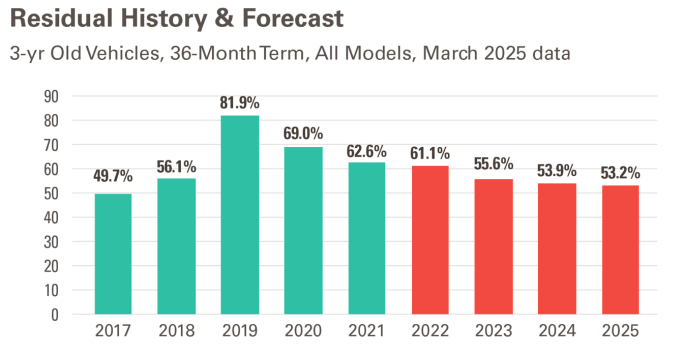
Values for three-year-old vehicles will remain above pre-pandemic averages.
Chart: Black Book
Remarketing: Uncertainty Returns
After peaking in 2022, resale values began to decline in 2024. However, new tariff impacts and reduced vehicle availability are reversing that trend.
The tariff-driven increase in new vehicle prices is pushing demand toward used cars, causing a 2.7% month-over-month price rise in April. The April Manheim Used Vehicle Index reached its highest level since October 2023.
Fleets that acquired vehicles aggressively ahead of anticipated cost hikes may find themselves in a better resale position. Monitoring resale markets will be critical as inventory levels shift again.
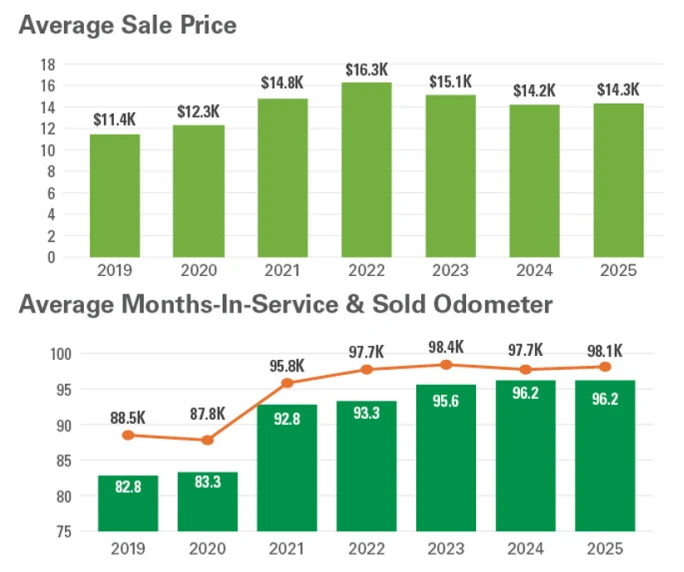
For remarketed vehicles, average sale prices are expected to increase slightly for 2025, even as total miles on those units continue to creep higher.
Chart: Element’s Strategic Advisory Team
Maintenance & Repairs Exacerbated by Aging Fleets
Maintenance costs are another major contributor to OpEx. Parts and labor remain expensive, but the biggest cost driver is fleet age.
Jason Kraus, VP of operations at Mike Albert Fleet Solutions, said aging vehicles present the biggest challenge. Delayed cycling strategies have exacerbated this issue, as fleets extend replacement timelines due to high acquisition costs and limited availability.
Compounding the problem: “Labor shortages impact timeliness to get a unit in the shop and diagnosed; parts shortages impact getting the unit repaired and back on the road,” Kraus added.
Element’s analysis pointed to continued challenges through 2026, particularly for preventive maintenance, as technician availability remains constrained and vehicles become more complex. Element expects a 20% to 25% increase in downtime over the current repair timelines, said Rich Forstner, vehicle damage appraisal supervisor at Element.
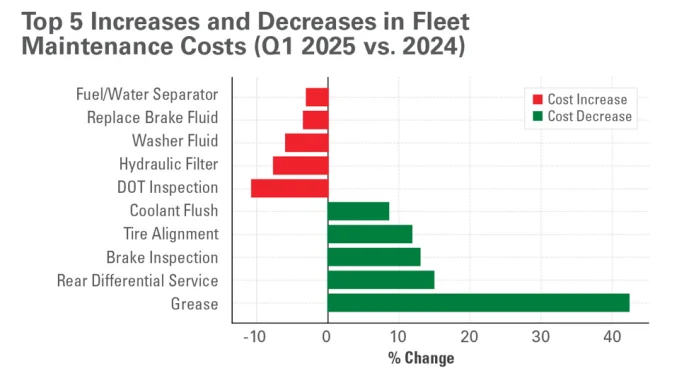
According to data from Fleetio, average maintenance and repair costs increased 4.9% in Q1 2025 compared to calendar year 2024. Year over year, 2024 saw an even greater 11.3% increase over 2023.
Chart: Element’s Strategic Advisory Team
Collision Costs & Never-Ending Parts Increases
Regarding the cost implications of vehicle repairs and accident management in 2025, Robert Martines, CEO of Corporate Claims Management (CCM), emphasized that new technology, costlier airbags, additional sensors, the need for recalibrations, pre- and post-scans, and the “never-ending parts price increases” are all driving up costs dramatically.
Martines noted that costs are exacerbated by the shortage of trained shop repair personnel. As a result, “Dealers know they have the upper hand, so they raise labor rates dramatically to cover the cost of their technicians and build in higher profit margins,” he said. “Sadly, we all pay for this.”
On insurance costs, Martines explained that accident-related expenses have significantly impacted policyholders. Insurance companies and brokers have indicated that the current expense paid by carriers was almost $1.50 per $1 collected, he said. “Rates have to increase to help recover losses.”
Collision repair is poised for a cost surge driven by expected tariff-related price increases in parts, materials, and tools.
According to Forstner, Element projects parts prices alone could rise 15% to 25%, with materials like paint/coatings and consumables jumping 20%. Meanwhile, tool prices (including labor) are expected to increase 15% to 20%, though prices on durable goods may take longer to ramp up.
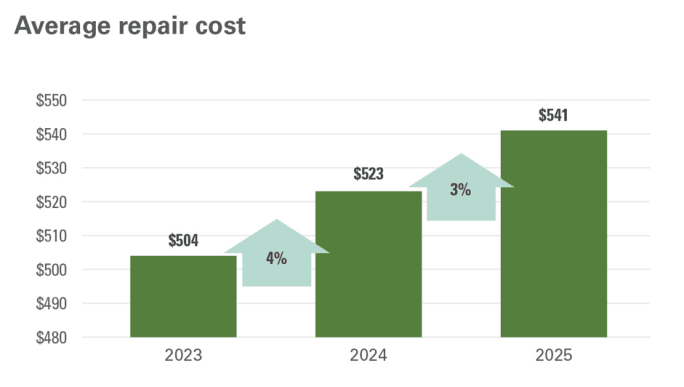
Chart: Element’s Strategic Advisory Team
Lower Fuel Prices, But Risks Remain
Fuel prices have trended downward in 2025, aided by increased oil production from OPEC.
According to the U.S. Energy Information Administration, as of May 26, regular gasoline prices had fallen by $0.41 per gallon from a year earlier, while diesel prices had fallen by $0.21.
AAA predicts fuel prices will remain lower than last summer, though weather is a wild card. The National Oceanic and Atmospheric Administration (NOAA) predicts a 60% chance of an above-normal season, which can affect oil refinery production along the Gulf Coast.
Element and Mike Albert caution that volatility remains a factor, particularly with global trade tensions influencing energy markets. Since fuel can account for up to 35% of a fleet’s budget, both emphasized the importance of fuel-efficient vehicles, optimized routing, and driver-behavior coaching to help manage this cost.
Budgeting Challenges Mount
With rising vehicle prices, high maintenance needs, and uncertain fuel and resale markets, many fleet operators are feeling the pinch.
“Factors like high interest rates, inflation, and uncertainty in the economic landscape are leading to more financial challenges for clients,” Kraus observed, adding that fleets running fuel-intensive or maintenance-heavy vehicles will be more affected.
When asked to predict the operating cost trends that will persist into 2026, Kraus responded with rising insurance premiums and the impact of technological advancements on fleet management.
Strategic Planning & Quick Wins
Despite the pressures, there are actionable areas for savings. Mike Albert said focusing on reducing fuel use, maintenance spend, and depreciation can produce “quick wins.”
Fleets should also reconsider their lifecycle strategies — some clients are pushing replacements from spring to fall, while others are evaluating mobile PM solutions for medium- and heavy-duty vehicles to reduce downtime.
Element added that predictive maintenance technology and disciplined PM schedules can mitigate rising costs, especially when paired with smarter vehicle acquisition decisions.
Fleet managers who stay agile — by diversifying OEM relationships, acting early, and maintaining rigorous cost oversight — will be best positioned to weather the volatility.
Subscribe to Our Newsletter
More Operations

Sponsored•October 14, 2026
A buyer's guide to fleet management software in 2027
Buying fleet management software in 2027 means looking beyond features and price. As fleet operations, technology and expectations evolve, this guide explores what today’s fleet professionals should consider when choosing a system that can deliver value now and adapt to what comes next.
Read More →
What Will Shape the Next Era of Fleet Management?
EVs, AI, and autonomous vehicles are reshaping fleet management. Discover what’s ahead—and how fleet leaders can prepare for the next era.
Read More →
How Fleets Can Recruit and Train Veterans for Technician Roles
Here's how the technician shortage has affected uptime for fleets, and what to do about it.
Read More →

Avis Budget Group Deploys Neology Toll Management Technology Across Major Brands
Neology’s neoFleet platform will manage toll transactions and toll-authority operations for vehicles across Avis, Budget, Payless, Budget Truck and Zipcar.
Read More →
Fleet Personal-Use Charges Edge Higher in 2026
Nearly eight in 10 surveyed fleets allow personal use of company vehicles, while just over half of respondents report charging employees for the privilege.
Read More →
The Future of Fleet + What’s Changing Right Now | AF News Recap
Could developments overseas offer a preview of what’s coming for U.S. fleets? This week, we’re looking at the future of AI, autonomy, and electrification, plus Ford Pro’s new certified pre-owned program, smarter vehicle offboarding, and a new way for fleets to manage toll expenses.
Read More →
How to Handle Vehicle Offboarding
What do fleet managers need to do when a driver leaves?
Read More →
Sponsored•October 1, 2026
Fleet Manager’s Ultimate Playbook: Navigating the New Standard in OEM Connectivity
Rising operating costs, driver safety concerns, and unplanned downtime are putting unprecedented pressure on modern fleets. Discover how fleet managers use embedded OEM connectivity and real-time vehicle data to cut TCO, prevent downtime, and protect drivers without aftermarket telematics hardware.
Read More →
U.S. Bank Adds Verra Mobility Toll Management to Voyager Fleet Platform
The integration allows U.S. Bank Voyager fleet customers to manage toll payments and violations alongside fuel, EV charging and maintenance expenses.
Read More →
ADAS Prevents Crashes. But Repairs Cost More | AF News Recap
ADAS-equipped vehicles may crash less often, but they can cost more when they do. This week, we’re breaking down what that tradeoff means for fleets, plus Subaru’s first Forester Wilderness Hybrid, Nissan’s new e-POWER Rogue, and why Calstart has become Catalyst Mobility.
Read More →