




Vocational Spotlight: Utility Fleets
With a large percentage of Class 1-8 trucks in use, utility fleets are unique in the vocational fleet market, typically driving shorter routes and putting on more engine hours than fleets with much higher mileage.

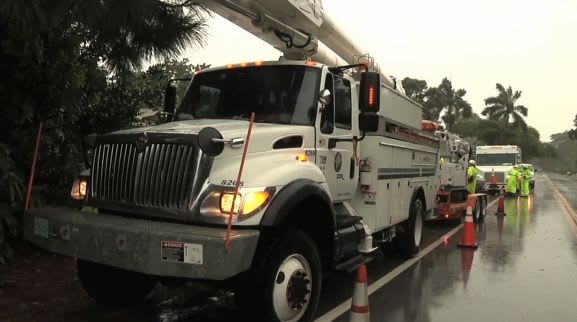
Fleet vehicles from Florida Power & Light take part in storm response training, including demonstrating efficient field work to restore power. (PHOTO: FPL)
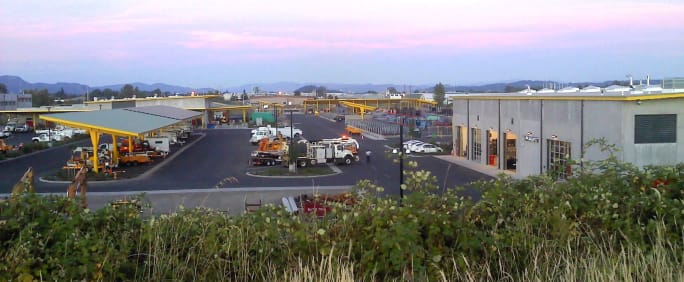
The Eugene Water & Electric Board (EWEB) fleet consists of approximately 320 vehicles and has recently outsourced its parts room to NAPA IBS. (PHOTO: EWEB)
Utility fleets help keep the power going, lights on, and gas running. From a focus on reducing parts room costs to storm response training to using vehicles as mobile safety billboards, utilities look to their fleets for both cost savings and revenue.
EWEB Outsources for Savings
Eugene Water & Electric Board (EWEB) is Oregon’s largest customer-owned public utility that provides low-cost water and electricity services to the businesses and citizens in the area.
EWEB operates approximately 320 vehicles, with the majority — around 210 units — consisting of Class 1-8 trucks.
Generally, vehicles do not leave the Eugene-metro area, so each vehicle only travels approximately 6,100 miles annually. While this may seem low based on normal utilization standards, the utility fleet does put on more engine hours than a similar-sized fleet.
“We have anti-idling programs in place to minimize our idling, but we still have vehicles that need to operate on the job site,” explained Gary Lentsch, CAFM, fleet manager for EWEB. “With telematics in every vehicle, by factoring in the engine hours, our fleet would be closer to a 3-million-mile fleet. We feel this has been an effective way to manage the fleet as far a vehicle utilization goes.”
Recently, EWEB outsourced its parts room to NAPA IBS and, in doing so, expects to better comply with internal controls, allow technicians more time to work on vehicles, and reduce the true cost of parts.
EWEB fleet previously managed its parts room without a parts person due to its relatively small size. But, after an internal review, the fleet decided it wasn’t the most efficient method, Lentsch noted.
The fleet needed to comply with the agency’s internal controls and solve some of its procurement problems: too much technician time spent on parts purchasing, and the complex and time-consuming process of buying parts over certain dollar thresholds.
“Together, we have reduced our fossil (petroleum) based fuels by more than 60%,” said Gary Lentsch, CAFM, fleet manager for EWEB.
“We anticipate reducing our entire fleet operation’s operation and maintenance budget by around 6% in comparison to having an in-house parts person,” Lentsch said. “For the cost of just one full-time employee, we were able to have NAPA staff our parts room for enough hours to cover both shifts with two employees.”
Additionally, crew leaders and technicians normally spent about an hour per day researching, ordering, picking up parts, and doing paperwork, meaning they had less time to spend on vehicles.
“For us to meet our own needs, we added overtime and outsourced more work to balance the workload. With the NAPA IBS program we’ve been able to reduce that time to about 15 minutes day,” Lentsch said. “For us, it was like adding a technician to the shop floor.”
All this extra work also increased the true cost of parts, from technician time to accounting time to cut a check. With the IBS program, the fleet eliminated six of the nine steps needed to procure a part, and the fleet receives just one invoice per month.
The fleet will now also be able to recapture its warranties and core credits immediately, where in the past, staff was often behind in recovering credits.
NAPA purchased 95% of the fleet’s existing parts inventory. Lentsch said only about 40% of parts actually come from NAPA, with the rest being purchased from local businesses.
According to Lentsch, outsourcing the parts room gives him more time to focus on technicians and fleet operations.
“When we implemented the IBS program, we went over our expectations of the program very clearly. We wanted to find a balance in maintaining our parts room that met our needs. Because we’re meeting with the employees from the IBS program on a regular basis, we felt that we have the ability to address any concerns in a timely manner,” he said.
In addition to outsourcing its parts room, over the past several years EWEB has worked to develop several peer-recognized sustainability programs including developing “green service” preventable maintenance programs, installing telematics in every vehicle as well as construction equipment, and the use of such alternative fuels as E-15, E-85, and R-99.
“Together, we reduced our fossil (petroleum) based fuels by more than 60%. By choosing these fuels we have been able to reduce our carbon intensity by more than 35%,” Lentsch said.
FPL Trains on Storm Response
Florida Power & Light Company (FPL) tested the response of more than 3,000 employees to Hurricane Alexa — a virtual Category 2 storm that was simulated to make landfall in Naples and exit the state along Florida’s Treasure Coast — during the company’s annual storm drill.
During recent storm response training, FPL demonstrated how crews work more efficiently in the field to speed restoration. The company’s storm response fleet, including its Mobile Command Center and Community Response Vehicle, allow field employees to operate remotely in the hardest hit areas. The company’s network of smart meters allows response crews to use a simple computer “ping” to confirm lights are back on before a crew leaves a neighborhood, replacing the traditional door-to-door approach.
This multi-day event is a critical component of the energy company’s extensive year-round training to ensure employees are ready to respond when their customers need them the most. As part of the week-long exercise, the company showcased new technology that would be utilized during a storm response, including an Unmanned Aircraft System (UAS) and an amphibious robot, both of which provide the company greater visibility of damage and speed restoration in the aftermath of a hurricane.
Representatives from the Florida National Guard, U.S. Department of Energy, partner energy companies, and the Florida Division of Emergency Management, including Director Bryan Koon, observed and, in some cases, participated in the storm simulation at FPL’s Command Center in Riviera Beach, Fla.
During the drill, FPL demonstrated how emerging technologies are changing the way field employees assess damage in the aftermath of a storm — from drones that can survey overhead power line damage, to amphibious robots that can provide access to unsafe, flooded areas. In addition, the company’s mobile application puts damage information at the fingertips of restoration crews after a storm passes.
Columbia Gas Uses Vans for Safety Message
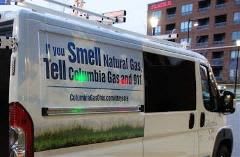
Many fleets utilize their vehicles as mobile billboards. Columbia Gas of Ohio has taken it one step further and used their fleet vehicles as mobile safety billboards. (PHOTO: Columbia Gas)
Columbia Gas of Ohio is one of many fleets that utilizes its vans as mobile billboards. But, the fleet took its vehicle graphics to the next level.
The utility uses its fleet of vans to remind customers to call 811 before digging or to call the utility and 911 if they smell gas, also known as the “Smell and Tell” campaign.
“Keeping customers safe is our first priority and part of our culture,” said Dan Creekmur, president, Columbia Gas of Ohio. “I’m proud that we’re taking these messages to customers. I want to be sure that everyone knows about 811 and Smell and Tell.”
The utility said that the vehicle wraps have already been installed on several vehicles and will appear across the statewide fleet over the next several months.
Originally posted on Work Truck Online
More Global Fleet
GeoFencing Adds to Your Truck Security Arsenal
Geofencing is a familiar fleet tool today, but its early adoption marked a major shift in vehicle tracking, route monitoring, and the debate over employee privacy.
Read More →
Holman Takes Full Ownership of ARIZA in Mexico
Holman is bringing its Mexican fleet management operation fully under its own brand after more than 30 years as a joint venture. The change gives multinational fleet customers a single Holman operation across the U.S., Canada, and Mexico.
Read More →
5 Tire Maintenance Tips to Help Prevent Work Truck Downtime
Regular tire checks can do more than extend tread life. These five maintenance practices can help work truck fleets catch problems early, reduce costs, and prevent downtime.
Read More →

Proven Ways to Reduce Work Truck Downtime
The age-old problem of downtime will always be a reality, but with new strategies at hand, fleets have more ways to keep trucks on the road longer.
Read More →


Cameras, Safety and Insurance: From Reactive Claims to Real-Time Prevention (Part 2 of 2)
Part Two: Commercial auto remains one of the most challenging and costly lines of coverage for fleet operators and insurers alike. Continue learning more about how to effectively address these issues from Onur Aksan, Enterprise Business Development Executive, Geotab
Read More →
Cameras, Safety and Insurance: From Reactive Claims to Real-time Prevention
Commercial auto remains one of the most challenging and costly lines of coverage for fleet operators and insurers alike. Learn more about how to effectively address these issues from Onur Aksan, Enterprise Business Development Executive, Geotab.
Read More →
Fleet Costs Are Rising: Here’s How Leaders Are Responding
Fleet leaders are under pressure to reduce costs, adapt to economic uncertainty, and make smarter decisions. See how peers across North America are responding with real data, proven strategies, and forward-looking insights. Download the 2026 Market Pulse Report to benchmark your strategy and uncover where you can gain an edge.
Read More →
Enterprise Fleet Management Surpasses 900,000 Vehicles in U.S. & Canada
Enterprise Mobility connects with mobility solutions around the globe
Read More →