




UPS Completes Deployment of 300 New ‘Green’ Trucks
The company’s new compressed natural gas trucks are expected to yield a 20-percent emissions reduction over the cleanest diesel engines available in the market today.
In February, UPS deployed 300 new delivery trucks to its delivery service fleet. Powered by compressed natural gas (CNG), the vehicles were rolled out in seven cities in Colorado, Georgia, Oklahoma, and California.
The new alternative-fuel vehicles, which join more than 800 CNG vehicles already in use by UPS worldwide, are part of an order placed last May. The new models allow UPS to further reduce its dependence on traditional fossil fuels, such as gasoline and diesel, and lower its carbon footprint. UPS already operates the largest private fleet of alternative-fuel vehicles in its industry - 1,819 in total with these additions.
Deployed from East to West Coasts
The new CNG trucks have been deployed over the past month to Denver (43 vehicles); Atlanta (46); Oklahoma City (100); and four California cities: Sacramento (21), San Ramon (63), Los Angeles (9), and Ontario (18). All are currently in service.
"Deploying alternative-fuel vehicles dates back to the early days of UPS, and this CNG deployment is one more step toward the greening of our fleet," said Robert Hall, UPS director of vehicle engineering. "Continuing to add CNG delivery trucks to our fleet is a sustainable choice because natural gas is a cost-effective, clean-burning, and readily available fuel."
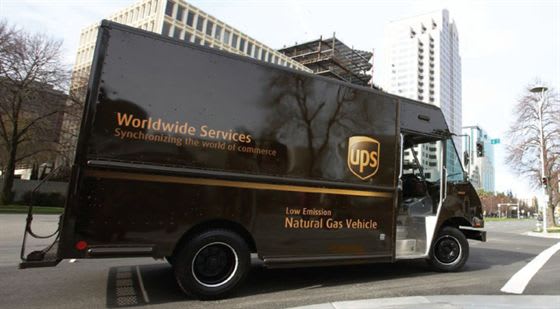
CNG to reduce Emissions 20 Percent
UPS began deploying trucks powered by CNG in the 1980s, when it purchased traditional gas- or diesel-driven vehicles and converted them to run on compressed gas. The 300 trucks deployed in February were built as CNG vehicles.
The CNG truck bodies are externally identical to the signature-brown trucks that comprise the UPS fleet. Marked with decals as CNG vehicles, the trucks are expected to yield a 20-percent emissions reduction over the cleanest diesel engines available in the market today.
For its alternative-fuel fleet, UPS has deployed CNG, liquefied natural gas, propane, electric, and hybrid-electric vehicles in the U.S., Canada, Mexico, Germany, France, Brazil, Chile, Korea, and the United Kingdom. In addition, the company recently announced the purchase of seven hydraulic-hybrid delivery vehicles, a first in the industry, and has conducted research with hydrogen fuel-cell vehicles.
"Deploying eco-friendly delivery vehicles is one of the many ways UPS demonstrates its commitment to sustainable business practices," Hall said. "The company plans to continue to expand its 'green fleet' and focus deployments in areas with air quality challenges."
More Green Fleet

The EV Breakdown Nobody's Talking About: Why Most Electric Vehicle Roadside Calls Aren't Mechanical Failures
Here's why EV breakdowns are widely misunderstood.
Read More →
ChargePoint Now Available in Energy Pass
ChargePoint and additional planned charging network integrations were added to GM's Energy Pass.
Read More →

First Look: Slate Auto's Electric Fleet Pickup
Could an affordable, modular EV pickup make electrification more practical for fleets?
Read More →
Slate Debuts Colorful, Unique EV Models
A recent media and client event, studded with electric vehicles dressed up on platforms, planted a new position for the manufacturer in the wider EV market. Fleets will find cost-saving advantages.
Read More →
Slate Electric SUV, Pickup Switchable Model Aims For Light-Duty Fleets
Everything about this EV is counterintuitive and understated, making it stand out from the crowd.
Read More →
Inspiration Mobility Acquires Key Electrada Assets
Inspiration Mobility Group has acquired select assets of Electrada, adding the fleet electrification provider's team, technology, and charging infrastructure development capabilities to its energy management business.
Read More →
Turning Connected Vehicle Data Into Decisions That Matter
Fleet leaders have more data than ever, but turning that data into clear, actionable decisions remains a challenge. This white paper shows how leading organizations are using connected vehicle data to improve safety, reduce costs, and optimize fleet performance. Learn how to turn insight into action across your fleet.
Read More →
Are You Tracking Your Fleet's True Total Cost of Ownership?
Bobit Business Media surveyed 190 fleet professionals and found that while most fleets are tracking costs, fragmented systems and data gaps are keeping true TCO visibility out of reach. With rising pressure to control spend in an increasingly volatile environment, the gap between what fleets think they know and what the data actually shows is wider than you might expect. See how your peers are managing costs today and where the industry still has room to improve.
Read More →
Hybrids: Electrification Without the Challenges
For fleet managers, fuel is one of the biggest line items in the budget — and it's one hybrids can shrink without changing how your people work. Download the eBook to see the numbers, understand the technology, and get a step-by-step guide to making the switch.
Read More →