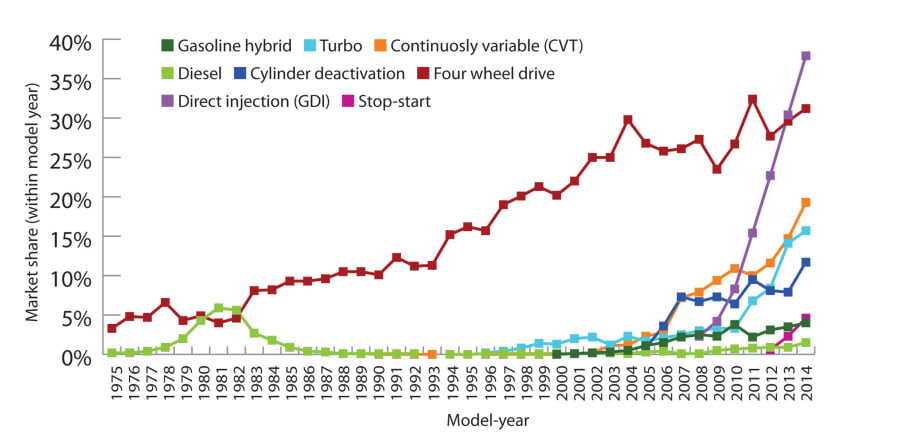
The market share year by year of automotive fuel-saving technology. Source: UMTRI
7 min to read
The market share year by year of automotive fuel-saving technology. Source: UMTRI
If there’s one constant in today’s technologically fueled world it’s change. And, for today’s automobile that is particularly the case. The past decade has seen transformative changes in both engine and transmission technology.
Ad Loading...
Among the advances are smaller displacement, turbocharged gasoline engines, and lightweighting.
Ad Loading...
Running parallel to the natural technological advances are the federal government’s CAFE standards, which mandate OEMs develop more fuel-efficient vehicles that produce fewer emissions.
Following are some of the advances that are fueling the revolutionary changes in new powertrain technology.
At a Glance
Automotive powertrain technology continues to advance. Among the noteworthy trends and advances:
Increased efficiency of the traditional gasoline internal combustion engine.
The use of turbocharging to make smaller displacement engines more powerful and efficient.
The addition of more gears to the gearbox.
The use of lightweight materials in both vehicle bodies and engines.
Getting More Out of the Internal Combustion Engine
For most fleets and consumers, the gasoline-powered internal combustion engine (ICE) is the ubiquitous engine type. These engines are getting smaller, more powerful, and more efficient with some OEMs offering gasoline-powered ICEs that can get as high as 42 or more mpg.
And, while the gasoline-powered ICE may be a mature technology, Brandon Schoettle, project manager for Sustainable Worldwide Transportation at the University of Michigan’s Transportation Research Institute (UMTRI), sees that it still has room to improve.
“There’s still even more work being done on ICE technologies. These newest systems use traditional gasoline, but are more akin to diesel engines that use more compression than spark ignition. This is very new stuff. These new engines gain even better efficiency. They can use cheaper gasoline, so you have this increased efficiency and can go to a lower octane instead of some of these technologies that push things the other way and require higher octane, higher quality fuels.”
Ad Loading...
Schoettle and his research partner, Michael Sivak, Ph.D., director of UMTRI’s Sustainable Worldwide Transportation (SWT), recently completed research into the way vehicle powertrain technologies have changed over the years and the attitudes consumers have about such technology as variable valve technology and stop-start technology, which are among the advances that are changing the way vehicles are being driven by fleets and consumers alike.
That being said, Schoettle does see that the traditional ICE will reach a natural performance endpoint.
“Will they ever be able to meet battery electric or fuel cells as the years go on? That’s a taller order,” Schoettle said. “Because you know you can get a smart car or something that achieves 50-60 mpg, but you have run- of-the-mill electric cars now that get much more than that, and fuel cell vehicles are just the starting point of where they’re at. I think there’s still room, and there will probably be some progress in the new technologies that come out in the next few years, but they have some stiff competition from batteries and some other technologies.”
Over the past several model cycles there seems to have been at least one announcement of a transmission with an extra gear or two. Several OEMs have available transmissions reaching up to gear nine in some of their light-duty trucks.
These multiple gears have helped to make the engines they’re mated to more efficient, maximizing the mpg gains for both the gasoline- and diesel-powered engines.
Ad Loading...
Getting Twin Charged
Turbocharging isn’t a new technology. The trend toward smaller displacement engines has been fueled, in part, from advances in turbocharging technology.
But, a new trend is allowing today’s engines to get even more efficiency by having the ability to take advantage of both turbocharging and supercharging. These twin-charged engines use the supercharging feature at low RPMs in off-highway situations and the turbocharging feature when the engine gets into high RPM situations in highway or other high-speed situations.
One of the downsides to these twin-charging systems is that they are expensive to use, according to Schoettle.
Continuously Variable Transmissions
Continuously variable transmissions have been gaining ground over the past several years.
This automatic transmission can change seamlessly through a number of gear ratios without input from the driver.
Ad Loading...
This also increases efficiency for the engines they are mated to, allowing the vehicle to stay in the gear that is ideal for the operational situation, both in terms of fuel economy and overall power.
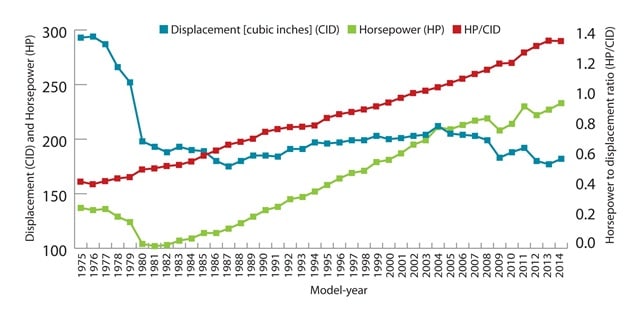
Trends in Engine Displacement and HP. Source: UMTRI
Benefitting from Lightweighting
One of the advances aiding powertrain efficiency has been the increasing use of lightweight materials by many of the OEMs both in the body and engines.
Military-grade aluminum, magnesium, titanium, and polymer resins are just some of the lightweight materials that are finding homes in light-duty vehicles.
Overall, this lightweighting has helped to make engines more efficient by requiring them to move less mass. For fleets operating light-duty pickups, the benefit of this lightweighting is higher cargo capacities, meaning the fleet doesn’t, in some cases, have to move up to a larger vehicle to do the same work, cutting up-front purchasing costs.
Providing Diesel-Like Efficiency
The next gasoline powertrain advancement is still on the drawing board, but could provide fleets the best of both worlds — the convenience of using gasoline while getting diesel-like performance. The homogeneous-charge compression-ignition (HCCI) engine can provide diesel-like efficiencies with very low emissions of NOx and particulate.
Ad Loading...
According to Sandia National Laboratories, which is researching the technology, an HCCI engine uses “a dilute, premixed fuel/air charge [that] auto-ignites and burns volumetrically as a result of being compressed by the piston.”
The technology is being researched by both automotive companies and fuel companies as well, according to Schoettle, and beyond its diesel-like efficiency and low levels of pollutants, the engines will most likely be able to run on low-octane gasoline, making them more economical to operate.
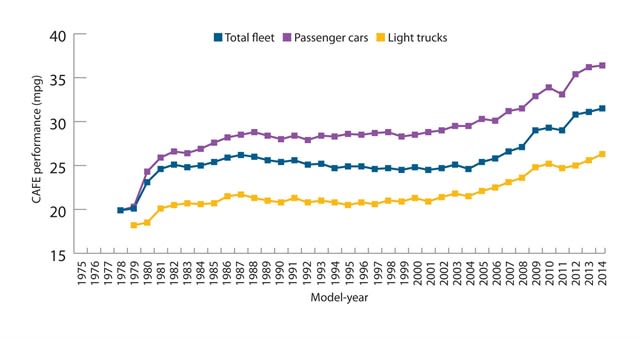
CAFE Performance Measures in MPG. Source: UMTRI
Stop-Start Proliferation
While not exactly a powertrain advance, stop-start technology is designed to improve efficiency by shutting the engine off when a vehicle is stopped in traffic and restarting when the driver touches the accelerator.
The technology is a kind of extension of some of the anti-idling technology that’s being used in trucks to save fuel.
Schoettle said that of all the technology he’s researched recently, this is the only one that has drawn little support from consumer drivers. This may be due to the fact that the first versions of the technology were rather inelegant, making the vehicle feel as if it was stalling. But, he noted that electric vehicles also have their own version of this technology and it’s relatively seamless and well accepted.
Ad Loading...
While today’s technology may not be popular, at least with consumer drivers, Schoettle predicts that once it’s perfected “it will be in every car.”
Diesel is Making a Comeback
The light-duty diesel vehicles of today have similar performances to traditional gasoline-powered vehicles, and the benefit of higher efficiency. With diesel prices plummeting, light-duty diesel vehicles are becoming even more economical to operate.
Brandon Schoettle, project manager for Sustainable Worldwide Transportation at the University of Michigan’s Transportation Research Institute (UMTRI), noted that many of the advances in diesel technology were perfected in the heavy-duty market.
“Advances in some of the heavy-duty diesel technology and turbocharging are what you’re seeing in the Chevrolet Cruze, which is a turbocharged diesel, so it’s a very small version of what’s been in heavy-duty trucks for a long time,” Schoettle said.
Diesels may offer fleets other advantages. Fleets may see premiums when remarketing diesels. This has been the case in recent years with fleets that operate medium-duty vehicles, reaping premiums for diesel-powered engines.
Solidifying the Menu of Alt-Fuel Choices
While alt-fuels are nothing new, over the past several years, OEMs have expanded the choices available to both fleets and consumers. For fleets, light- and medium-duty trucks with hardened valves, ready for conversion to either liquefied petroleum gas also known as propane autogas or compressed natural gas (CNG) have become readily available, but, so, too, have hybrid electric vehicles, battery-electric vehicles, and, most recently, hydrogen fuel cell vehicles.
These alt-fuel vehicles, while generating enthusiasm, still have yet to meet or surpass the volume of gasoline- or diesel-powered vehicles. However, many of these systems have appeared due to the mileage requirements of CAFE, and, with the upcoming emissions requirements that are being added, appear to be here to stay.
While there has been no clear “winner” as of yet in the alt-fuel race, Schoettle made his own prediction — based on his research — of which systems may come out on top of the alt-fuel heap, namely electric and hydrogen.
“The main problem for hydrogen is the infrastructure. Beyond that, it begins functioning a heck of a lot like a regular car. It expends fuel and you fuel up the tank. The usage of the vehicle doesn’t ask the user to do anything different,” Schoettle said.
Ad Loading...
While electric vehicles will change the way drivers handle fueling, the upshot will be a cost of ownership for fleets and consumers that may trump the other traditional fuels in the long term.
“You can skip fuel stations altogether and fuel at home. There is some good evidence that the majority of people don’t deplete their batteries during the day — so they simply go home and plug in at night. It’s incredibly convenient if you can do all your refueling at home. The price of that fuel is almost free, it’s incredibly inexpensive. Beyond the initial higher cost of the vehicle, refueling the vehicle is pennies compared to what the cost of gasoline is,” he said.
Schoettle suggests that the argument in favor of electricity and hydrogen is both the fact that their greenhouse gasses are nil — something that both propane autogas and CNG produce in some quantities — and that the fuels themselves can be produced in a nearly clean way. For example, electricity produced using hydroelectric power produces no harmful emissions.
Neology’s neoFleet platform will manage toll transactions and toll-authority operations for vehicles across Avis, Budget, Payless, Budget Truck and Zipcar.
Nearly eight in 10 surveyed fleets allow personal use of company vehicles, while just over half of respondents report charging employees for the privilege.
Could developments overseas offer a preview of what’s coming for U.S. fleets? This week, we’re looking at the future of AI, autonomy, and electrification, plus Ford Pro’s new certified pre-owned program, smarter vehicle offboarding, and a new way for fleets to manage toll expenses.
Rising operating costs, driver safety concerns, and unplanned downtime are putting unprecedented pressure on modern fleets. Discover how fleet managers use embedded OEM connectivity and real-time vehicle data to cut TCO, prevent downtime, and protect drivers without aftermarket telematics hardware.
ADAS-equipped vehicles may crash less often, but they can cost more when they do. This week, we’re breaking down what that tradeoff means for fleets, plus Subaru’s first Forester Wilderness Hybrid, Nissan’s new e-POWER Rogue, and why Calstart has become Catalyst Mobility.
Iorillo brings nearly 20 years of fleet management and sales experience to the role, including previous positions at Element Fleet Management, CEI, Donlen and Ryder.
Where will fleet’s next generation of leaders come from? This week, we’re looking at the industry’s talent pipeline, what certification can add to a fleet career, how to build an award-worthy track record, and the return of Automotive Fleet’s Personal Use Survey.