




Toyota Helps Advance Hydrogen Fueling Infrastructure
Toyota Motor Sales supports California's hydrogen fueling initiative by dedicating funds to FirstElement Fuel, which will build 19 public stations.


The FirstElement Fuel Management Team — (L-R) Shane Stephens-Romero, Joel Ewanick, and Tim Brown — is working closely with Toyota to expand fuel cell adoption in California. Photo: Business Wire
Toyota Motor Sales, U.S.A. has allocated more than $7.2 million to hydrogen fueling solutions provider FirstElement Fuel Inc., for the construction of 19 public hydrogen refueling stations located in Northern and Southern California. The two companies are partnering to support the long-term operation and maintenance expenses of the stations.
The initiative is a result of the California Energy Commission (CEC)’s recent public announcement and Assembly Bill 8, which amended the Alternative and Renewable Fuel and Vehicle Technology Program to award financial assistance to provide at least 100 publicly available hydrogen fueling stations by 2024.
“We provided financial assistance to FirstElement to support and kick start this initial infrastructure development,” said Jana Hartline, environmental communications manager for Toyota Motor Sales, USA.
While Hartline noted that Toyota doesn’t expect to be in the fuel business, the initial jumping off point of the initiative is crucial.
“If we support this up front, as the public gets into these cars and becomes more familiar with the technology, the hydrogen market will increase and we’ll see more of these vehicles on the road,” Hartline explained.
To help ensure the success of the project, the California Fuel Cell Partnership worked hand in hand with the CEC and OEMs to understand where stations should be located for maximum effectiveness and efficiency. The organization has also worked tirelessly to raise awareness for the need of this alternative-fuel infrastructure and how fuel cells work.
There are currently 17 stations in development, with the goal of 45 stations to be completed in California by the end of 2016.
Educating the Public About Hydrogen Fuel
For this initiative to succeed, Hartline pointed out that it’s crucial for customers to have positive experiences with the technology and gain the adequate support they need.
According to Hartline, fueling a hydrogen vehicle is similar to fueling a traditional internal combustion engine. Also, the driving experience is “just as nice” or “even a little better,” she added.
And, even better than gasoline-powered vehicles: The only thing out of tailpipe is water. There are no emissions.
Other benefits of hydrogen fuel, Hartline explained, are that fuel cells are scalable. Hydrogen fuel works well for commercial applications or buses, as well as for passenger vehicles; and hydrogen holds promise for the future.
“We view this as our technology for the future,” she added. “Hydrogen as a fuel is interesting because there are so many ways to make hydrogen, such as with renewables. As the most abundant element in our atmosphere, the future of hydrogen as a fuel holds tremendous promise.”
One example of such abundance can be found in Fountain Valley, Calif., where a wastewater treatment plant is making hydrogen fuel from methane emissions generated during sewage treatment.
As far as when this fueling technology will take a solid hold, Hartline pointed to the Prius as an example. “The Prius has taken a decade to become mainstream. We see a similar curve for fuel cell technology, but the infrastructure is key,” she said.
Hartline expects other manufacturers to soon follow Toyota’s lead and actively support similar initiatives.
More Green Fleet
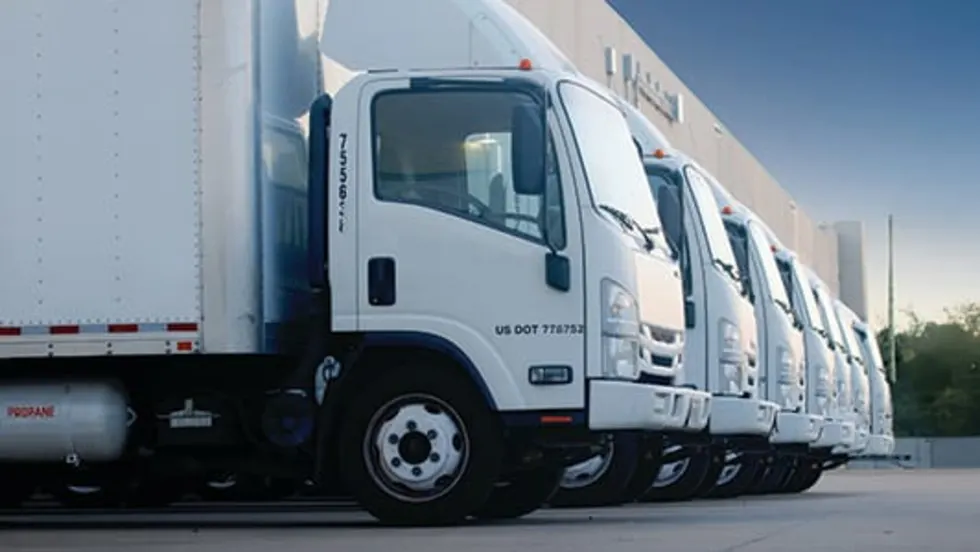
New Propane Autogas Program Offers Fleet Compensation
Qualified commercial fleets can receive $7,500 per eligible propane autogas vehicle and up to $10,000 for new refueling site prep. Learn how the program works and see whether your fleet qualifies.
Read More →
EV Charging Use Is Outpacing Infrastructure Growth
ChargePoint’s 2026 Charging Forward Report points to rising charger use, higher-powered charging, commercial vehicle electrification, and energy-management technology. Here’s what fleets should know.
Read More →
Merchants Fleet Reports 290M EV Miles as Fleets Navigate Changing Electrification Market
From millions in operating savings to hundreds of millions of EV miles, Merchants Fleet’s latest report reveals what’s working and what’s changing in fleet electrification.
Read More →
The EV Breakdown Nobody's Talking About: Why Most Electric Vehicle Roadside Calls Aren't Mechanical Failures
Here's why EV breakdowns are widely misunderstood.
Read More →
ChargePoint Now Available in Energy Pass
ChargePoint and additional planned charging network integrations were added to GM's Energy Pass.
Read More →

First Look: Slate Auto's Electric Fleet Pickup
Could an affordable, modular EV pickup make electrification more practical for fleets?
Read More →
Slate Debuts Colorful, Unique EV Models
A recent media and client event, studded with electric vehicles dressed up on platforms, planted a new position for the manufacturer in the wider EV market. Fleets will find cost-saving advantages.
Read More →
Slate Electric SUV, Pickup Switchable Model Aims For Light-Duty Fleets
Everything about this EV is counterintuitive and understated, making it stand out from the crowd.
Read More →
Inspiration Mobility Acquires Key Electrada Assets
Inspiration Mobility Group has acquired select assets of Electrada, adding the fleet electrification provider's team, technology, and charging infrastructure development capabilities to its energy management business.
Read More →