


At a glance:
72% of fleet operators face repair problems weekly or monthly
49% say lower costs would make them switch, but predictability is the real ask
35% spend over $250K annually on repairs
 MENU
MENU SEARCH
BBM research insights reveal that budget headaches might be less about costs than fleet pros think.
The real strain on fleet operations isn’t the repair bill—it’s the uncertainty that comes with it, from estimate to invoice.
Credit: Automotive Fleet
If you run fleet operations, you have probably said some version of this in a budget meeting: we need to reduce repair costs.
It is the right instinct. For 35% of operators in this survey, annual repair spend exceeds $250,000. When a vehicle sits idle waiting on a part, or an invoice comes in 40% above estimate, pushing for lower costs feels like the logical response.
But new research suggests that framing is solving the wrong problem.
Between December 2025 and January 2026, BBM Research completed 80 interviews with fleet managers, maintenance leaders, and operations executives at public and private fleets. These were people directly accountable for uptime, budget, and keeping vehicles on the road. What they said about costs was informative. What they actually needed was something different.
The survey asked respondents to name their top maintenance and repair headaches. Four themes surfaced consistently, regardless of fleet size or industry. You will probably recognize all of them.
Parts delays topped the list, named as a top headache by 44% and a top frustration by 50%. When a vehicle goes down, and the parts are not there, the clock keeps running. Unexpected repairs were close behind, cited by 36% as a recurring pain point.
Downtime followed. 35% cited long downtime as a top frustration. For fleets in last-mile delivery, utilities, HVAC, or transit, one vehicle down rarely stays isolated for long. It ripples through the whole operation.
Administrative burden was next: phone calls, emails, spreadsheets, multiple platforms, and no reliable view of where any given vehicle stands in the repair cycle. 16% cited paperwork as a top frustration; 13% cited poor communication.
Finally, cost predictability. Only 8% explicitly named changing estimates as a standalone frustration. That number looks low, but the real cost picture is more layered than any checkbox question can capture.
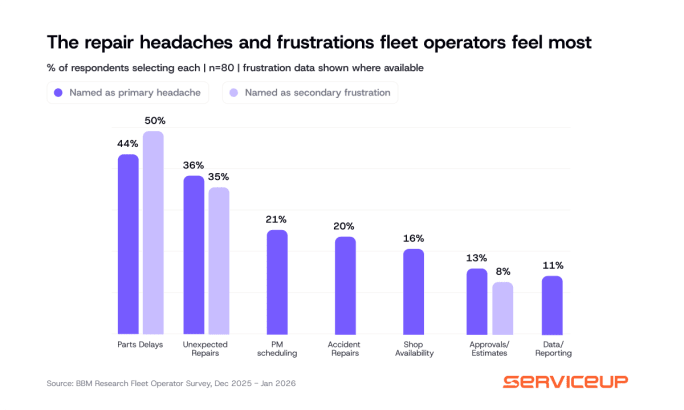
The biggest headaches aren’t surprising: parts delays and unexpected repairs lead a list of frustrations that keep fleets off the road.
Credit: ServiceUp / BBM Research
This is where the data gets interesting and probably reflects your own experience.
When asked what would make them switch providers, 49% said lower total costs. Nearly double the next answer, faster repairs at 30%. On the surface, that reads like a clear directive: find a cheaper option, and you have solved the problem.
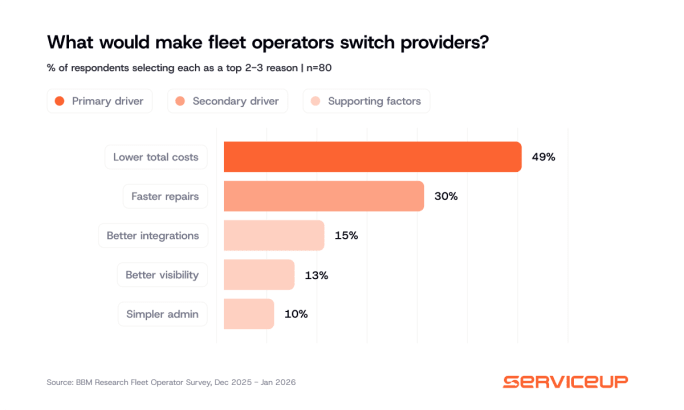
Operators say they want lower costs—but what really drives change is speed, visibility, and predictability.
Credit: ServiceUp / BBM Research
That’s the wrong read. When respondents described their biggest frustrations in their own words, the theme was not price. It was unpredictability. They wanted to know what they would pay before the repair started. They wanted the estimate to match the invoice. They wanted a maintenance budget they could defend in December, built in January.
That is not cost reduction. That is cost certainty. If you have ever had to explain a repair overage to your CFO, you already know they are not the same thing.
The operator who pays $3,200 for a repair quoted at $3,200 is satisfied, even if someone else could have done it for $2,900. The operator quoted $2,200 and invoiced $3,400, even though they technically paid less. The surprise is the problem. Predictability is the value.
What would make fleet operators switch providers?
Lower total costs: 49%
Faster repairs: 30%
Better integrations: 15%
Better visibility and updates: 13%
Simpler admin: 10%
You live in the operational friction every day. You know which shops go quiet for three days and which vendors never follow up. When it is time to justify a change, that conversation moves up the chain to finance, to your CFO or COO.
Your finance team does not care that Tuesday's repair was delayed to Friday. They care that Q2 had $40,000 in repair costs that were not in the forecast. They care about variance. They care about predictability.
If you go to leadership with 'we need to reduce repair costs,' you are starting a conversation that is hard to prove and easy to defer. If you go with 'we need to eliminate repair budget surprises,' you are starting a conversation that finance already cares about, with a clearer path to approval.
If you run your own shop, this still applies
Seventy-three percent of operators in the research handle repairs primarily through in-house shops. If that is you, you might assume most of this does not apply.
Look closer. Despite running their own operations, 72% of those operators still face repair headaches weekly or monthly. Parts delays hit in-house shops just as hard. Supply chain constraints do not care whether your shop is on-site. And capacity ceilings are just as real when you are in the shop, especially during the months when the queue backs up for two weeks.
The gap is not in your shop. It is in everything that the shop was never designed to handle.
How often do repair headaches come up?
Every week: 43%
Monthly: 29%
Every few months: 15%
Rarely: 5%
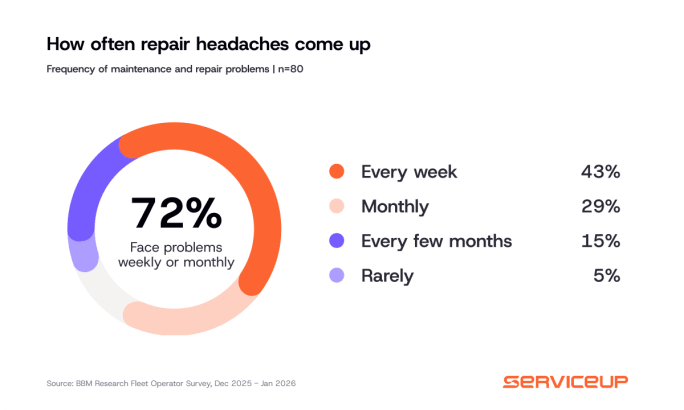
Repair issues aren’t occasional—they’re a steady drumbeat, with most fleet operators dealing with problems at least monthly.
Credit: ServiceUp / BBM Research
This research was commissioned by ServiceUp, a fleet repair management platform, in part to better understand what fleet operators actually need from their repair process. The clearest takeaway: cost savings are a promise. Cost predictability is a process.
Cost-savings asks you to trust a number that may take 12 months to appear in a spreadsheet. Cost predictability means estimates that hold, invoices that match approvals, and a maintenance budget you can still defend six months later.
15% of survey respondents requested a follow-up conversation with the research team. For senior decision-makers in a phone or online survey, that is a notable signal. A meaningful share of fleet operators knows the current approach is not working well enough.
If that sounds familiar, the data points to a clear shift in what questions to ask. Not 'how much will this cost?' but 'how much certainty will this give me?' Ask how estimates are standardized. Ask what happens when a repair runs over. Ask for real numbers on budget-variance reductions from actual customers, not just cost-savings claims. Ask whether the solution works alongside your in-house shop or tries to replace it.
That is the question the data is pointing to. Not enough of the industry is answering it directly.
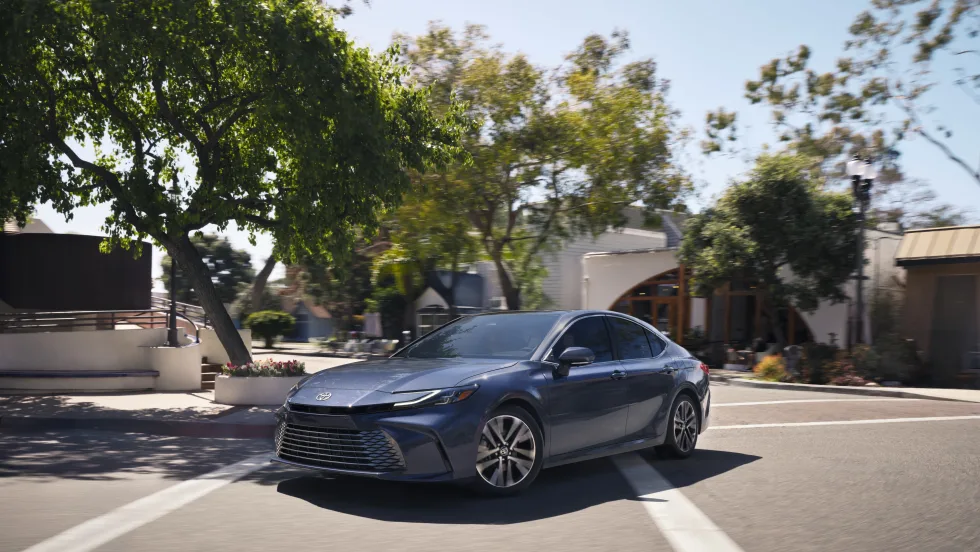
The 2027 Toyota Camry is a carryover with new pricing.
Read More →
Chevrolet is updating two of its smallest SUVs with added driver-assistance technology, redesigned interiors, and revised trim options. The changes could add more safety equipment as standard for commercial fleets, while a new Trailblazer configuration adds another all-wheel-drive option.
Read More →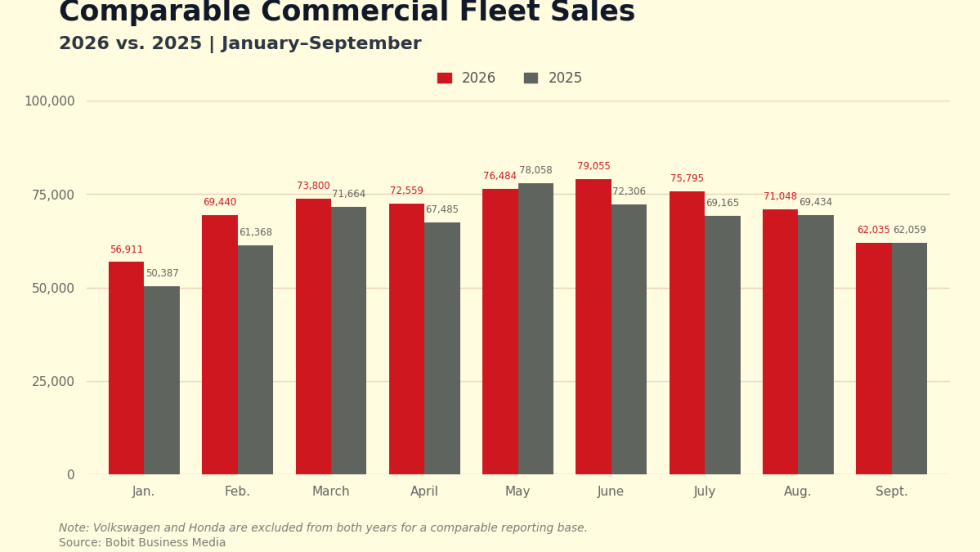
September commercial fleet sales were essentially unchanged from a year earlier, slowing year-to-date growth while keeping volume ahead of 2025.
Read More →
The longtime Mondelēz International fleet executive joins the Automotive Fleet Hall of Fame.
Read More →
After more than four decades at Boehringer Ingelheim, Lee Miller leaves a legacy built on fleet expertise.
Read More →
From managing fleets of thousands of vehicles to advancing safety and mentoring fellow professionals, Mark F. Petersen made his mark across both the corporate and supplier sides of fleet.
Read More →
As EV deployments move beyond pilot programs, charger reliability can directly affect vehicle readiness, driver productivity and route scheduling.
Read More →
The new Rogue Hybrid uses Nissan’s e-POWER system with dual electric motors, offers an estimated 40 mpg and starts at $35,490.
Read More →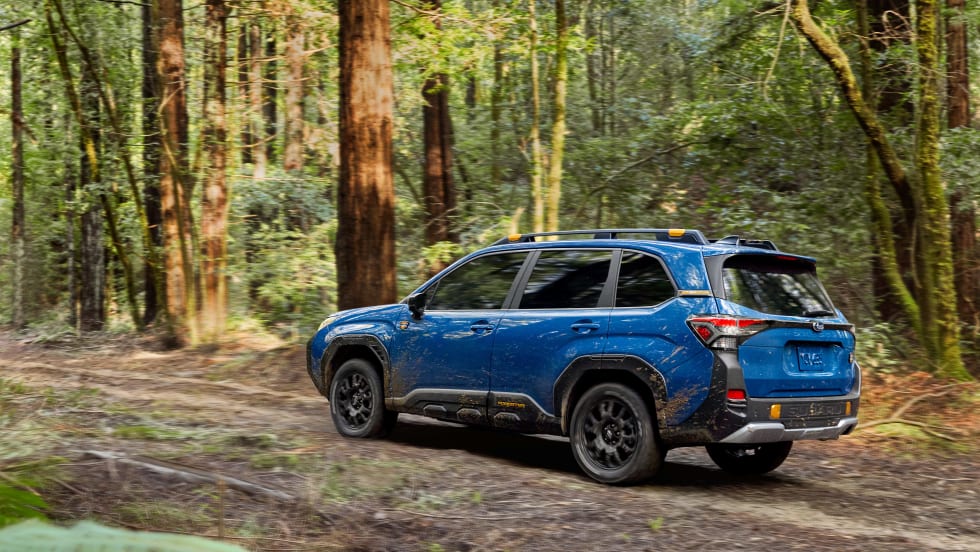
The 2027 Forester lineup starts at $29,995 and adds a Wilderness Hybrid with 194 combined horsepower and 9.3 inches of ground clearance.
Read More →
The former Prologis Mobility and Shell executive will help expand EV Realty’s truck charging business and move its power-first infrastructure model into autonomous vehicle depots and other fleet sectors.
Read More →