




The Future of Fuel Cells in Fleet
Hydrogen fuel cell electric vehicles will eventually be coming down the pipeline; however, while necessary infrastructure is still a way off, some fleets may be able to utilize these units soon.

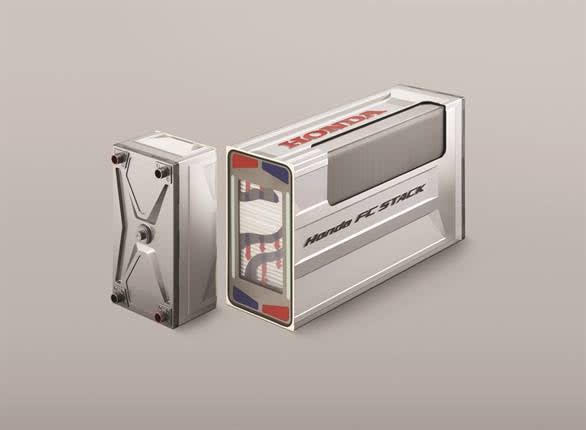
The Honda FCX Clarity utilizes a fuel cell similar to the illustration pictured above.
What if fleets could operate electric vehicles without the typical range anxiety and long wait to recharge the battery? What if it took less than five minutes to refuel these vehicles to achieve about 400 miles between fill-ups — comparable to gasoline- and diesel-powered vehicles — and produced zero emissions?
That’s the promise of hydrogen fuel cell electric vehicles (FCEVs). These vehicles use electric motors, but, instead of relying on battery power they generate electricity through a chemical reaction between refillable hydrogen fuel and oxygen within a fuel cell, emitting only water vapor.
And, a lot has happened in the past year that could position the hydrogen FCEV as a viable alternative-fuel option for fleets to consider within the next decade.
In January 2013, Daimler AG, Ford Motor Company, and Nissan Motor Co. signed an agreement to jointly develop a common FCEV system to reduce engineering costs and achieve economies of scale to roll-out an affordable, mass-market FCEV as early as 2017.
In July 2013, General Motors and Honda announced a long-term agreement to co-develop next-generation fuel cell system and hydrogen storage technologies for the 2020 time frame, lowering production costs through shared expertise, increased volume, and common sourcing strategies.
Then, at the Consumer Electronics Show (CES) 2014, the world’s largest trade show, Toyota unveiled its hydrogen-powered mid-size sedan FCV concept, expected to become a production vehicle in 2015, that offers a range of about 300 miles, zero-to-60 acceleration of about 10 seconds, with no emissions, other than water vapor. Refueling of the hydrogen tanks takes three to five minutes.
According to Reuters, Toyota said that it had cut the cost of its hydrogen fuel system by nearly $1 million per vehicle model, as the company prepares to launch the FCV with a price tag around $50,000.
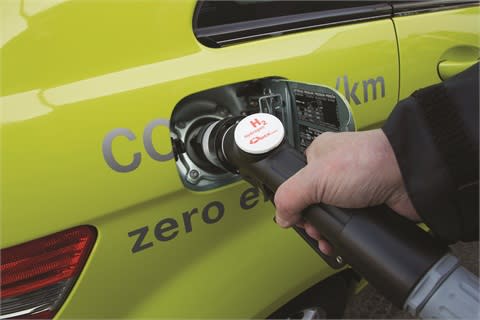
The Mercedes-Benz F-CELL is fueled with hydrogen with a fuel pump, very similar to how a gasoline-powered vehicle is fueled.
That’s a significant pricing breakthrough that seems to parallel the cost reductions outlined in the U.S. Department of Energy’s (DOE) latest “Fuel Cell Technologies Market Report,” which noted that fuel cell costs have declined by more than 80 percent since 2002 — from $275 per kilowatt (kW) to $47 per kW in 2012, not far from the agency’s target of $30 per kW by 2017, which would make FCEVs more appealing for mass-market production.
And, with fuel-cell technology costs plummeting, the FCEV market is poised for accelerated expansion. According to Navigant Research, worldwide sales of FCEVs will reach the 1,000 mark in 2015 and then begin a period of strong growth, surpassing two million vehicles annually by 2030.
The Infrastructure Challenge
But, driving down production cost is only one part of the equation; there must also be sufficient access to hydrogen refueling stations to support FCEV growth.
“If the infrastructure is in place — which is a big ‘if’ — then I would say you could actually see a pretty significant ramp-up of demand into the tens of thousands of [fuel cell] vehicles per year,” said Lisa Jerram, senior research analyst for Navigant Research. “Europe is planning a major rollout for infrastructure and so is California. But, it’s really a balancing act of matching your investment in infrastructure with actual demand. And, it’s definitely a slow process right now because there’s not much in terms of public access stations since there aren’t enough cars to support them.”
As of press time, there are only 10 public access hydrogen refueling stations in the U.S. — nine in California and one in South Carolina — according to the DOE’s Alternative Fuels Data Center. Compare that number with the 6,686 public access recharging stations for plug-in electric vehicles and 618 refueling stations for compressed natural gas (CNG) vehicles, and it’s obvious the infrastructure has a long way to go.
However, Bud DeFlaviis, director of government affairs for the Fuel Cell and Hydrogen Energy Association (FCHEA), estimates the total number of hydrogen refueling stations — public and private for use by large fleets for centralized fueling — at around 200 stations.
What kind of growth is expected in hydrogen refueling stations over the next few years to help support greater demand in FCEVs?
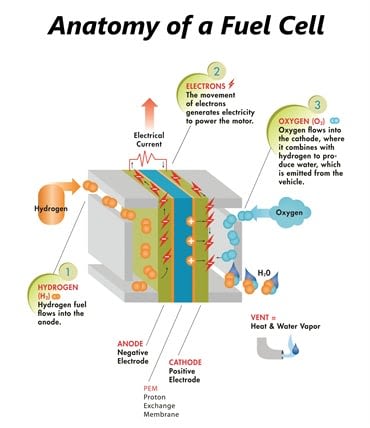
The illustration above shows the anatomy ofa fuel cell system. Beginning with hydrogen, electrons and oxygen work together to emit only heat and water vapor.
“Future station deployment in California will be based on plans developed by the membership of the California Fuel Cell Partnership,” DeFlaviis said. “The partnership’s report recommends 68 stations to launch the commercial market in California by the start of 2016, and 100 stations to sustain it. At that point, stakeholders believe further investment will come from the private sector and public cost-share funding will no longer be required. When the state realizes 100 stations, the fueling network will have the ability to support up to 50,000 vehicles. Beyond California, the H2USA public/private partnership is beginning to develop deployment scenarios for other parts of the country.”
DeFlaviis noted that it’s hard to speculate about the rest of the country.
“Continual deployment depends on how quickly jurisdictions remove barriers to entry and offer incentives to encourage greater hydrogen infrastructure. Of course, demand pressure from consumers will also speed greater adoption,” he said.
Introduce Fuel Cells to Fleet
What does the future look like for fuel-cell vehicles in fleet? What types of fleets will likely be the early adopters?
“I think it’s fair to expect FCEV fleets to be more heavily concentrated where a commitment to infrastructure is strong and/or zero emissions vehicle (ZEV) mandates are in place. States such as California, Connecticut, South Carolina, New York, Michigan, and Ohio have demonstrated this commitment, with others to hopefully follow suit,” DeFlaviis said. “Also, I think once we absorb some ‘lessons learned’ from Japan, Korea, and Germany, more jurisdictions and municipalities will start to take a look on how fuel cell buses and other FCEVs can be integrated into their overall vehicle fleets.”
According to Jerram of Navigant Research, “Fleets that are looking to counter high fuel costs, that’s where fuel cells are going to be more accepted — especially if there’s sufficient infrastructure. The battery vehicle is not likely to fully meet their need because of range issues and size issues, which the fuel cell technology helps solve. California is one of the places that will serve as a proving ground to test the value of fuel-cell vehicles — and help fleets assess whether there’s a business case to make the investment.”
More Green Fleet
New Propane Autogas Program Offers Fleet Compensation
Qualified commercial fleets can receive $7,500 per eligible propane autogas vehicle and up to $10,000 for new refueling site prep. Learn how the program works and see whether your fleet qualifies.
Read More →
EV Charging Use Is Outpacing Infrastructure Growth
ChargePoint’s 2026 Charging Forward Report points to rising charger use, higher-powered charging, commercial vehicle electrification, and energy-management technology. Here’s what fleets should know.
Read More →
Merchants Fleet Reports 290M EV Miles as Fleets Navigate Changing Electrification Market
From millions in operating savings to hundreds of millions of EV miles, Merchants Fleet’s latest report reveals what’s working and what’s changing in fleet electrification.
Read More →
The EV Breakdown Nobody's Talking About: Why Most Electric Vehicle Roadside Calls Aren't Mechanical Failures
Here's why EV breakdowns are widely misunderstood.
Read More →
ChargePoint Now Available in Energy Pass
ChargePoint and additional planned charging network integrations were added to GM's Energy Pass.
Read More →

First Look: Slate Auto's Electric Fleet Pickup
Could an affordable, modular EV pickup make electrification more practical for fleets?
Read More →
Slate Debuts Colorful, Unique EV Models
A recent media and client event, studded with electric vehicles dressed up on platforms, planted a new position for the manufacturer in the wider EV market. Fleets will find cost-saving advantages.
Read More →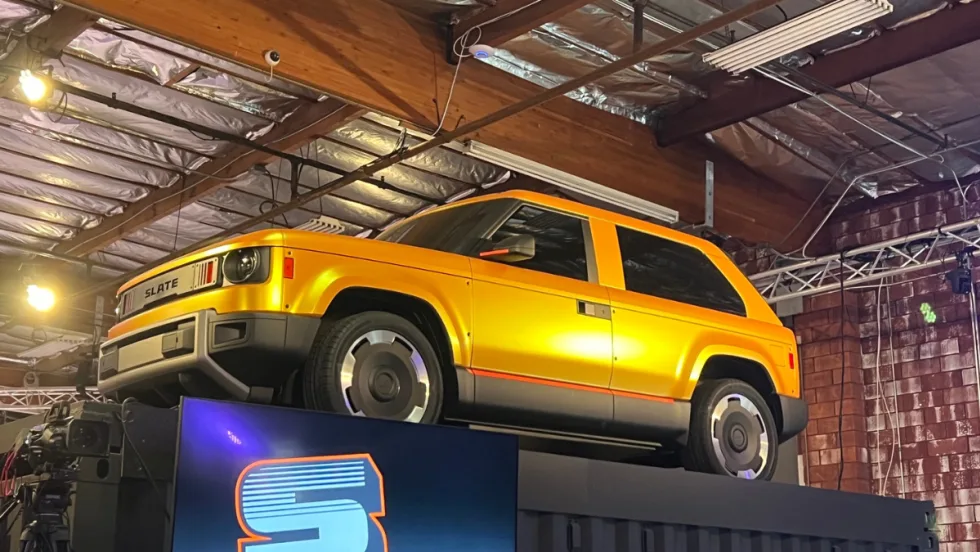
Slate Electric SUV, Pickup Switchable Model Aims For Light-Duty Fleets
Everything about this EV is counterintuitive and understated, making it stand out from the crowd.
Read More →
Inspiration Mobility Acquires Key Electrada Assets
Inspiration Mobility Group has acquired select assets of Electrada, adding the fleet electrification provider's team, technology, and charging infrastructure development capabilities to its energy management business.
Read More →