When considering an alternative-fuel vehicle option, such as natural gas,
there may be some additional up-front costs; however, overall lifecycle costs
are proving the decision to be a sound option.
by Rob Minton
August 11, 2015
5 min to read
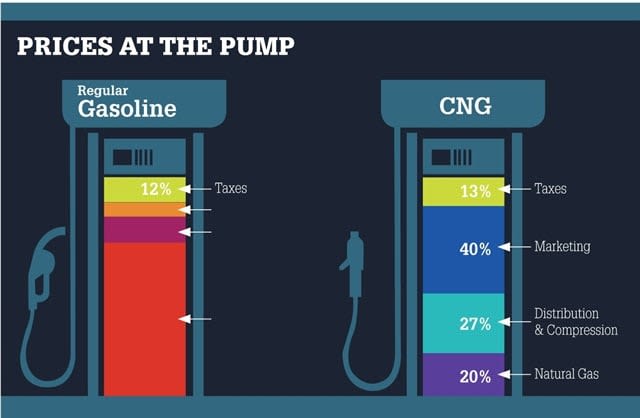
Overall, compressed natural gas prices are not subject to as much fluctuation due to the breakdown of its pricing. Source: VNG Co.
Displacing petroleum imports with natural gas not only keeps dollars in the U.S., but also lowers the transportation costs for U.S. businesses, making them more competitive and allowing them to expand their businesses.
Ad Loading...
Despite the recent reduction in gasoline prices, natural gas vehicles (NGVs) remain a good vehicle choice for fleets. NGVs enjoy significant economic advantages over comparable diesel and gasoline vehicles.
Ad Loading...
Natural gas prices, while historically volatile, have become a bit more predictable since the shale gas revolution took hold. These prices are expected to remain relatively stable for years to come, while oil prices constantly go up and down.
The U.S. Energy Information Administration projects that natural gas will cost $1 to $2 less than diesel and gasoline for many years to come. And, for fleet managers, natural gas vehicles can act as a hedge against rising oil prices. With some of their vehicles using natural gas and others diesel, companies can diversify their fuel risk.
Fleets converting to natural gas will be able to lock in these lower costs for years because the price outlook for natural gas is stable.
Considering the Economics
Many fleets use a total cost of ownership (TCO) analysis to make vehicle selection decisions once other criteria, such as application requirements and vehicle option content decisions, have been considered.
When reviewing the economics supporting selection of NGVs, consider:
Ad Loading...
Higher Acquisition Costs: To convert a gasoline-powered vehicle to a compressed natural gas (CNG) bi-fuel vehicle, the gaseous prep option should be chosen. Note that, since CNG burns hotter than gas, hardened seals and valves are required to prevent fuel system failures. The cost of the gaseous prep option is minimal — generally less than $300 — and the cost to convert the vehicle to a bi-fuel pickup will generally run around $8,750. State and local incentives in the form of grants or rebates do exist that can offset the incremental cost of the conversion. Volume incentives are another way to reduce this cost.
Reduced Spending on Fuel: Due to the lower price point and stability of CNG, the cost to fuel a CNG vehicle is typically substantially lower than a gasoline or diesel truck.
At A Glance When considering adding natural gas vehicles to your fleet, or converting existing models, several economic factors should be considered:
Higher acquisition costs.
Reduced fuel expenses.
Similar maintenance spend.
Overall depreciation costs.
Leasing costs.
Potentially higher TCO due to varied fuel prices.
For example, in 2014, gasoline averaged $3.36 per gallon while CNG was $2.16. For a typical, ¾-ton pickup truck that achieves 12 mpg and utilizes CNG 80 percent of the time, the savings would be $8,000 over a five-year or 100,000-mile lifecycle, or $1,600 per year.
While average gasoline prices have been lower in recent months and are expected to remain low throughout 2015, the general consensus is that fuel prices will increase again due to increased global demand for energy.
Increasing the CNG utilization of a bi-fuel vehicle is one way to increase the ROI. One way to do so is to incent drivers, which can lead to improved utilization over time. One best practice utilized by fleets that have already made the switch to natural gas is publishing utilization rates. This creates competition among drivers and can also establish new habits to seek out CNG stations for vehicle refueling.
Another consideration is that CNG station coverage, while improving, is still relatively low, so getting proper utilization rates is partially dependent upon the market station coverage. Analyzing markets and determining which fleet vehicles operate in areas where CNG stations are available is an important factor to consider when choosing which fleet vehicles to convert to CNG.
Ad Loading...
Similar Maintenance Spend: CNG vehicles are gasoline vehicles with added components to store and feed CNG to the engine. Long-term maintenance costs can actually be lower, due to the fact that CNG is a cleaner-burning fuel and generates less wear-and-tear on some engine components (assuming the gaseous prep option is chosen).
Effective Depreciation Costs: Depreciation is a function of what the vehicle initially cost and what it sold for at the end of the lifecycle. Since a CNG vehicle initially costs more than a gasoline-powered version, the question is, what is the value at the end of life? Due to the scarcity of data on CNG bi-fuel pick-up sales, it’s difficult to say with certainty what the incremental value is of the conversion at auction. Resale data from fleet management company Donlen indicates the conversion maintains the same residual percentage as the truck itself when sold in markets where CNG stations are relatively plentiful. (For the purposes of this analysis, it is assumed that a vehicle would be moved to a market where CNG vehicles are valued, such as Oklahoma or Texas, and includes an estimate for the cost of the vehicle transport.)
Leasing Costs: Due to the higher initial acquisition cost, the financing cost of leasing a bi-fuel pickup truck is generally marginally higher as well.
TCO Conclusions
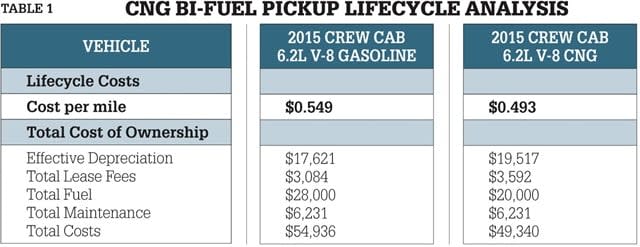
Putting all those costs together in a TCO analysis (see Table 1), the CNG bi-fuel vehicle costs $41,183 while the gasoline-powered vehicle cost $46,569. This is a savings of $5,386 over the five-year/100,000-mile lifecycle, or 5.6 cents per mile.
In the example shown, a 2015 6.2L V-8 gasoline-powered truck is compared with one that has been converted to a bi-fuel gas/CNG vehicle. The various cost components of the two comparably equipped vehicles are examined. Note: A state incentive of 50 percent of the cost of the conversion was applied, such as is available through the Pennsylvania Alternative Fuels Incentive Grant (AFIG) Program. Source: Donlen.
Additionally, looking at the timing of the cash flows comparing the CNG bi-fuel vehicle to the gas engine, the CNG option is cash-flow positive in every year of the five-year/100,000-mile lifecycle.
If, however, you think that the residual value of the vehicle is uncertain, another way to look at the data is to do a simple payback analysis.
Again, using an 80-percent CNG utilization assumption, it would take 2.9 years to pay back the cost of the conversion, lowering fleet operating costs in years four and five of the vehicle’s lifecycle.
Ad Loading...
And, if, like many fleets today, the vehicle is not cycled out at five years (whether due to uncertain resale value of the bi-fuel vehicle or because trucks are run longer than 100,000 miles), the savings would be increased as additional years progress.
Other factors fleet managers need to consider when determining a return on investment include insurance rates as well as payload changes based on additional weight from fuel tanks.
The positive economics of NGVs are here to stay. Independent studies now show NGVs capturing significant market share of both the light- and heavy-duty vehicle markets. The National Petroleum Council (NPC), under an “aggressive” scenario, predicts NGVs will capture 50 percent of the light-duty market, upwards of 35 percent of the Class 3-6 truck market, and almost 50 percent of the Class 7-8 truck market by 2050.
Rob Minton is director of sales for VNG, which is a national fueling facility program for natural gas vehicles.
From millions in operating savings to hundreds of millions of EV miles, Merchants Fleet’s latest report reveals what’s working and what’s changing in fleet electrification.
A recent media and client event, studded with electric vehicles dressed up on platforms, planted a new position for the manufacturer in the wider EV market. Fleets will find cost-saving advantages.
Inspiration Mobility Group has acquired select assets of Electrada, adding the fleet electrification provider's team, technology, and charging infrastructure development capabilities to its energy management business.
Fleet leaders have more data than ever, but turning that data into clear, actionable decisions remains a challenge. This white paper shows how leading organizations are using connected vehicle data to improve safety, reduce costs, and optimize fleet performance. Learn how to turn insight into action across your fleet.
Bobit Business Media surveyed 190 fleet professionals and found that while most fleets are tracking costs, fragmented systems and data gaps are keeping true TCO visibility out of reach. With rising pressure to control spend in an increasingly volatile environment, the gap between what fleets think they know and what the data actually shows is wider than you might expect. See how your peers are managing costs today and where the industry still has room to improve.