




Related Photos: Assembling Ford's Transit Van
The Complex Efficiency of Assembling Ford's Transit Van
Ford offers 58 configurations of its full-size van, and produces them all on one line at its Kansas City Assembly Plant.

Paul Clinton・Former Senior Web Editor
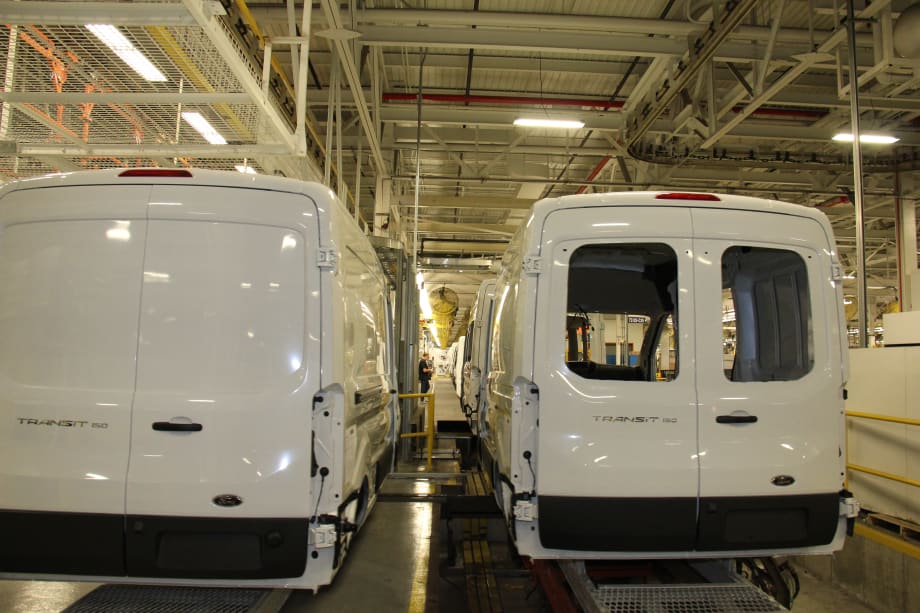
Photo by Paul Clinton.
4 min to read
Photo by Paul Clinton.
Ford offers its full-size Transit van in 58 configurations that would seem to thwart an efficient assembly process with its mix of wheelbases (three), body lengths (five), roof heights (three) and engines (three).
However, to watch the various configurations move toward completion on a single assembly line at the Kansas City Assembly Plant (KCAP) is to behold what may be the most complex vehicle assembly of a light-duty vehicle sold in the U.S.
The 58 configurations provide a starting point to the customization available. There are nearly 2,000 variations of Transit built at KCAP — only the hood and left- and right-hand fenders appear on all variants. There are more than 3,500 different end-item parts that can go into a Transit, including 12 doors and more than 100 pieces of glass.
"Transit offers the most configurations of any vehicle in its class," said Raj Sarkar, general marketing manager for Ford North America Fleet, Lease, and Remarketing. "We have the right product for each customer and their individual needs, and we have the manufacturing capability to build all of those Transit variations with quality at KCAP."
How all the parts converge with impressive precision on the assembly line demonstrates just how far Ford has evolved its founder's initial three principles to automate vehicle assembly with heavy machinery, work stations, and minimal movement of parts.
Ford builds Transits at the plant using two shifts, including cargo vans, passenger wagons, chassis cabs, and cutaways. In 2014 — the first year of production that began April 30 — Ford built 42,951 Transits. Every Transit sold in North America is built at KCAP. The plant is also one of two U.S. factories to build the F-150, producing nearly 325,000 of the best-selling vehicle in 2014. The plant is now building almost two F-150s for every Transit.
"We are very proud to build both America's best-selling truck and best-selling van right here at KCAP," said Tim Young, the plant's manager.
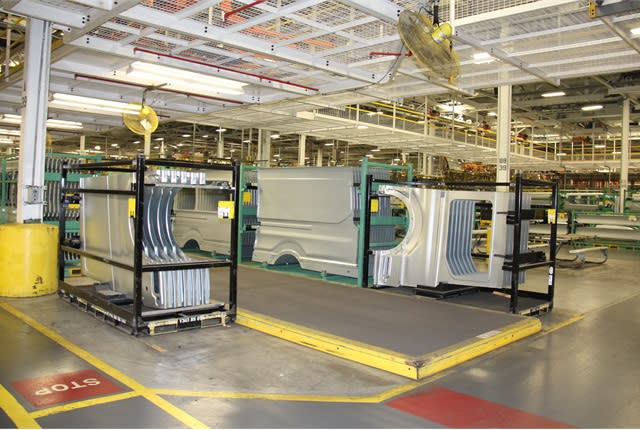
Photo by Paul Clinton.
KCAP is Ford's largest manufacturing facility in the world, covering 5.5 million square feet on 1,269 acres. The company significantly upgraded the plant in 2011 to support production of Transit and increased demand for the new F-150 with a $1.1 billion investment that included a 437,000-square-foot stamping facility that opened in 2012 and a 78,000-square-foot paint shop. The paint shop expansion included installation of the three-wet paint and two-wet monocoat processes, which are more environmentally friendly and don't compromise paint quality and durability.
The plant builds Transits in a customer-order-driven sequence known as a "natural blend order" that incorporates the just-in-time parts arrival process. Parts come into the factory and reach the workstations along the line in a way that minimizes the amount of parts storage required on the plant floor. Because parts reach the line just when they're needed, workers can build a multitude of versions of the van on a single line. This process is also called "bull's-eye sourcing" at the plant.
"That allows us to handle the complexity," Young said. "It gives us a tremendous amount of flexibility."
Each workstation has what's known as an AIS box that's named for its vendor, American Industrial Systems, Inc. The box displays a list of parts that need to be added to the van at that step in the process and a sequence of how the parts are added. The vehicle and parts information sent to the box is known as "the broadcast."
In addition to providing instructions for workers, the AIS box and broadcast allow plant managers to track each job and monitor vehicle build quality.
At the start of each job, each van is assigned a Vehicle Identification Number (VIN) that stays with the vehicle build and parts assigned to that job.
In addition to new vans, the plant also produces replacement parts for Ford's service network that are sent to dealers to stock their parts inventory.
The plant runs two shifts for Transit of eight to 10 hours a day, five or six days a week based on demand.
"In the end, it's all about giving customers what they want," Young said. "Transit offers incredible utility to our customers, and we've been able to put flexible manufacturing processes in place that let us build the utility into Transit that our customers demand and need. We can build the Transit configuration with the utility that they're looking for at any moment of any day."
Subscribe to Our Newsletter
More Operations

Here's When You Should Make an Exception to Fleet Policy
Fleet policies are designed to create consistency, but not every driver or situation fits neatly within standard rules.
Read More →
AI-Native or AI-Acquired: What Should Fleet Managers Look for in an AI Platform?
Six questions can help fleet managers look beyond AI marketing claims to evaluate integration, data access, and real-world operational performance.
Read More →
Sponsored•October 14, 2026
A buyer's guide to fleet management software in 2027
Buying fleet management software in 2027 means looking beyond features and price. As fleet operations, technology and expectations evolve, this guide explores what today’s fleet professionals should consider when choosing a system that can deliver value now and adapt to what comes next.
Read More →

What Will Shape the Next Era of Fleet Management?
EVs, AI, and autonomous vehicles are reshaping fleet management. Discover what’s ahead—and how fleet leaders can prepare for the next era.
Read More →
How Fleets Can Recruit and Train Veterans for Technician Roles
Here's how the technician shortage has affected uptime for fleets, and what to do about it.
Read More →
Avis Budget Group Deploys Neology Toll Management Technology Across Major Brands
Neology’s neoFleet platform will manage toll transactions and toll-authority operations for vehicles across Avis, Budget, Payless, Budget Truck and Zipcar.
Read More →
Fleet Personal-Use Charges Edge Higher in 2026
Nearly eight in 10 surveyed fleets allow personal use of company vehicles, while just over half of respondents report charging employees for the privilege.
Read More →
The Future of Fleet + What’s Changing Right Now | AF News Recap
Could developments overseas offer a preview of what’s coming for U.S. fleets? This week, we’re looking at the future of AI, autonomy, and electrification, plus Ford Pro’s new certified pre-owned program, smarter vehicle offboarding, and a new way for fleets to manage toll expenses.
Read More →
How to Handle Vehicle Offboarding
What do fleet managers need to do when a driver leaves?
Read More →
Sponsored•October 1, 2026
Fleet Manager’s Ultimate Playbook: Navigating the New Standard in OEM Connectivity
Rising operating costs, driver safety concerns, and unplanned downtime are putting unprecedented pressure on modern fleets. Discover how fleet managers use embedded OEM connectivity and real-time vehicle data to cut TCO, prevent downtime, and protect drivers without aftermarket telematics hardware.
Read More →