





The last of a dying breed of compact vans is discontinued. Where does that leave fleets?
The Compact Van Strikes Back
After a four-year “resting period,” the compact van is back, alive and well, and offering even more options than ever.
November 8, 2013
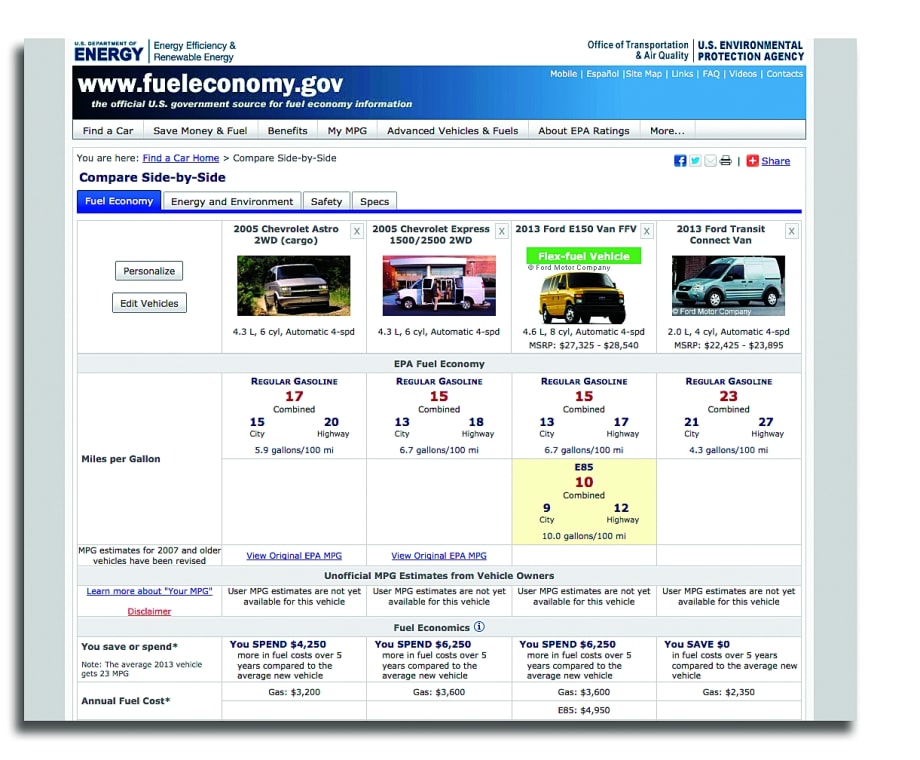
Today’s compact vans, such as the 2013 Transit Connect, has a nearly 30-percent fuel economy advantage over full-size vans from 2005. The reduced price tag is also making the compact van an attractive alternative to full-size vans and trucks.
Source: U.S. EPA
6 min to read
In 2005, when General Motors ceased production of the Chevrolet Astro/GMC Safari vans, it seemed the compact van segment was left for dead.
But, today, with new compact cargo van offerings from Ford (Transit Connect) and Nissan (NV200), and more to come from GM and Ram in the next 18 months, small vans are roaring back to prominence among fleets looking to reduce fuel spend and total cost of ownership with lighter-duty applications.
The Precipitous Decline
To understand the historical context in which yesterday’s compact vans (which included the Ford Aerostar, Chevrolet Astro, and GMC Safari) came to such an abrupt end.
Compact van sales fell off the cliff as the segment peaked in 1993 with 362,769 units. Within two years, sales had dropped by more than 100,000 units to 247,142. Three years later, in 1998, sales fell by another 120,000 units to 127,958. By 2005, the last generation of small vans rolled off the assembly line, marking the end of an era until Ford resurrected the segment with its introduction of Transit Connect to the U.S. market in 2009.
Some of the decline could be attributed to the rise of the SUV and minivan in the mid- to late-1990s, which presented a viable alternative to the compact passenger van for consumers. The factor that likely killed the segment altogether by 2005 was the small difference between compact vans and full-size counterparts, especially in terms of fuel economy and price.
“Compact vans of yesterday were too similar to the full-size van in efficiency — and they were still very heavy vans. There wasn’t a tremendous difference between them,” said Jeremy Acevedo, supervisor, pricing and industry analysis for Edmunds.com.
The numbers tell the story.
Take, for example, the fuel economy ratings of the Chevrolet Astro and the full-size Chevrolet Express 1500 van. Both 2005 models were equipped with the 4.3L V-6 gasoline engine. According to www.fueleconomy.gov, there’s only a 2 mpg advantage for the Astro; 17 mpg combined city/highway vs. 15 mpg combined for the Express. Yet, the price was actually slightly higher for the smaller van, with an original MSRP for the Astro of $22,930, compared to $22,860 for the Express, according to www.Autotrader.com. This offered little incentive for buyers to “go small.”
“Aside from meeting job requirements, the economics of a product offering must work for the fleet buyer in order to generate sales,” explained Sarah Mallonga, project manager, strategic consulting for PHH Arval. “Otherwise, market demand for the product would decline, affecting the product’s profitability. In turn, the motor company would be forced to change the product’s price structure, reengineer the product, or discontinue it altogether. At that time, the fleet buyer found the economics of the small cargo vans to be less favorable than the full-size vans and other vehicle offerings that met their job requirements.”
Bringing Back a Lost Segment
That is, until Ford resuscitated the segment in 2009, when the automaker brought its global platform Transit Connect to the U.S. market. That year, Ford sold a modest 8,834 units. In 2010, Transit Connect sales tripled to 27,405 units and the numbers have trended steadily upward since.
Ford’s “proof-of-concept” that small vans can actually sell in the U.S. has drawn other automakers into the fray, with Nissan rolling out its NV200 this year and announcing a joint venture with GM to offer a Chevrolet-badged NV200, branded the City Express, in 2015. Ram recently announced plans to bring its Fiat Doblo-based cargo van to the U.S. by the end of 2015, and Mercedes-Benz is taking a wait-and-see approach as to whether it will enter the market with its Citan, a smaller van alternative to the full-size Sprinter.
“There seems to be a big difference between yesterday’s compact vans and the new crop — in terms of fuel efficiency. And, with the extended rooflines, the size is just right,” Acevedo said.
Fuel economy has definitely improved with the new generation of compact vans. The 2013 Transit Connect offers 21 mpg city/27 mpg highway and 23 mpg combined, which translates into a nearly 30-percent fuel economy advantage over the 2005 Chevrolet Astro. That’s with the 2013 version; the redesigned 2014 Transit Connect, which will arrive at dealers in late 2013, is expected to achieve up to 30 mpg on the highway with its 1.6L EcoBoost engine.
Also, there’s a substantially wider fuel economy gap between the compact and full-size vans of today, which didn’t exist a decade ago. Finally, today’s smaller vans have a smaller price tag than their full-size counterparts, with a starting MSRP for the 2015 Ford Transit at $22,425 compared to $27,325 for the full-size 2013 Ford E-150, according to www.autotrader.com.
“The new crop of small vans is such a novel concept because you have a utility type vehicle that’s also very fuel efficient. So, it works for a lot of businesses and consumers. And, the price point is there too,” Acevedo said.
The smaller size of the vans also make them more suitable in urban applications, where they need to safely navigate tight spaces and low ceiling heights of parking garages, said Matt Lichtenstein, manager of operations, upfitting for LeasePlan USA.
Sharon Knatz, senior consultant, new vehicle acquisitions for PHH Arval, said that the fleet management company has clients who use both compact and full-size vans, depending on the application. “It’s not one-vehicle-does-everything anymore. You need the right van for the job, but prior to 2009, our clients didn’t have a choice; they had to buy a full-size van,” she said.
The smaller van option for the appropriate application can be a cost-saver for fleets. “When we look at the data from our clients, the cost per mile on the compact van is lower than the full-size van,” said Mallonga with PHH Arval. “It’s not one-vehicle-does-everything anymore. You need the right van for the job, and some of our clients didn’t have a choice; they had to buy a full-size van,” she said.
Has the decline of compact pickup sales (with the exit of Ford Ranger and GM’s Colorado/Canyon from the U.S. market) contributed to the increased demand for compact vans?
“Absolutely. It provides a viable alternative to the compact pickup in terms of the functionality it provides,” said Acevedo with Edmunds.com.
Lichtenstein with LeasePlan USA agreed. “The discontinuation of a domestic mid-sized truck has pushed fleet customers to either move up into a full-size truck or take a better look at compact vans the OEMs are offering,” he said.
Another growth driver of today’s compact van market is the trend toward more global vehicle platforms. “I think we’ve passed the day where vehicles can exist in single markets. Bringing these vehicles that have a track record of success in other markets to the U.S. markets seems to be a fruitful venture. For OEMs, fiscally, it’s just a responsible move,” Acevedo said.
Subscribe to Our Newsletter
More Operations

Sponsored•October 14, 2026
A buyer's guide to fleet management software in 2027
Buying fleet management software in 2027 means looking beyond features and price. As fleet operations, technology and expectations evolve, this guide explores what today’s fleet professionals should consider when choosing a system that can deliver value now and adapt to what comes next.
Read More →
What Will Shape the Next Era of Fleet Management?
EVs, AI, and autonomous vehicles are reshaping fleet management. Discover what’s ahead—and how fleet leaders can prepare for the next era.
Read More →
How Fleets Can Recruit and Train Veterans for Technician Roles
Here's how the technician shortage has affected uptime for fleets, and what to do about it.
Read More →

Avis Budget Group Deploys Neology Toll Management Technology Across Major Brands
Neology’s neoFleet platform will manage toll transactions and toll-authority operations for vehicles across Avis, Budget, Payless, Budget Truck and Zipcar.
Read More →
Fleet Personal-Use Charges Edge Higher in 2026
Nearly eight in 10 surveyed fleets allow personal use of company vehicles, while just over half of respondents report charging employees for the privilege.
Read More →
The Future of Fleet + What’s Changing Right Now | AF News Recap
Could developments overseas offer a preview of what’s coming for U.S. fleets? This week, we’re looking at the future of AI, autonomy, and electrification, plus Ford Pro’s new certified pre-owned program, smarter vehicle offboarding, and a new way for fleets to manage toll expenses.
Read More →
How to Handle Vehicle Offboarding
What do fleet managers need to do when a driver leaves?
Read More →
Sponsored•October 1, 2026
Fleet Manager’s Ultimate Playbook: Navigating the New Standard in OEM Connectivity
Rising operating costs, driver safety concerns, and unplanned downtime are putting unprecedented pressure on modern fleets. Discover how fleet managers use embedded OEM connectivity and real-time vehicle data to cut TCO, prevent downtime, and protect drivers without aftermarket telematics hardware.
Read More →
U.S. Bank Adds Verra Mobility Toll Management to Voyager Fleet Platform
The integration allows U.S. Bank Voyager fleet customers to manage toll payments and violations alongside fuel, EV charging and maintenance expenses.
Read More →
ADAS Prevents Crashes. But Repairs Cost More | AF News Recap
ADAS-equipped vehicles may crash less often, but they can cost more when they do. This week, we’re breaking down what that tradeoff means for fleets, plus Subaru’s first Forester Wilderness Hybrid, Nissan’s new e-POWER Rogue, and why Calstart has become Catalyst Mobility.
Read More →