




The Challenge of Managing a Small Fleet
Successfully managing the small fleet requires that the fleet manger devise solutions to highly individual situations rather than responding with pat answers.
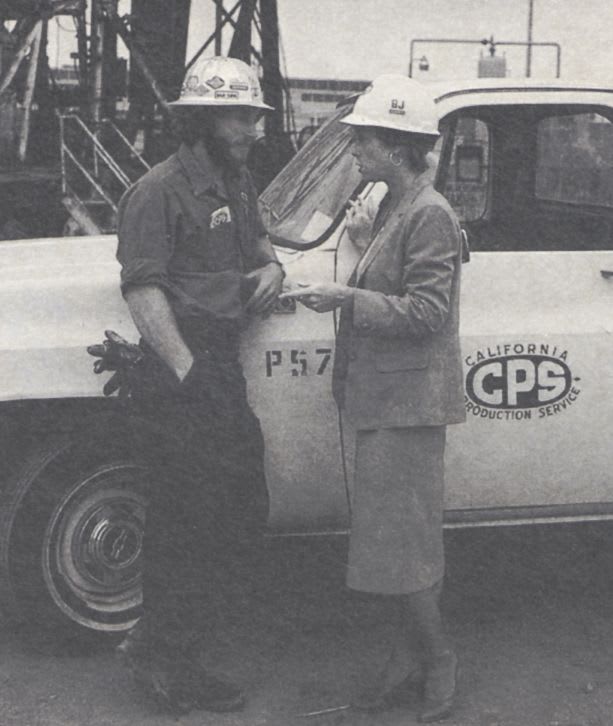
Fleet manager Claudia Finn in the field.
Tolstoy begins Anna Karenina with the words: "Happy families are all alike; every unhappy family is unhappy in its own way." The same is true for fleets, with one small inversion: Poorly run fleets are remarkably similar, lacking organization, control, and planning. But well-run fleet operations differ each from the next as much as shark from cheese.
Fleet manager Claudia Finn in the field.
No two businesses are the same. And small businesses differ from one another more than large businesses. Successfully managing the small fleet requires that the fleet manger devise solutions to highly individual situations rather than responding with pat answers.
A year ago, California Production Service, Inc. (CPS) decided that they needed a fleet administrator. Until then, the fleet function was the responsibility of five different managers. "But the task needed to be consolidated with one person," says June Scott, director of personnel, safety, and training. "We had become a rather large company, and fleet management couldn't just be added to someone's job function."
That all sounds perfectly straight-forward. What it doesn't communicate was the enormity of the task that decentralization had created: problem DMV registrations had accumulated; vehicles were not on the jobs they were registered to; maintenance was hit-and-miss. In a word, the task that the new fleet administrator faced was "challenging."
What's more, the task complicated by CPS' usage profile: No Hartmann briefcases on back seats here; CPS works in the oil patch. And not only is oil-patch work dirty, it's heavy-duty as well. More-over, usage of comparable vehicles varies greatly. CPS is based in Rancho Dominguez, CA, but has five division offices throughout the state, employing 650 people.
The company hired Claudia Finn to fill the fleet administrator's job. In a manner not atypical with small fleet mangers, Finn had not worked in fleet management. before, although she was no stranger to vehicle operations after nine years with National Car Rental. But with the changing nature of fleet management, her knowledge of an IBM PC keyboard has proven more important than her lack of familiarity with a GM mechanics' maintenance manual.
Finn sums up her progress to date: "We're at the point where we can stop just reacting and start planning. The first major challenge was to put our physical inventory, licensing, registration, and permits in order. Out equipment is mobile, and we never knew where it was located at any moment. Now, our PC provides us with that info" Finn can not only query the IBM, but she is able to generate monthly reports for the different divisions, keeping them updated as to what they need in terms of licenses, permits for moving equipment, and replacement-with maintenance to be added to the list shortly.
CPS' fleet contains: 80 Caprices, driven by "tool pushers" who function as crew chiefs and occasionally take out customers. The white Caprices have 350 V-8s and, due to the necessities of oil-patch work, as much heavy-duty equipment as can be ordered. Additionally, CPS has three Delta 88s, used by salesmen; five 98s, used by division managers; and five executive vehicles, such as Cadillacs, Rivieras, and Cutlass Broughams. All these drivers take their cars home.
CPS additionally has a fleet of light trucks. Finn comments, "Ordering our cars is easy compared with trucks. You order a basic Caprice and choose certain options. But when we spec our trucks, we have to match what we spec perfectly with job requirements: step bumpers, bed widths and lengths, engine sizes, transmissions, rear locking differentials." In the Class I and II range, CPS has 30 Chevrolet three-quarter tons, used as mechanics' trucks, (including 15 upscale Silverados, which tool pushers may choose rather than Caprices), and 50 Chevrolet half-tons used to transport crews to job sites.
Of course, like many small-fleet mangers, Finn's responsibilities include more tan cars and light trucks. She is also responsible for heavier equipment, including 2.5 ton tool trucks and transportable oil-well service rigs.
Most CPS cars and light trucks are now leased form PHH. Finn contends, "It's more economical to lease our lighter vehicles, which we go through quickly because of wear and tear." Mileage will vary depending on location: "In Bakersfield, a tool pusher will put 200 to 300 miles on a car each day simply because of the territory he covers, whereas another division's tool pusher doesn't have to travel that far."
Frequently, the effectiveness of the fleet manager is measured by the ability to interact with drivers and vendors. Finn's attitude has allowed her to earn her stripes quickly: "The men know that I'm not here to tell them what to do, but that I want to know what they know. I ask them what they need, and they share their knowledge freely."
When it comes to managing the small fleet, Finn is a representative example of the current evolution of fleet management. Women are no longer an anomaly in the fleet world. Consider the following case:
Denice Franklin manages the fleet operation for Security Courier in Irving, a medium-size Texas town. All together, they have 140 vehicles-vans, executive luxury cars, but a majority of station wagons. A reliable fleet operation is a must for a company whose business relies on transport: Security Courier provides courier service for financial institutions, picking up all processing, such items as dead checks, general ledger, and letters and transporting them to a processing center. Company vehicles operate in seven major 200,000 miles within two years.
Finding the vehicle that meshes with Security Courier's usage profile has been one of the major challenges Franklin has had to face. "In the beginning, we ran the AMC Concord wagon, which was a good wagon insofar as mileage and maintenance. But we ran into a problem in that we had to become an AMC dealer because we had to stock in stock some items with a high dollar cost. In '83 we began buying basic Ford LTD wagons; we've got 10 that are just reaching the 98,000-mile mark. With hindsight, we decided that the first package had a little too much luxury for a commercial operation. So in '84 we bought the taxi package, which has things like heavy suspension, heavy duty cooling, and bench seats.
"High mileage makes disposing of company vehicles all the more challenging. It's hard, believe me. Most of the time we have private dealers bid for them. We also keep a certain number for parts." Security Courier has in-house maintenance, with two full-time mechanics and a body man on contract.
Maintenance, however, is not the most challenging task Franklin faces. "The most difficult is keeping on top of the problems," Franklin attests. "It's hard to plan, especially with a small operation. You can schedule until you're blue in the face. But if one vehicle gets wrecked and another suddenly needs maintenance, that shoots your plans. A small operation like ours lacks the flexibility of a big company.
"Driver awareness is also a problem," Franklin continues. "Most drivers, when they driver their personal cars, are not used to this kind of mileage our company cars log. They think, 'Hey, this is an '83; I can just get in it and go.' I need better driver awareness of the fact that these cars are logging mileages you'll never see in the lifetime of your family car. And I'm trying to educate my drivers: With a little care from you and a lot from us we can have a well-running vehicle. Drivers need to be aware of oil lights, tire pressure, water pressure, all gauges and engine sounds. I see the courier as my first line of defense, my early warning system. When the courier comes to me with a write-up on his log, mentioning an engine noise, It's time to look at the vehicle. My second line of defense is my preventive maintenance man. As routes have gotten heavier, it has become necessary to do PM on a monthly basis, rather than at mileage intervals.
"In terms of having a successful vehicle operation, we have only two tools: the person and the machine. We do our utmost to develop the person so he can realize his potential as a professional driver. Our company started 15 years ago, and our owner used to run routes himself; we have always focused on how important the driver component is."
Franklin started as a courier herself and worked her way up through the company. She admits it has been something of a challenge.
"When working with some of our vendors, for example, they would overlook me and talk to the mechanic. They didn't want to talk to a woman about autos. But in truth, they respect you a whole lot more when they find out you actually know what you're talking about. Now, I have good communication with my vendors; they respect me, and I respect them."
Another company with similar challenges is Morrison Supply, a wholesale plumbing business with a corporate office in Fort Worth and nine other locations throughout Texas. Morrison operates 37 cars and 23 trucks. "We still balance leasing against buying," says Fleet Manger Robert Polson, "in the same way that we balance paying cash against borrowing money. Currently 35 percent of our cars are owned, and the balance are on open-end lease for 40 months from Leasing Association in Houston"
Polson thinks it is difficult for a small company to decide once and for all whether to lease or buy. "The question is not, 'What is the best way to handle it?' but 'What is the best way to handle it at any point in time?' Interest rates can go back up a couple of points. Our company treasurer is a CPA and can run a computer program that tells us when it is best to buy and when to lease. It depends, of course, on how much we're borrowing for other operations."
Mileage depends on usage. "It depends who's driving the vehicle and where it's located," Polson says. "Salesmen in west Texas log up 60,000 miles in 18 to 20 months. Salesmen in the cities will go up to 30 months."
Polson says that they start considering disposing of a vehicle when it gets around 60,000 miles. "But we might not get around to doing anything about it till 65 or 66." The company disposes of vehicles by getting at least three bids and then selling to the highest.
Like many other small-fleet managers, Polson has other responsibilities. Additionally, he is in charge of company inventory, purchasing, warehousing, and billing. The amount of time he spends with fleet management varies. "Some months, I only have to approve the bills," he says, "but in May, for example, we bough six new cars and trucks. Still, t seldom takes more than 5 to 10 percent of my time."
Polson says that, as with other part-time small-fleet managers, he hasn't solved all the problems yet. "We haven't properly addressed the challenge of driver training. As a company, we have not had a good safe-driving record. We've had a number of wrecks, and it has become a source of great concern. When last we renewed our liability insurance, our premium went up 83 percent."
Polson knows what is required of him. "We're going to have to come up with a way to train drivers, a more regular safety program," he says. "The tendency with a small fleet is to shove it under the table but when a problem hits you in the pocketbook, you can't leave shoved under the table any longer.
"We're at something of a disadvantage because our pay scales are not competitive enough to get quality drivers." he comments, "In Houston, we have had a tremendous driver turnover. Sometimes a driver will start in the morning and come back in at 11, saying 'This ain't for me.' This is a challenge for me as a fleet manger. As a supervisor, I want quality people, but put yourself in an individual manager's position: One morning, he's short three truck drivers. He's going to grab the first three drivers he can find to get that load delivered. But in the long run, quality employees are just as important an investment as quality equipment."
Morrison's usage profile is fairly uniform; one fleet that varies usage is that of the American Red Cross. The St. Louis office operates 78 vehicles, including 52 autos, including a few wagons, 16 vans, and 10 two-ton trucks. Fleet Manager Ken Fish explains that the majority of autos are used to transport personnel to mobile blood sites, for example. "Personnel include registered nurses, salaried staff, and volunteers, whom we additionally transport from their church or organization."
The challenge of fleet management at the American Red Cross comes not so much from varied usage as from accounting. For example, 37 of the vehicles are leased; the balance, owned. "We got into leasing in '83 with only six vehicles," Fish explains. "We also bought six vehicles that were identical to the six we leased, and compared costs. In terms of dollars, it was basically an even break. The leasing company bought for a little less money than we could, but the difference in the purchase price was about enough to equal the management costs charged by the leasing company. As a tax-exempt organization, we are not concerned so much with income tax as with the use of our funds. Allowing for the lost income from cash invested in vehicles, we found that our costs were almost identical. But our interest was best served by leasing. In terms of dollars, it was basically an even break, but leasing freed up a considerable amount of cash for other uses."
However, the term of the lease varies. "Most of our leases are on two years," Fish explains, "but 11 are leased for one year. They are used almost exclusively for blood delivery, and they average over 50,000 miles in one year of service."
Vehicle usage creates some special problems. "Each day is much different from the day before because we have to do a lot of juggling to transport people and equipment to the place needed with a minimum number of vehicles. As far as I'm as concerned, our situation is unlike any other fleet. Our vehicles based in St. Louis are driven by a great number of drivers; our 11 blood delivery vehicles, for example, are driven by 880 people, largely volunteers working one or two days a week." This creates special maintenance and mechanical problems.
To solve some of them," Fish explains, "we got an automated fuel system, which always includes data on mileage driven along with a printout of fuel consumption. We monitor fuel consumption as an indication of engine condition. Additionally, we change oil, inspect, and lube every 5,000 miles, which is more frequent than manufacturers suggest. But it gives us the opportunity to look for things the drivers might not have seen. So inspection and PM are really the key."
But what if it were impossible to develop any type of usage profile. What if vehicles were used for everything from high-mileage police work to occasional community service visits to the aged. Imagine trying to mange the fleet for a small government, and if you can imagine the disparity of tasks, then you can imagine the job that falls to Lenny Abrams, fleet manger for the Yakima Indian Nation.
The tribe found it necessary to set up a fleet operation in '80 to manage its 150 vehicles. The fleet now contains 65 cars 75 light trucks and vans, and 10 trucks over 10,000 GVW. Fifteen of the cars are police vehicles; the rest are used for official business. "Average annual mileage is 14, 000," Abrams says, "but councilmen will put on close to 20,000, and police cars will go 30,000. The Portland area is a frequent trip for our councilmen and we frequently have to travel 200 miles to get to Spokane or Seattle."
In contrast to highway driving the Yakima Indian Nation provides many other services that do not require high-mileage travel. "We're like a governmental agency," Abrams explains, "offering community service programs, again programs, etc. Much travel is on the reservation, visiting homes or schools, conducting workshops.
"Frequently vehicles must operate off-road," Abrams continues. "We have 75 light 4X 4s that operate mostly off-road. Our timberlands program administrators have to check on timber and operate as an enforcement agency. We also have wildlife and fisheries programs. They use 4X 4s exclusively, both domestics and imports."
Part of the Yakima fleet is owned, part leased. Abrams explains: "When they started the fleet, there were X number of dollars, and they needed 40 vehicles. I think leasing is advantageous sometimes, depending on the equipment you need. I can't see paying $8,000 to a leasing company in three years for a car that only goes 10,000 miles a year, and then having to pay them again if we want to buy that car." For disposal, vehicles are offered to tribal enrolled members and then to the public, with price adjusted for mileage and condition from NADA book value.
"Keeping the vehicles running" is the most challenging part of the job for Abrams. "I suppose it's true for other fleet mangers, but maintenance has been one of our biggest problems. I'm also in charge of the mechanical program. We started a PM program for every time we change oil. But because of the different usage profiles for our vehicles, it's difficult to establish guidelines. We always go by the book or go it one better. Our soils survey program, for example, has nine vehicles. They don't put many miles on them, but their miles are with lots of dust. So we have to treat them differently. We can't say every three months or 6,000 miles for those vehicles."
The in-house maintenance program has been tailored to fit the longer hours that make the Yakima Nation's fleet more similar to a small government than a small company. "We only have two mechanics, and their shop is open from 6 a.m. to 7 p.m. They do everything but body and transmission work. The shop is also open on Saturdays; when a program needs the vehicle all week, we'll schedule that vehicle into the shop on Saturday."
The difficulty is setting strict company policies for PM also holds for vehicle turnover. "We try to set a policy on vehicle turnover of, say, 60,000 miles. The difficulty is in trying to find a policy that most of the vehicles will fit into. Most companies work that way. But with us, we have a police fleet that goes 30,000 miles a year and a community services vehicle that goes 14,000. Instead of being rigid, our challenge is to be flexible."
More Operations

Moventum Fleet Management Names Mark Iorillo Head of Sales
Iorillo brings nearly 20 years of fleet management and sales experience to the role, including previous positions at Element Fleet Management, CEI, Donlen and Ryder.
Read More →
Fleet Has a Talent Pipeline Problem. What Comes Next? | AF News Recap
Where will fleet’s next generation of leaders come from? This week, we’re looking at the industry’s talent pipeline, what certification can add to a fleet career, how to build an award-worthy track record, and the return of Automotive Fleet’s Personal Use Survey.
Read More →
Smith System Launches Driver Risk Management Program
Fleets have more driver data than ever, but identifying risky behavior doesn't necessarily correct it. Smith System's new Driver Risk Management program combines monitoring, training, and follow-up coaching to help fleets connect risk signals with driver intervention.
Read More →
Automotive Fleet Opens 2026 Personal Use Survey for Commercial Fleet Managers
Less than two weeks left! Commercial and corporate fleet managers are invited to share how their organizations handle company vehicle personal-use policies, charges, and driver eligibility.
Read More →
From AI Prompts to AI-Generated Safety Songs | AF News Recap
Can better prompts make AI more useful for fleet managers? This week, we’re breaking down smarter fleet analysis, an AI-assisted experiment that turned safety training into music, and what happened to fuel prices in August.
Read More →
How to Write Better AI Prompts for Fleet Analysis
Include these six elements in your fleet prompts to generate more relevant analysis and accurate answers.
Read More →
Fleet Meets: Eric Kilgore
This edition of the Fleet Meets series features one of the industry's best leaders driving multi-market and national operations.
Read More →
Why Reactive Fleet Management Is Becoming Too Expensive to Sustain
Research highlights a growing need for proactive management strategies to address rising costs in fleet operations effectively.
Read More →
What Your Fleet KPIs Aren’t Telling You
Tracking fleet metrics is only useful when the data leads to better decisions. This guide helps fleet leaders assess cost, utilization, and downtime more accurately, identify performance gaps, and prioritize the actions that can improve operational results.
Read More →
Hidden in Plain Sight: Fleet Compliance Risks
Fleet compliance isn't just about having policies — it's about consistently enforcing them. This practical guide reveals six hidden compliance risks common in public sector and shared fleet operations and outlines proven strategies to improve visibility, accountability, and audit readiness
Read More →