The Canadian Fleet Market is a Tale of Two Regions
During the first six months of 2015, two core factors strongly influenced the commercial fleet market in Canada: price of crude oil dropping to below $40 per barrel and the foreign exchange rate of the Canadian dollar (CAD) declined against the U.S. dollar.
During the first six months of 2015, two core factors strongly influenced the commercial fleet market in Canada:
Ad Loading...
1. Price of crude oil dropping to below $40 per barrel.
Ad Loading...
2. The foreign exchange rate of the Canadian dollar (CAD) declined against the U.S. dollar. As of press time, the Canadian dollar was $0.75 CAD to the U.S. dollar. It was $0.92 CAD during the same period last year.
As an export nation, this has positively impacted Canada, particularly provinces such as Ontario and Quebec, which have a strong manufacturing sector. The weaker Canadian dollar makes their exporters less expensive in the U.S., which is Canada’s largest trading partner. Canada is a net export nation with 75 percent of its exports going to the U.S.
But, it is the oil and gas industry that is one of the largest fleet segments in the country. Although Canada is primarily a service-based economy, commodities represent a large segment of the Canadian market. In recent years, the decline in the price of commodities, especially oil, have had an impact on the Canadian economy.
BAGNALL
“This has resulted in a shift in economic growth from the oil-rich provinces of Alberta and Saskatchewan to the manufacturing-based provinces of Ontario and Quebec in Central Canada,” said Peter Bagnall, director - fleet and commercial sales at General Motors Canada. “The drop in the price of crude oil to below $40 a barrel has had a significant impact on our business, affecting the energy sector primarily.”
As a consequence, according to Bagnall, there has been a two-fold impact on the Canadian commercial market:
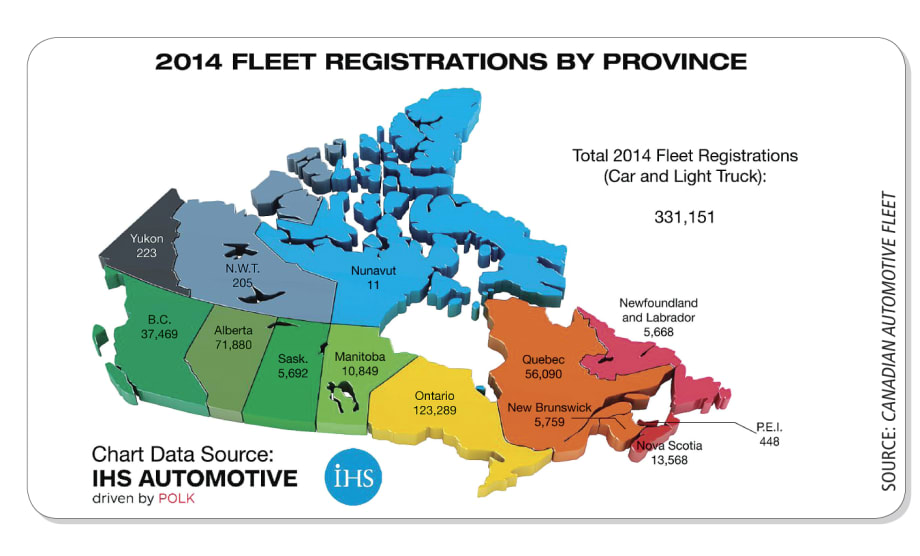
1. Shift in fleet sales from Western to Eastern Canada has occurred.
Ad Loading...
2. Shift in sales mix from large pickups to passenger cars and crossovers.
“In aggregate, the commercial market in Canada is basically flat year-over-year,” said Bagnall.
Despite the slowdown in business activity in certain parts of Western Canada, automotive sales nationwide are extremely strong.
“In Canada, retail automotive sales are running extremely hot. It’s on a record pace this year for more than 1.9 million units. That’s the current SAAR,” said Bagnall. “When you look at the commercial market, the market is essentially flat, year-over-year through July. The good news here is that GM Canada commercial fleet sales are actually up 15 percent year-to-date on the back of our deep product portfolio. So, our share is obviously growing.”
In terms of commercial business at GM, two things have happened, according to Bagnall: “We’ve seen the sales shift from west to east, and we’ve also seen the mix shift somewhat from large pickups, to a greater skew to passenger cars, vans, and crossovers.”
Ad Loading...
Although there is a shift in types of vehicles acquired by fleets, Bagnall stressed that pickup truck sales in Canada continue to be strong.
“I want to be clear that large pickups continue to represent more than 40 percent of the Canadian commercial market and Western Canada is our biggest truck market,” said Bagnall. “With the significant reduction in the price of oil, our customers in the energy sector have been forced to look at all opportunities to get more efficient and take cost out of their business.”
One way Canadian fleets have been looking to reduce acquisition and operating costs is by downsizing to a smaller truck segment.
“We see some customers moving from ¾-ton trucks to ½-tons in an effort to save on acquisition cost and improve fuel efficiencies,” said Bagnall. “We also see the mid-pickup market growing, which is great for GM Canada, as the Chevrolet Colorado and GMC Canyon now own close to 50 percent of the Canadian commercial market in mid-pickups.”
Bagnall said this ability by GM to serve different truck segments is a result of its industry-exclusive three-truck strategy.
Ad Loading...
“During this change in the Canadian economy, this is proof that our three-truck strategy was the right business decision. Combine that with GM Canada having the largest dealer network in the country (453 dealers) 125 of which are commercially focused Business Elite dealers,” said Bagnall. “Obviously, this gives us a distinct advantage when it comes to servicing our customers faster and more conveniently than our competition. As you know, downtime is not an option in commercial fleet.”
In addition, according to Bagnall, “In fact, we continue to grow our wholesale team with a focus on business development through our Business Elite dealers. The success at GM Canada Fleet and Commercial is directly proportionate to the strength and success of our commercially focused GM dealers.”
Strongest Vocational Segments
Source: Canadian Automotive Fleet
The strongest vocational segments for commercial fleet sales in Canada are energy and construction.
“No question that, as our great country continues to grow, construction plays a bigger role in the economic development of Canada,” said Bagnall.
As in the U.S., the small business segment is the growth engine for fleet sales.
Ad Loading...
“In Canada, it is really the small local businesses that drive our economy. Actually, as the old saying goes up here, ‘over 80 percent of the commercial customers buy fewer than 30 units per year.’ Hence, the need to truly connect with customers at the local level and the importance of a commercially focused dealer network,” added Bagnall.
It is difficult to identify the average fleet size in Canada. “I have seen figures range anywhere from 35 up to 70 units, but, at the end of the day, the average very much depends on what your definition of ‘fleet’ means. Some OEMs have tied a fleet designation to a business number in Canada, and inclusion of these registrations drops the average dramatically,” said Bagnall.
In terms of current vehicle depreciation trends, normally a 2-percent-per-month depreciation reserve is used in Canada.
Present interest rates and taxation rates in Canada are having a minimal impact on fleets.
“Obviously lower carrying costs are favorable as it pertains to lifecycle costs, but, similar to the U.S., Canada has been running at very attractive rates for some time now,” said Bagnall.
Ad Loading...
Current order-to-delivery (OTD) times for Canadian fleets are a key focus at GM Canada.
“Based on what customers are saying, and recent feedback from our FMC partners, GM’s OTD is steadily improving and that’s a good thing for everyone. We pride ourselves at keeping the customer at the center of everything we do and OTD is a key pillar of our business plan,” said Bagnall.
Fuel Price Trends
Although retail fuel prices are low, it has not had a significant impact on the types of fleet vehicles acquired. “I am not seeing much impact in the Canadian fleet space on lower fuel prices. Prices at the pump are hovering around $1.10 CAD per liter and that is still quite high even with the recent drop in crude we’ve experienced,” said Bagnall.
Fleet Forecast for 2016
The forecast is for flat sales in the commercial fleet market for the 2016 calendar-year.
“Last year, we grew our commercial volume at GM Canada with basically flat market conditions. This year, we are tracking at 15-percent growth in a flat industry,” said Bagnall. “With the economic conditions robust in Central Canada and pulling back in the west, I personally expect the commercial market to maintain a level pace. In other words, I see the market remaining fairly consistent as we move into 2016.”
Ad Loading...
About the Author
Mike Antich is editor of Automotive Fleet magazine, published by Bobit Business Media, and conference chair of the Global Fleet Conference held in North America. He can be reached via e-mail at mike.antich@bobit.com.
Geofencing is a familiar fleet tool today, but its early adoption marked a major shift in vehicle tracking, route monitoring, and the debate over employee privacy.
Holman is bringing its Mexican fleet management operation fully under its own brand after more than 30 years as a joint venture. The change gives multinational fleet customers a single Holman operation across the U.S., Canada, and Mexico.
Regular tire checks can do more than extend tread life. These five maintenance practices can help work truck fleets catch problems early, reduce costs, and prevent downtime.
Part Two: Commercial auto remains one of the most challenging and costly lines of coverage for fleet operators and insurers alike. Continue learning more about how to effectively address these issues from Onur Aksan, Enterprise Business Development Executive, Geotab
Commercial auto remains one of the most challenging and costly lines of coverage for fleet operators and insurers alike. Learn more about how to effectively address these issues from Onur Aksan, Enterprise Business Development Executive, Geotab.
Fleet leaders are under pressure to reduce costs, adapt to economic uncertainty, and make smarter decisions. See how peers across North America are responding with real data, proven strategies, and forward-looking insights. Download the 2026 Market Pulse Report to benchmark your strategy and uncover where you can gain an edge.