




Should My Company Mandate and Promote Driver Vaccines?
This legal roadmap for transportation businesses examines employers’ obligations regarding vaccinations and employees’ right to refuse them. Related issues such as potential liability, contract worker status, ADA disabilities, and privacy are also explored.
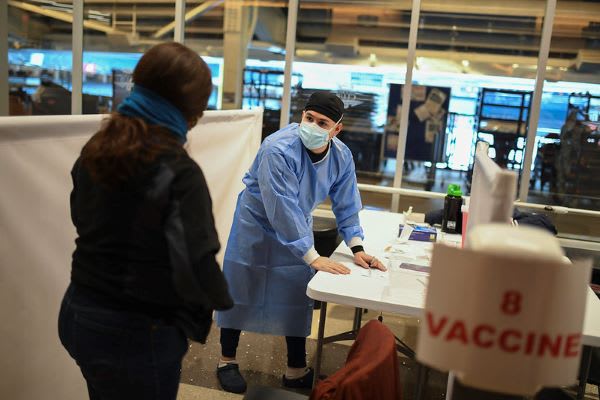
COVID-19 vaccinations take place at Yankee Stadium. Even when drivers are vaccinated, masks, cleaning and disinfection, and other mitigation measures will still need to be followed.
Photo via Flickr/ U.S. Air Force Reserve photo by Staff Sgt. Christopher S. Muncy.
Vaccines are becoming increasingly available by the day, and more and more people are becoming eligible to receive them.
As states allocate the vaccines in phases to different segments of the population, their availability raises questions for passenger ground transportation businesses and other organizations with commercial drivers. Some key questions are whether to require drivers to get the COVID-19 vaccine, does it matter if the drivers are employees or independent contractors, and how to conduct business if drivers are vaccinated, including whether to advertise that fact to customers.
To answer some of those questions, the International Association of Transportation Regulators (IATR) recently held an online information session on COVID-19 vaccine safety and priority for transportation workers featuring Dr. David Weissman, director of the Respiratory Health Division at the National Institute for Occupational Safety (NIOSH). I co-moderated the session with Dr. Cammie Chaumont Menendez, IATR Safety Committee chair and a senior scientist at NIOSH/U.S. Centers for Disease Control and Prevention (CDC).
Dr. Weissman provided an overview of the vaccines and explained that all three available vaccines are effective at preventing serious illness, hospitalization, and death from COVID-19 disease — including variant strains of the virus. He also explained vaccine priority and groups of transportation workers who have been prioritized, and provided several useful resources for transportation businesses.
This article offers a roadmap for transportation businesses with employee or independent contractor drivers to help navigate this rough terrain. Below are some considerations for mandatory vaccination programs versus voluntary compliance.
Mandating Vaccines
Requiring employees to get immunizations and vaccines is not new. Those who work in health care, schools, and other industries are regularly required to get various vaccines as a condition of employment. Whether a transportation business can require drivers to get the COVID vaccine depends on whether the driver is an at-will employee or a contract worker.
For employers, the availability of COVID-19 vaccinations raises questions about the applicability of various equal employment opportunity (EEO) laws, including the Americans with Disabilities Act (ADA), the Rehabilitation Act, Title VII of the Civil Rights Act (Title VII), and the Pregnancy Discrimination Act. According to guidance from the U.S. Equal Employment Opportunity Commission (EEOC), employers can legally — under these laws — require their employees to get the coronavirus vaccine if allowing an employee to work without it would pose a “direct threat” to others in the workplace. However, employers must be prepared to reasonably accommodate employees who either cannot, or will not, be vaccinated due to a disability (under the ADA) or a sincerely held religious objection (under Title VII).
For reasons related to the ADA’s restrictions on making disability-related inquiries of employees, employers who opt to mandate vaccines are encouraged to have a third party administer them rather than doing it themselves. By having a third party that does not have a contract with the employer — such as a pharmacy or health care provider — administer the vaccine, the employer is insulated from the pre-vaccination medical screening questions that are likely to elicit information about a disability.
To avoid further triggering the ADA’s restrictions on disability-related inquiries, employers should tell employees to provide a vaccination “receipt” that does not include any personal medical information. Those who are vaccinated should receive a card or printout that states which COVID-19 vaccine they received and where and when they received it. Employers should keep the proof of vaccination in confidential files (similar to employee medical files), separate from personnel files, and with restricted access.
If an employee does not have proof of vaccination, asking for the reason the employee did not get the vaccine could elicit information about a disability and would be subject to the pertinent ADA standard that “disability-related” inquiries be “job-related and consistent with business necessity.” To meet this standard, an employer would need to have a reasonable belief, based on objective evidence, that an unvaccinated employee will pose a direct threat to the health or safety of her or himself or others. That is a high standard, which may be best to avoid.
Some may refuse to get vaccinated because of a medical condition, pregnancy, or sincerely held religious belief. Employers who mandate vaccinations will be required to take additional measures under the ADA to engage in the interactive process with these employees – and be prepared to make reasonable accommodations for them.
The EEOC advises that employers may rely on recommendations from the CDC when deciding whether an effective accommodation that would not pose an undue hardship is available. Employers should also consult applicable Occupational Safety and Health Administration (OSHA) standards and guidance.
In some circumstances, an employer may be able to exclude a worker from the workplace lawfully even if the worker is unable to receive the vaccination because of a disability or sincerely held religious belief, and the inability to be vaccinated cannot be reasonably accommodated.
This does not mean the employer may simply terminate the worker’s employment. Employers would need to determine if any other rights apply under the EEO laws or other federal, state, and local authorities before taking such a step. The same would be true if an employee is unwilling to get vaccinated for reasons that are not protected by EEO laws.
Paid Time off for Vaccinations?
State and local laws may require employers to provide paid leaves of absence for employees to receive COVID-19 vaccines, either under traditional sick leave laws or COVID-19 specific legislation. For example, New York State enacted legislation granting all public and private employees paid time off to receive the COVID-19 vaccine without having to use other types of leave.
Under the new law, which went into effect March 15, 2021, employers will be required to give employees up to four hours of paid time off per injection. In addition to the paid leave requirements, the law bars employers from terminating, threatening, penalizing, or otherwise discriminating or retaliating against an employee for exercising her or his rights under the law, including requesting a leave of absence to be vaccinated for COVID-19.
The law is in effect from March 15, 2021, to December 31, 2022, but it is not retroactive. Meaning, employers do not have to compensate employees who took time off prior to March 15, 2021, to get the vaccine. However, through 2022, employees will be entitled to a “sufficient period of time,” up to four hours per vaccine — which would include second doses and possibly any subsequent booster shots if necessary.
This leave cannot be charged against any other leave that the employee may have available, including sick leave. New York employers should tell employees who request vaccine leave to provide their vaccination “receipt” (which does not include any personal medical information) upon return to work. The legislation does not state whether employers can control when an employee schedules a vaccine appointment, and the State may issue guidance on that point and others after it becomes law.
Vaccines and Contractors
Many essential worker-drivers are independent contractors. With respect to requiring vaccines, the terms of the contracts that create and govern the relationship between the worker and the company will dictate whether a vaccine mandate is permissible.
A transportation business may require independent contractor (IC) drivers be vaccinated as a condition of the engagement if they include appropriate language in their contract. For current IC drivers, their existing contracts may need to be amended to allow such a mandate. Because these mandates are an aspect of control, this is an area of concern with respect to violating worker classification laws. We highly recommend a careful review of proposed or existing agreements with the assistance of legal counsel.
Whether to Require Vaccines
Just because the EEOC has stated that employers may require the vaccines does not necessarily mean employers should do so. In addition to ADA compliance, there are some considerations for employers before deciding whether to require employees to be vaccinated or, instead, to encourage employees to get the vaccine voluntarily on their own — including the logistics of administering a vaccine policy, the burden of managing accommodation requests, the impact on morale, and the potential for litigation.
Drivers may not want to get the vaccine. These vaccines became available at “warp speed” and brought skepticism and controversy with them. But the public seems to be getting on board with immunization. The proportion intending to receive a vaccine ranged across surveys from 42%-86% (as of November and December 2020 polls) — but hesitations and skepticism remain.
Currently, all the COVID-19 vaccines are only available to the public under Emergency Use Authorizations (EUA) granted by the FDA. This is different from FDA approval. There are unknown risks associated with these vaccines, and there have been reports of severe allergic reaction including anaphylaxis to the vaccine. The Federal Food, Drug, and Cosmetic Act requires the secretary of Health and Human Services to “ensure that individuals to whom the product is administered are informed … of the option to accept or refuse administration of the product.” In other words, even if an employer mandates employees get the vaccine, employees still legally have the right to refuse it.
Even if a driver is vaccinated, masks, cleaning and disinfection, and other mitigation measures will still need to be followed. It is important to note that we do not yet know how long the COVID-19 vaccines provide protection from getting sick, and whether they keep people from spreading COVID-19. Thus, it is possible that a driver who has been vaccinated could still spread the virus to others.
Those who receive the vaccine will still be required to follow the CDC’s guidance and any federal, state, or local laws related to curbing the spread of the virus in public places (wear masks, avoid close contact with others and poorly ventilated spaces, etc.). Moreover, the day after he took office, President Joseph R. Biden, Jr. signed executive orders requiring face coverings be worn on all forms of public transportation. As implemented by the CDC, this requirement includes taxis, rideshares, paratransit services, and intercity buses among other modes of transportation. Even with vaccines, we still have a long road to normalcy. Until then, there are best practices for those in the passenger ground transportation business.
Potential Liability
On October 14, 2020, the International Association of Transportation Regulators issued best and accepted practices and model regulations for regulators of for-hire ground transportation regarding health, safety, and resiliency in response to COVID-19 pandemic. The goal of the model regulations is to provide regulators with specific rules and guidelines based on best and accepted practices that regulators may implement through their jurisdiction’s legislative or rulemaking process or use for policymaking, administrative and/or ministerial regulatory agency actions.
In developing the model regulations, the IATR’s COVID-19 Task Force found that the majority of for-hire ground transportation regulators have not imposed COVID-19-specific regulations relating to health and safety and disfavor doing so. These regulators’ practice and preference is instead to defer to their public health officials on such matters and encourage those under their jurisdiction to adhere to guidance and directives issued by those public health officials.
There is potential liability for employers. Currently, guidance from the CDC and state and local health authorities does not recommend that employers require vaccinations. As noted above, the vaccines are still experimental. If an employee suffers an injury from a vaccine that they only received because the employer mandated it, the employer might be liable. Injury or illness from the vaccine will likely be compensable under states’ workers’ compensation statutes. Where employers require or encourage immunization, the vaccines would benefit the employer and serve a business purpose and, thus, related claims would be covered under workers’ compensation laws.
These are only some of the concerns that transportation operators should take into consideration when deciding whether to mandate or encourage drivers and other employees to get vaccinated. Another option is to remain neutral and let employees decide for themselves. Remaining neutral would not appear to create any issues for transportation businesses.
Vaccination Status as Marketing Tool
Understandably, those in the business of transporting passengers are eager for business to return. To the extent that people have stopped using car services and buses because they are concerned about catching the virus from their driver, it is tempting to advertise the fact that your drivers are vaccinated. However, companies should resist that temptation and carefully consider the legal ramifications of making such representations to customers directly or in advertisements to the public.
The vaccination status of a workforce, even if aggregated, would inappropriately disclose individuals’ private information. An employee’s vaccination status is medical information that an employer must keep confidential by law. The EEOC has taken the position that any information concerning an employee's medical condition is protected under the ADA or FMLA. The EEOC guidance is clear that “[t]he ADA requires employers to keep any employee medical information obtained in the course of the vaccination program confidential.” This would include whether a worker has received a vaccine.
In addition, as noted in this article, the CDC does not know how long the vaccine provides immunization or whether it will prevent those who have been vaccinated from spreading the virus to others. Advertising that your drivers are “immune” or “COVID-free” could give customers a false sense of security.
Weigh the Benefits
Many have welcomed the arrival of vaccines, and many are voluntarily getting vaccinated when they are eligible. The increasing availability of vaccines raises many questions for employers of essential workers about vaccinating employees, including mandatory vaccination policies, and conducting business.
Businesses that employ drivers should carefully weigh the benefits and considerations of mandating vaccines versus encouraging drivers to get them before making any policy decisions. Employers should include input from management, human resources, employees, and legal counsel, as appropriate. Those who wish to encourage vaccines can consult CDC resources on promoting vaccination in the workplace.
I predict that the question of whether to mandate vaccines will be null because voluntary vaccination seems to be the trend. It is also possible that, if there is insufficient voluntary acceptance of the vaccine, the government could mandate it either universally or for particular sectors, such as essential workers.

Matthew W. Daus is partner & chair, Transportation Practice Group at Windels Marx Lane & Mittendorf. He's also the transportation technology chair and a distinguished lecturer at the City University of New York’s Transportation Research Center.
Photo courtesy of Matthew M. Daus.
Originally posted on Work Truck Online
More Safety

Does Your Fleet's Culture Encourage Distracted Driving?
What happens when the people responsible for enforcing safety rules are the ones setting the wrong example? The answer may reveal why some of the biggest risks to fleet drivers have little to do with what's written in the employee handbook.
Read More →
Fleet Manager’s Ultimate Playbook: Navigating the New Standard in OEM Connectivity
Rising operating costs, driver safety concerns, and unplanned downtime are putting unprecedented pressure on modern fleets. Discover how fleet managers use embedded OEM connectivity and real-time vehicle data to cut TCO, prevent downtime, and protect drivers without aftermarket telematics hardware.
Read More →
From Driver Well-Being to EV Charging | AF News Recap
Mental health belongs in the fleet safety conversation. This week, we’re looking at five ways fleets can support employee well-being before a crisis, plus Holman’s expansion in Mexico, new one-day Fleet Forward passes, and why EV charging demand is outpacing infrastructure growth.
Read More →
Nexar-Nauto Merger Aims to Give Fleets Better Safety Intelligence Through Larger Driving Dataset
Stefan Heck tells Automotive Fleet that combining more than 10 billion miles of driving history with Nexar's AI models will give fleets deeper insights into driver risk and roadway conditions than either company could provide independently.
Read More →
Don't Wait for a Crisis: 5 Ways to Build Mental Health Into Your Fleet Safety Program
For Suicide Prevention Month, fleet and safety leaders have an opportunity to put mental health where it belongs: at the center of workplace safety.
Read More →
How Camera Data Can Strengthen a Fleet’s Insurance Renewal
Insights from a commercial insurance carrier and a broker show how fleets can turn video telematic data, driver coaching, and improved claims results into a stronger case at insurance renewal.
Read More →
The Safest Fleets Aren’t the Ones with the Most Technology
You’ve made the telematics investment. Here’s how to capture the other half of its value and build the safest fleet on the road.
Read More →
Hidden in Plain Sight: Fleet Compliance Risks
Fleet compliance isn't just about having policies — it's about consistently enforcing them. This practical guide reveals six hidden compliance risks common in public sector and shared fleet operations and outlines proven strategies to improve visibility, accountability, and audit readiness
Read More →
NETS Sets 2026 Fleet Safety Benchmark Conference for Indianapolis
The Sept. 15–17 program will feature fleet benchmarking data, case studies, emerging technologies, and implementation strategies while running alongside the NSC Safety Congress & Expo.
Read More →
Off-the-Job Crashes Account for 43% of Employers’ $61.7 Billion Crash Burden
NETS quantifies costs dispersed across fleet, risk, HR, and other departments while providing new per-crash benchmarks for employers.
Read More →