




SEPAC- 'Q & A' With an industry 'first'
Banks enter leasing with 'dedicated subsidiaries'.
AUTOMOTIVE FLEET recently had the opportunity to speak with Al Sutton, executive vice president and general manager, and Bob Mitchell, director of fleet leasing and industry relations, for SEPAC Acceptance and Lease Services, Inc., a subsidiary of Security Pacific National Bank. SEPAC has a fleet of 25,000 vehicles, and, as a subsidiary of the tenth largest bank in the nation, is one of a few offering this type of specialized service to both the broker and the individual customer. They enjoy 600 "leasing offices" in California alone in the form of bank branches, and are moving into other states with their services. As a growing trend in the leasing industry, and with the advent of Savings and Loans starting their involvement in leasing, we thought a Q & A with SEPAC officials would give an industry-wide took at banks in leasing.
SEPAC was established in 1979 with direct and indirect leasing divisions. We pick up the conversation discussing one of the company's other services to dealers.)
AF: We understand SEPAC is now offering an acceptance plan to their list of services.
SUTTON: We saw as we progressed in this business a need to broaden the scope of the company to a couple of additional services. With the dealer body and the inconsistency of financing available, dealers were asking us for alternatives to their normal finance source. So we have introduced an acceptance division to the company. Which means we now go into a dealer and handle his needs in moving a vehicle from his floor to the user whether it be a lease or a finance transaction. We introduced the acceptance product principally as complimentary to the lease product.
AF: Does that include floor-planning?
SUTTON: No, not dealer financing. Strictly customer lease and finance. We found certain dealers did not separate leases or sales. We are not involved in dealer financing, by that I mean inventory, wholesale or capital loan or what have you. We acknowledge that every dealer needs a strong finance source, but we also know that he is making a big mistake if he has all his eggs in one basket, and he doesn't have an alternative source of financing. So we tend to be a financing and merchandising service, whatever that might entail, be it self-liquidating retail financing, or leasing with a residual value.
AF: What is you direct/indirect ratio today?
SUTTON: It is still about 20 percent direct and 80 percent indirect. It has been constant since we launched the program. That figures out to about 4000 direct units.
AF: As you expand into neighboring states, which we understand you are, without the benefit of 600 plus offices, what services will you offer?
SUTTON: As we move out of state, we will only be offering third-party indirect lease and financing programs.
AF: Unless Security Pacific becomes like First Interstate or another bank.
SUTTON: I do not believe interstate banking will become a reality here in my business lifetime.
AF: What are your five year goals in expanding?
SUTTON: At the time SEPAC was established, the bank saw in this one-product company a significant role in California. They also envisioned that it possibly had a national purpose, that there was a national market our know-how could reach. We developed a plan of researching the country, looking at states west of the Mississippi, and as a result decided to make our first out of state move to Kansas City, MO. This is an office we look at as being a lease and loan production office of SEPAC. Five years from now we plan to pretty well cover those states where a friendly business atmosphere exists and where our services would meet an economic need. Profitability aside, the success of this company depends on whether out services cause a dealer to be more successful over a period of time than if the services weren't available. Our five year plan calls for SEPAC to have a very significant national impact on the automobile business.
AF: How do you perceive the impact of the S&L's here in California after the ruling which apparently gives them the opportunity to enter the leasing market?
SUTTON: We think that is positive. The more institutions that move into the auto business at a retail level, it is bound to have a positive impact on the movement of product ....if they do it right. It they make that decision to go into it and in the right way they are going to have to look for some expertise. And we see as a possible role for our know-how, servicing such S & L's?
AF: You would service S &L's?
SUTTON: We would provide them with services of one type or another. It might be a marketing service, it might be management know-how, it might be systems. It could be all kinds of management information. It does not do the industry any good to come into this business and do it wrong.
AF: How do you see them in terms of competing for the cost of money? Are they going to be competitive? Will they have an edge?
SUTTON: Under the recent legislation that tends to equalize competition for money, I think all of us will reach a point where it will cost everyone about the same. It will depend upon the efficiency of the institution in attracting these funds. There are certain margins you must enjoy if you are going to have a consistent and valuable service. The company providing the service must produce adequate return on their resources.
If you do it right, you stay in business. If you price wrong, you go out of business.
AF: What is you ranking in California in terms of indirect and direct leasing?
SUTTON: I would say we are in the area of number two in indirect. I know we are not number one, and I don't think we are number three. The three majors are First Interstate, Wells Fargo and SEPAC. After that it drops way off. We are the three majors. On a direct lease side, we are number one.
AF: On your direct efforts, I assume you are aggressive internally, but how do you go after the market?
SUTTON: On our direct, we are principally devoting out efforts to familiarizing the banking offices and their employees with leasing as an additional finance service.
AF: Do you have any limitations on your fleet program? Let's say a company with 500 cars that banks with Security Pacific comes in and an officer says "you might be interested in our leasing program." Are you equipped to take on that account and provide major lessor services?
SUTTON: Yes, if that customer has a full-fledged transportation department and can do for themselves what some of the major lessors can do, we are certainly then very ready to move in with leasing as an alternative form of financing. No, from the standpoint of being a competitor with the major lessors. It the bank customer is looking for all the transportation service that goes with that, I don't think we can do that as well as others. We'll tell him that.
AF: Some would say banks are getting into areas with muscle and trying to take over an industry.
SUTTON: We don't see it that way. We are not in that industry to replace anyone. We see it not too differently than banks handling the direct financing needs of their customers. As the education level grows relative to leasing you are going to have people naturally thinking about a financial institution handling their lease. For a major bank with a strong consumer program, they must have a leasing program in order to be complete. So we are not striking out to take business away from anyone. A customer-oriented bank cannot afford to be without this.
AF: How about disposal?
SUTTON: When you accept the residual and credit risk, you are going to get some cars. We dispose of cars every month. We do it through an independent company. They operate storage facilities for us, recondition through a closed bid auction. The company is called Acquirecorp, and they are in Norwalk, California.
AF: How many cars a month do you move through disposal?
SUTTON: On the average, I would say 60 or 70 cars a month. It could be 100, sometimes it could be 50.
AF: Do you perceive your 20 percent direct growing?
SUTTON: In the long run, I am inclined to think that as consumers associate leasing with banking, it will grow in this state (California). Out of state, of course, we will only be involved with indirect. Remember, 30 years ago, there weren't that many people walking into a bank and wanting to finance their cars. This has changed, and we think it will change with leasing. A bank will never replace the services a leasing company can provide, unless they have a company dedicated to it specifically-like ourselves.
How well we do in the market will be a result of how our service excellence is perceived in the market. We expect to continue to be very competitive, and become even more so in the future.
More Operations

Fleet Meets: Eric Kilgore
This edition of the Fleet Meets series features one of the industry's best leaders driving multi-market and national operations.
Read More →
Why Reactive Fleet Management Is Becoming Too Expensive to Sustain
Research highlights a growing need for proactive management strategies to address rising costs in fleet operations effectively.
Read More →
What Your Fleet KPIs Aren’t Telling You
Tracking fleet metrics is only useful when the data leads to better decisions. This guide helps fleet leaders assess cost, utilization, and downtime more accurately, identify performance gaps, and prioritize the actions that can improve operational results.
Read More →


Hidden in Plain Sight: Fleet Compliance Risks
Fleet compliance isn't just about having policies — it's about consistently enforcing them. This practical guide reveals six hidden compliance risks common in public sector and shared fleet operations and outlines proven strategies to improve visibility, accountability, and audit readiness
Read More →
Turning Fleet Payment Data into Executive Insights
Does data alone drive results in operations?
Read More →
Automotive Fleet Opens 2026 Personal Use Survey for Commercial Fleet Managers
Commercial and corporate fleet managers are invited to share how their organizations handle company vehicle personal-use policies, charges, and driver eligibility.
Read More →
Gary Van Orden Retires After Nearly Four Decades in Commercial Fleet
From answering customer calls at Ford Motor Company to leading fleet sales across multiple OEMs and a fleet management company, Gary Van Orden's career reflects nearly four decades of leadership in commercial fleet.
Read More →
How Stellantis Plans to Get Ahead of Fleet Downtime
Vehicle acquisition may grab the headlines, but fleet uptime increasingly determines operating success. Darren Bradshaw of Mopar North America gives the details.
Read More →
Hyundai Releases 2027 Commercial Program Incentives
The 2027 Model Year "Fleet Street Incentives" are available to commercial and government fleets.
Read More →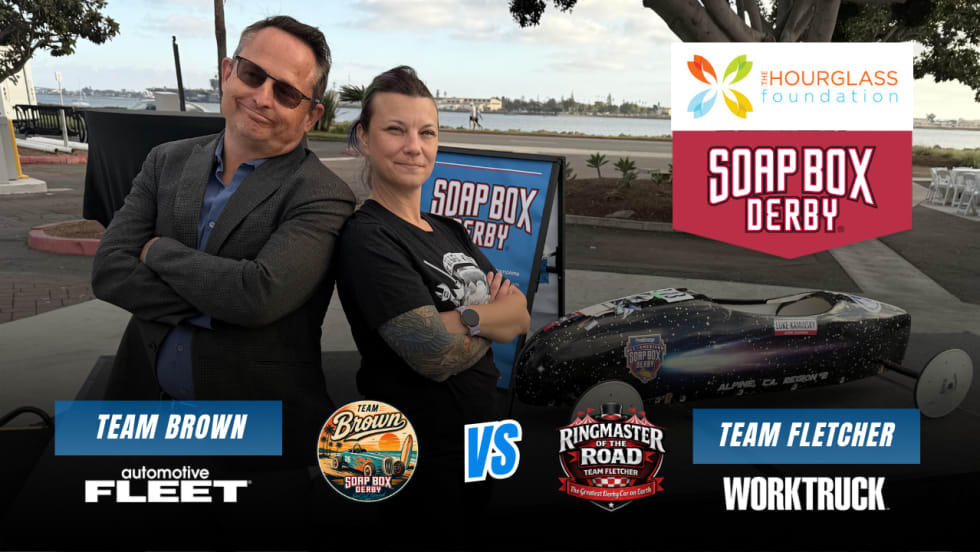
It's All Downhill from Here! Fleet Industry Raises $22,000 for Skilled Trades Scholarships
Work Truck’s Lauren Fletcher and Automotive Fleet’s Chris Brown turned a friendly racing rivalry into $22,000 for automotive technology and skilled trades scholarships.
Read More →