



Dig Deeper:
Identifying Direct and Indirect Costs of Fleet Accidents
 MENU
MENU SEARCH
As economic indicators of a financial slowdown grow more pointed, AF Editor Mike Antich cautions fleet managers to anticipate and prepare for mounting numbers of scam accidents putting their drivers and companies at risk.
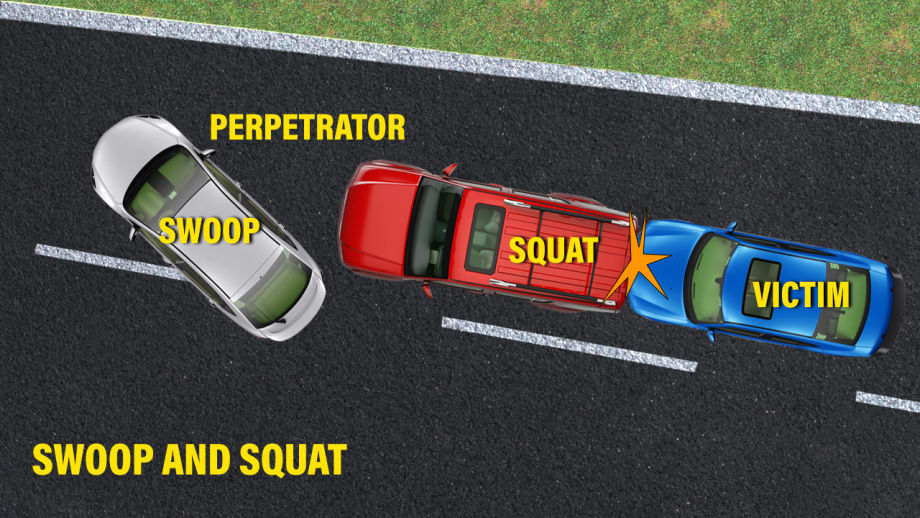
Historically, during economic downturns, incidents of scam accidents have increased. The common “Swoop and Squat” staged accident typically involves two or sometimes three criminal vehicles.
Image: National Insurance Crime Bureau
The forecast of an economic slowdown in calendar-year 2023 has been extensively written about in many respected business publications, and it’s a frequent topic of discussion by economists and analysts on many cable business programs, such as those produced by Bloomberg or CNBC.
However, historical precedents also can offer valuable credence when forecasting near-term future business activity. One example is starting to play out in today’s market.
One early indicator of economic stress is the volume of vehicle repossessions from consumers behind on their loan payments. Today that number is increasing, and it is catching the attention of many people.
An increase in vehicle repossessions is a recurring historical precedent that is often a prelude to an economic downturn. We’ve seen this phenomenon repeatedly over the past three decades. When the volume of vehicle repossessions increases, it's comparable to the proverbial canary in the coal mine, which supports the contention of those economist and analysts who say an economic slowdown is currently in the works.
We can also anticipate many other historical precedents to occur in calendar-year 2023 if we are indeed in the start of an economic slowdown.
An examination of historical precedent from past economic slowdowns or — worst case — past economic recessions invariably reveals economic downturns trigger an increase in insurance fraud. This historical precedent has been well documented over the years by the insurance industry.
Based on past loss experience, insurance fraud increases an estimated average 24% whenever the economy begins to slow down.
Insurance fraud can be manifested in many different forms. In the fleet industry, the number one type of insurance fraud committed against company vehicles in terms of total dollar value is fraudulent staged crashes, based on data compiled by the National Insurance Crime Bureau.
Why does this fraudulent activity occur? An analogy can put the answer in context. One of history’s most quoted bank robbers was Willie Sutton. When Willie was asked why he robbed banks, he answered, “Because that’s where the money is.”
Likewise, staged accident perpetrators engage in this fraud because they know that’s where they can make the most money with a lower probability of being apprehended.
Insurance fraud against commercial vehicles is very lucrative because criminals know a company vehicle will be insured or if self-insured, most companies will often settle out of court once a lawsuit has been filed.
Even small vocational businesses that operate only a few vehicles will typically, on average, carry a minimum of $1 million in liability insurance. For some criminals, this is an attractive incentive to engage in sham staged accidents.
While some staged accidents are amateur crimes, most are carefully planned and practiced in advance of the actual incident.
Fleet managers must be proactive in defending their companies against this type of fraud, which has a good probability of increasing in calendar-year 2023.
But more importantly, they must also make their company drivers aware this risk exists so they will know how to spot it and take precautionary maneuvers to keep themselves safe.
The National Insurance Crime Bureau has identified four common situations that carry a high likelihood of a staged accident. As a fleet manager, it is incumbent to remind company drivers to be on guard for the high-risk traffic situations where staged accidents often occur so they can be vigilant for these potential threats.
Here are four examples of staged accidents:
One of the most common staged crashes is called the “Swoop and Squat.” (Image 1) This staged crash typically involves two or sometimes three criminal vehicles. Two criminal vehicles will drive parallel to one another in same-facing lanes while a company vehicle is innocently following one of them.
In this case, one criminal vehicle will pull out in front of the other criminal vehicle, which will abruptly brake, causing your company vehicle to rear end it.
Sometimes a third accomplice vehicle may be involved, simultaneously pulling up alongside the company vehicle, preventing it from swerving to avoid the accident.
The overwhelming majority of company drivers are unaware of the “Swoop and Squat” scam. Fleet managers must inform drivers of this threat.
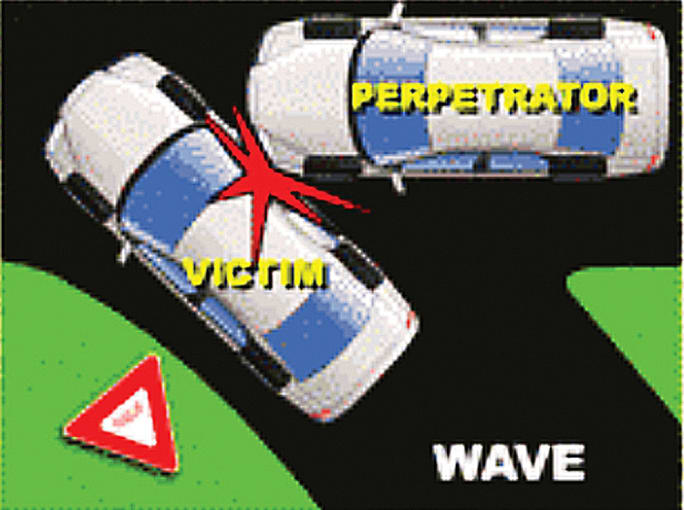
In the “Wave” staging, a criminal gives a false courtesy wave to the company driver, indicating they may proceed, then accelerates to crash into the company vehicle.
Image: National Insurance Crime Bureau
The second common staged crash is known as the “Wave.”
As illustrated in Image 2, the criminal driver will notice a company vehicle is attempting to switch lanes. He or she will give a courtesy wave to the company driver, indicating they may proceed. As the company driver maneuvers into the lane, the criminal driver will accelerate, colliding with the company vehicle.
When the police arrive, the criminal driver will deny ever giving a courtesy wave, stating the company driver was at fault for the collision.
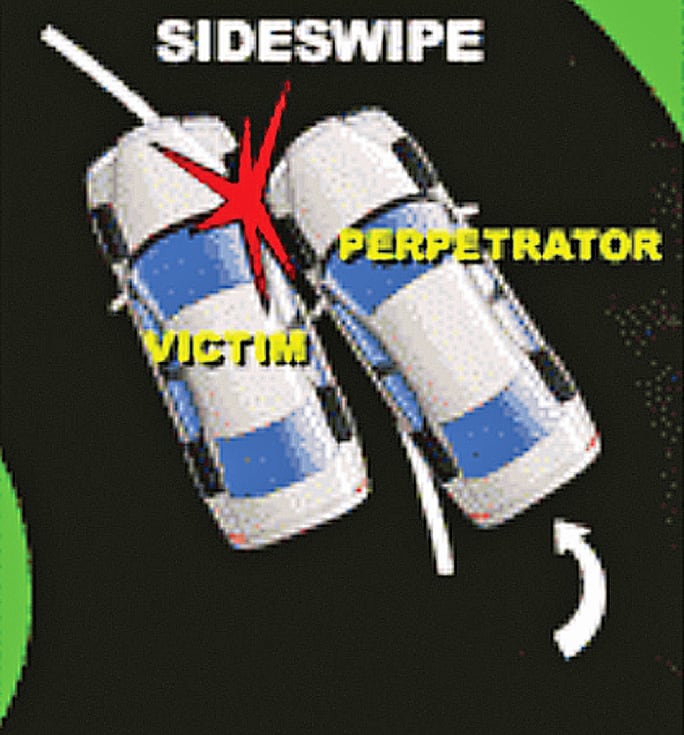
In the intentional sideswipe situation, the criminal drives in the outer lane of dual turning lanes, then rams or sideswipes the company vehicle as it simultaneously makes the turn.
Image: National Insurance Crime Bureau
The third most common staged crash is the intentional sideswipe. (Image 3) In this situation, a criminal driver in the outer lane of dual turning lanes rams or sideswipes the company vehicle while they are simultaneously making the turn. Advise company drivers to avoid turning, if possible, in parallel with another vehicle.
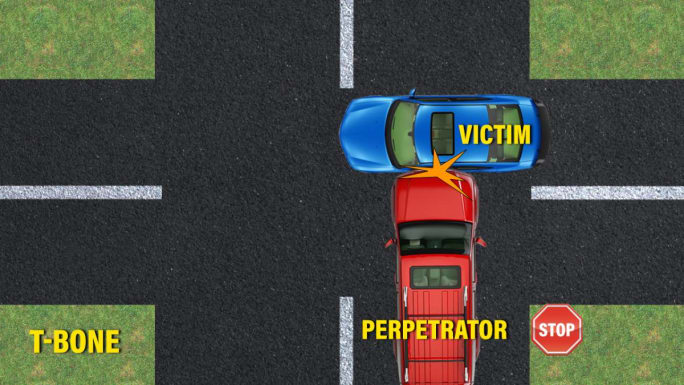
In a T-Bone staged crash, a criminal accelerates into a company vehicle, while scam "bystander" accomplices claim the company car ran a red light or stop sign.
Image: National Insurance Crime Bureau
Another type of staged accident incorporates the T-Bone Crash scenario. (Image 4)
In this setup, a criminal waits for a company vehicle to proceed through an intersection, then accelerates to T-Bone the company vehicle. Also participating in the scam are accomplices pretending to be bystanders on the street who witness the accident. When the police arrive, these accomplice witnesses claim the company vehicle ran the stop sign or traffic signal.
Many companies simply install dash cams to combat against this type of staged accident to avoid a driver’s word versus the criminal’s word situation.
Here are four recommendations for drivers who become victims of staged accidents.
The best defense against staged accidents by company drivers is to drive carefully and be vigilant of their surroundings. The best defense against staged accidents is to prevent them from occurring
To prevent the “swoop and squat” scenario that requires a sudden stop by the company vehicle, instruct drivers to never tailgate. Direct drivers to leave enough room to make a panic stop without hitting the vehicle in front of them.
When a collision has occurred and it is safe to do so, train drivers to immediately use their phones to photograph all damage done to the criminal’s vehicle. This step will limit the criminal’s ability to exaggerate the damage done to their vehicle.
In any fraudulent accident, a company may find itself liable for injuries its driver didn’t cause. This scam involves other criminals who are called “Jump-ins.” After the collision occurs, people suddenly appear and jump into the criminal’s damaged vehicle claiming they were passengers.
At the scene of the accident, train company drivers to pay close attention to the number of people in the other car and record each individual’s contact information. This measure will minimize the number of jump-ins who fraudulently claim they were in the vehicle at the time of the collision.
Always call the police, even if damage is minimal, to generate an official police report.
The more information a fleet driver can provide the company’s insurance provider or its risk and legal departments, the better equipped a fleet manager is to fight this type of fraud.

Rising operating costs, driver safety concerns, and unplanned downtime are putting unprecedented pressure on modern fleets. Discover how fleet managers use embedded OEM connectivity and real-time vehicle data to cut TCO, prevent downtime, and protect drivers without aftermarket telematics hardware.
Read More →
Mental health belongs in the fleet safety conversation. This week, we’re looking at five ways fleets can support employee well-being before a crisis, plus Holman’s expansion in Mexico, new one-day Fleet Forward passes, and why EV charging demand is outpacing infrastructure growth.
Read More →
Stefan Heck tells Automotive Fleet that combining more than 10 billion miles of driving history with Nexar's AI models will give fleets deeper insights into driver risk and roadway conditions than either company could provide independently.
Read More →
For Suicide Prevention Month, fleet and safety leaders have an opportunity to put mental health where it belongs: at the center of workplace safety.
Read More →
Insights from a commercial insurance carrier and a broker show how fleets can turn video telematic data, driver coaching, and improved claims results into a stronger case at insurance renewal.
Read More →
You’ve made the telematics investment. Here’s how to capture the other half of its value and build the safest fleet on the road.
Read More →
Fleet compliance isn't just about having policies — it's about consistently enforcing them. This practical guide reveals six hidden compliance risks common in public sector and shared fleet operations and outlines proven strategies to improve visibility, accountability, and audit readiness
Read More →
The Sept. 15–17 program will feature fleet benchmarking data, case studies, emerging technologies, and implementation strategies while running alongside the NSC Safety Congress & Expo.
Read More →
NETS quantifies costs dispersed across fleet, risk, HR, and other departments while providing new per-crash benchmarks for employers.
Read More →
The recall affects certain 2019-2026 Ram 1500 pickups that may have improperly attached second-row seat belt buckle anchors.
Read More →