




Safety Starts Before an Accident: Understanding StabiliTrak
GM keeps vehicles on the road with all-wheel drive, StabiliTrak, and traction control, and makes sure vehicles stop with anti-lock brake systems.

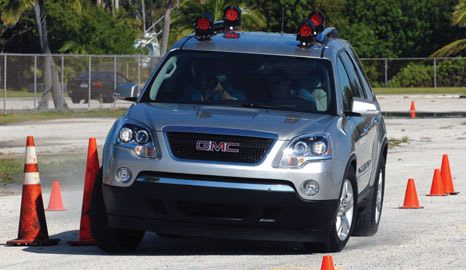
When a vehicle’s wheels lock up on wet and slippery roads or during a panic stop, the driver may lose traction and control, causing the vehicle to spin. Anti-lock brake systems (ABS) keep wheels from locking up, so the vehicle maintains directional control around hazards.
Photo: General Motors
General Motors is focused on providing comprehensive safety before, during, and after a crash. Before, according to the manufacturer, means avoiding a crash. GM has several safety innovations that help keep a vehicle on the road and in one piece.
StabiliTrak Saves Lives
In 1997, GM first introduced StabiliTrak, also known as electronic stability control (ESC), on its vehicles. Using sensors to detect the difference between the steering wheel angle, the direction the vehicle is turning, as well as other situational factors, StabiliTrak applies quick, precise force to the appropriate brakes to help drivers control a vehicle’s direction and keep it on course.
In low-traction conditions such as ice, snow, gravel, wet pavement, and uneven road surfaces, StabiliTrak helps significantly reduce single-vehicle crashes, according to the Insurance Institute for Highway Safety (IIHS). The federal government is mandating ESC on all new light vehicles by 2012. According to the manufacturer, all GM retail cars and trucks sold in the U.S. will have ESC standard by the end of 2010.
Anti-lock Brakes Stop Vehicles Quickly
When a vehicle’s wheels lock up on wet and slippery roads or during a panic stop, the driver may lose traction and control, causing the vehicle to spin. Anti-lock brake systems (ABS) keep wheels from locking up, so the vehicle maintains directional control around hazards.
ABS reduces the chances of wheel lockup by rapidly adjusting brake pressure. More specifically, ABS automatically changes the brake fluid pressure at each wheel to maintain optimum brake performance — just short of locking up the wheels. An electronic control unit regulates brake fluid pressure in response to changing road conditions or impending wheel lockup.
ABS works with the StabiliTrak system and is currently standard on most 2008-model GM vehicles.
Traction Control Keeps Vehicles on the Road
By selectively applying brake pressure to individual wheels, traction control helps reduce wheel spin on loose or slippery surfaces, according to GM. In the past, drivers had to feather the gas pedal to prevent the drive wheels from spinning wildly on slippery pavement.
Traction control systems are designed to help prevent a vehicle from slipping and sliding during acceleration. They improve vehicle stability by controlling the amount the drive wheels can slip when extra power is applied. The system automatically adjusts the engine power output and, in some systems, applies braking force to selected wheels during acceleration. Traction control is found primarily on vehicles with four-wheel, anti-lock brake systems and is standard on most 2008-model GM vehicles.
Additional Safety Features
GM vehicles that come equipped with all-wheel drive (AWD) systems feature the ability to transfer torque to some or all wheels, depending upon conditions. According to GM, this allows the system to maximize fuel economy, traction, or both.
Additional safety features such as daytime running lamps have saved 433 lives and averted 85,000 crashes of all types since 1995, according to the manufacturer.
Another new innovation is Eye Cue. By projecting critical information such as speed, high-beam status, turn signal status, and “check gauges,” onto the windshield, Eye Cue helps keep eyes where they belong: on the road ahead.
More Safety

Does Your Fleet's Culture Encourage Distracted Driving?
What happens when the people responsible for enforcing safety rules are the ones setting the wrong example? The answer may reveal why some of the biggest risks to fleet drivers have little to do with what's written in the employee handbook.
Read More →
Fleet Manager’s Ultimate Playbook: Navigating the New Standard in OEM Connectivity
Rising operating costs, driver safety concerns, and unplanned downtime are putting unprecedented pressure on modern fleets. Discover how fleet managers use embedded OEM connectivity and real-time vehicle data to cut TCO, prevent downtime, and protect drivers without aftermarket telematics hardware.
Read More →
From Driver Well-Being to EV Charging | AF News Recap
Mental health belongs in the fleet safety conversation. This week, we’re looking at five ways fleets can support employee well-being before a crisis, plus Holman’s expansion in Mexico, new one-day Fleet Forward passes, and why EV charging demand is outpacing infrastructure growth.
Read More →
Nexar-Nauto Merger Aims to Give Fleets Better Safety Intelligence Through Larger Driving Dataset
Stefan Heck tells Automotive Fleet that combining more than 10 billion miles of driving history with Nexar's AI models will give fleets deeper insights into driver risk and roadway conditions than either company could provide independently.
Read More →
Don't Wait for a Crisis: 5 Ways to Build Mental Health Into Your Fleet Safety Program
For Suicide Prevention Month, fleet and safety leaders have an opportunity to put mental health where it belongs: at the center of workplace safety.
Read More →
How Camera Data Can Strengthen a Fleet’s Insurance Renewal
Insights from a commercial insurance carrier and a broker show how fleets can turn video telematic data, driver coaching, and improved claims results into a stronger case at insurance renewal.
Read More →
The Safest Fleets Aren’t the Ones with the Most Technology
You’ve made the telematics investment. Here’s how to capture the other half of its value and build the safest fleet on the road.
Read More →
Hidden in Plain Sight: Fleet Compliance Risks
Fleet compliance isn't just about having policies — it's about consistently enforcing them. This practical guide reveals six hidden compliance risks common in public sector and shared fleet operations and outlines proven strategies to improve visibility, accountability, and audit readiness
Read More →
NETS Sets 2026 Fleet Safety Benchmark Conference for Indianapolis
The Sept. 15–17 program will feature fleet benchmarking data, case studies, emerging technologies, and implementation strategies while running alongside the NSC Safety Congress & Expo.
Read More →
Off-the-Job Crashes Account for 43% of Employers’ $61.7 Billion Crash Burden
NETS quantifies costs dispersed across fleet, risk, HR, and other departments while providing new per-crash benchmarks for employers.
Read More →