




Don't Miss This: Distracted Driving - Managing Inattentional Blindness
Reduce Accidents by Avoiding 4 Common Roadway Hazards
All fleets and drivers face risks during the job, but four major hazards can be prevented with these steps.
by John Kuder, Avatar Fleet
April 4, 2022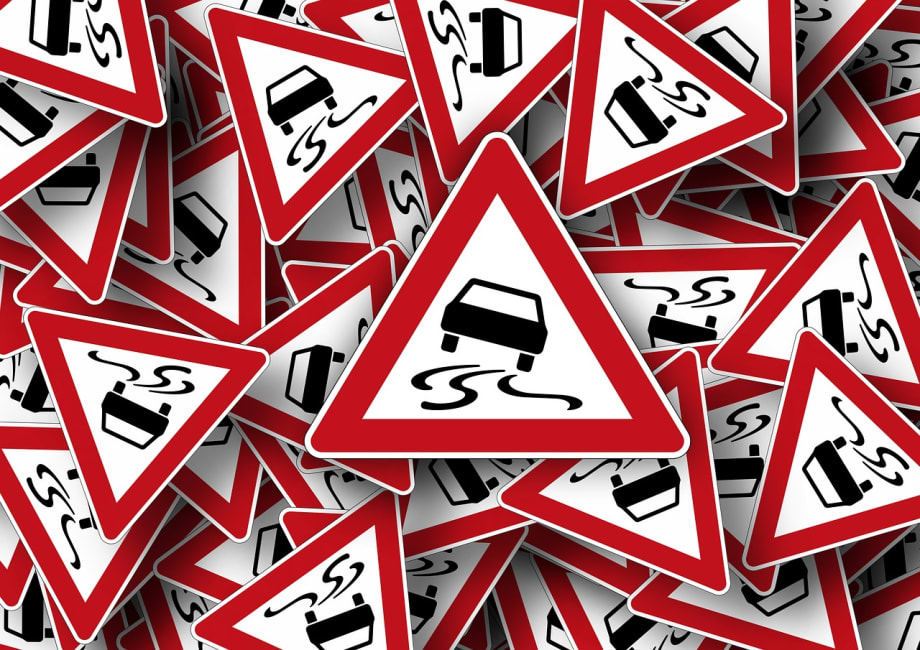
To avoid accidents on the road, remind drivers to leave enough following distance, practice safety at intersections, avoid distractions, and never drive under the influence.
Photo: Gerd Altmann/Pixabay
6 min to read
Your non-CDL driver accidents and injuries are costing you money. Worse yet, they result in pain and suffering. If you want to reduce accidents, injuries, and cost of loss, you need to invest in reducing these four major risks.
1. Distracted Driving
Distracted driving is the leading cause of accidents. If you think it doesn’t impact your company, you’re wrong. Nearly every person is guilty of distracted driving at some point.
Distracted driving can include:
Texting.
Talking on the phone.
Daydreaming.
Eating/drinking.
Talking to passengers.
And much more.
Even one second of not paying attention behind the wheel can lead to an accident.
Not only is distracted driving a major cause of accidents, but it often leads to more serious accidents. Distracted driving is a leading cause of fatal accidents due to high-speed collisions and pedestrian/cyclist strikes.
We guarantee that your drivers are putting themselves at risk by driving distracted.
Preventing Distracted Driving
The first step a company should take is implementing rules and policies on distracted driving. This sends the message that you care about safety and that, when behind the wheel, nothing matters more than driving.
However, on their own, rules and regulations will do little to prevent accidents. People break rules all the time.
Take these steps to reduce distracted driving accidents at your company.
Train your drivers to be attentive behind the wheel.
Only select and hire safety-conscious employees.
2. Impaired Driving
OSHA lists impaired driving or drunk driving as a top five cause of accidents. Substances such as alcohol and other depressants, stimulants, hallucinogens, and opiates greatly increase a driver’s risk of collision.
All of these substances will do one or more of the following:
Reduce reaction time.
Impair decisionmaking.
Increase the risk of falling asleep at the wheel.
It goes without saying: Illegal drugs and driving don’t mix. However, certain legal drugs can impair your ability to drive as well. It’s important that your drivers know how the medications they’re taking will affect them.
Preventing Impaired Driving
It’s important to educate your drivers on the dangers of impaired driving. However, if someone decides to drive impaired, it’s unlikely that education and training would have prevented them from doing so. Their tolerance for risk is just too high to be a driver.
Instead, it’s important to focus on the following preventative measures.
Proper drug testing: You may already be mandated by OSHA to perform drug testing. If not, you should test your employees for drug use in the following circumstances:
At time of hire.
Post-accident.
Reasonable suspicion.
Randomized testing.
Implement zero tolerance policy: Your company or organization must have a clear and strict policy on drug and alcohol usage. If an employee is found to have alcohol or illegal drugs on company grounds, he or she will be terminated. Employees driving under the influence will be terminated as well. Finally, you must have a policy in place for employees to report their medications to managers. Require your employees to let management know when they’re taking a medication that will impair their ability to drive.
Proper selection and hiring: As mentioned above, if someone drives impaired, they are likely just a risk-taker. You can’t change that about them. That’s why it’s important to select and hire employees who have the necessary traits and characteristics to succeed at your company. You should:
Determine the specific characteristics of your ideal job candidate.
Implement a realistic job preview during the hiring process.
Utilize selection tools like personality assessments and structured interviews.
Only hire employees who fit your needs.
3. Failure to Maintain a Safe Following Distance
Another leading cause of accidents is the failure to maintain a safe following distance. When your drivers don’t leave enough room in front of them, they put themselves at risk of serious accidents.
It’s simple: If you can’t stop in time, you’re going to have accidents.
Improper following distance often results in the following accidents, all of which can have severe consequences:
Rear-end collisions from not being able to stop in time.
Being hit from behind after suddenly stopping.
Sideswipes from avoiding rear-end collisions.
Off-road incidents from making evasive maneuvers.
Rollovers from suddenly needing to change directions.
How to Ensure Your Drivers Leave Enough Room
As common as the accidents we mentioned above are, they’re so easy to prevent. Your drivers just need to leave enough room in front of them.
How much room should they leave? It depends on the vehicle type. The minimum safe following distances based on vehicle class is:
Class 1 & 2 vehicles (vans, sedans, and light-duty trucks): 3 seconds.
Class 3 & 4 vehicles: 4 seconds.
Class 5 vehicles: 5 seconds.
Class 6 vehicles: 6 seconds.
Class 7 vehicles and up: 7 seconds or more.
Your drivers should have their minimum safe following distance for their vehicle type memorized. And, they should never follow someone too closely. Of course, you need to implement effective safety training to get them there.
Invest in online defensive driving training focused on maintaining a safe following distance.
Host monthly safety meetings to discuss loss-leaders like not leaving enough room.
Do ride-alongs with your drives to ensure they leave enough room in front of them.
4. Unsafe Driving at Intersections
Intersections are the most dangerous driving environment your employees face.
Intersections pose the risk of:
Rear-end collisions.
Side-swipes.
Fixed object strikes.
T-bone accidents.
Head-on collisions.
Pedestrian and cyclist collisions.
Your drivers’ risk of these collisions goes up at intersections because of all the variables. Other vehicles, people on the road, and changing traffic patterns increase the chance of accidents.
Your drivers need to know how to safely navigate intersections in order to prevent these common and costly accidents.
Preventing Accidents at Intersections
To reduce your accidents and cost of loss, implement an online defensive driving program that teaches drivers the following:
Look ahead for risk at intersections. As you approach an intersection, look ahead for other vehicles, pedestrians, turn-only lanes, and the status of the light.
Cover your brake as you approach an intersection. You must always be prepared to stop.
Yellow means stop. Never speed up to make a yellow light. Slow down and come to a safe stop. Remember: it’s better to be late than it is to have an accident.
Look around before entering the intersection. Scan the intersection for risk. Before entering the intersection, look left, right, then left again to make sure it’s clear.
Look around before turns. Turns are a common cause of accidents at intersections. Look around, check your blindspots, and check the intersection before making a turn.
Accidents Can Be Prevented
Accidents don’t “just happen.” They are caused by people and their unsafe behaviors. When your drivers don’t prioritize safe, defensive driving, they put themselves and your company at risk.
The good news is that accidents can be prevented. If you invest in safety programs that reduce your non-CDL drivers’ unsafe behaviors, you will have fewer accidents.
This means your employees make it home safe, you will have a more efficient operation, and your cost of loss will plummet.
Investing in safety is a win for everyone.
About the Author: John Kuder is a senior instructional designer at Avatar Fleet, the creators of the non-CDL safety training course, The Fleet Safety Course.
Subscribe to Our Newsletter
More Safety

Sponsored•October 1, 2026
Fleet Manager’s Ultimate Playbook: Navigating the New Standard in OEM Connectivity
Rising operating costs, driver safety concerns, and unplanned downtime are putting unprecedented pressure on modern fleets. Discover how fleet managers use embedded OEM connectivity and real-time vehicle data to cut TCO, prevent downtime, and protect drivers without aftermarket telematics hardware.
Read More →
From Driver Well-Being to EV Charging | AF News Recap
Mental health belongs in the fleet safety conversation. This week, we’re looking at five ways fleets can support employee well-being before a crisis, plus Holman’s expansion in Mexico, new one-day Fleet Forward passes, and why EV charging demand is outpacing infrastructure growth.
Read More →
Nexar-Nauto Merger Aims to Give Fleets Better Safety Intelligence Through Larger Driving Dataset
Stefan Heck tells Automotive Fleet that combining more than 10 billion miles of driving history with Nexar's AI models will give fleets deeper insights into driver risk and roadway conditions than either company could provide independently.
Read More →
Don't Wait for a Crisis: 5 Ways to Build Mental Health Into Your Fleet Safety Program
For Suicide Prevention Month, fleet and safety leaders have an opportunity to put mental health where it belongs: at the center of workplace safety.
Read More →
How Camera Data Can Strengthen a Fleet’s Insurance Renewal
Insights from a commercial insurance carrier and a broker show how fleets can turn video telematic data, driver coaching, and improved claims results into a stronger case at insurance renewal.
Read More →
The Safest Fleets Aren’t the Ones with the Most Technology
You’ve made the telematics investment. Here’s how to capture the other half of its value and build the safest fleet on the road.
Read More →
Sponsored•August 7, 2026
Hidden in Plain Sight: Fleet Compliance Risks
Fleet compliance isn't just about having policies — it's about consistently enforcing them. This practical guide reveals six hidden compliance risks common in public sector and shared fleet operations and outlines proven strategies to improve visibility, accountability, and audit readiness
Read More →
NETS Sets 2026 Fleet Safety Benchmark Conference for Indianapolis
The Sept. 15–17 program will feature fleet benchmarking data, case studies, emerging technologies, and implementation strategies while running alongside the NSC Safety Congress & Expo.
Read More →
Off-the-Job Crashes Account for 43% of Employers’ $61.7 Billion Crash Burden
NETS quantifies costs dispersed across fleet, risk, HR, and other departments while providing new per-crash benchmarks for employers.
Read More →
Ram Recalls More Than 1.27 Million 1500 Pickups for Seat Belt Anchor Issue
The recall affects certain 2019-2026 Ram 1500 pickups that may have improperly attached second-row seat belt buckle anchors.
Read More →