




Ramifications of a 67 MPH Top Speed
This cross-country service fleet uses engine calibration technology to control each van’s top speed — improving driver safety and fuel usage.


Using Derive’s technology, Loring White, CEO of CBE Inc., was able to set the maximum speed limit on each van to 67 miles per hour. Photo courtesy of CBE.

Using Derive’s technology, Loring White, CEO of CBE Inc., was able to set the maximum speed limit on each van to 67 miles per hour. Photo courtesy of CBE.
In addition to using telematics to track his drivers, Loring White wanted to set a maximum speed limit for each of his fleet vans. After looking at a few options, he went with Derive Efficiency’s engine calibration technology.
“We use Derive’s technology to limit how fast each van can go,” says White, CEO of CBE Inc., a cross-country service fleet that sells and services point-of-sale solutions and security products. “We wanted to save on fuel. The faster you drive, the more fuel you use. And in my opinion, we are protecting our drivers from speeding and potentially getting tickets.”
By installing Derive’s engine calibration technology into each of his vans, White is able to program the vehicle before it goes out into the field.
“We set the software [that controls the engine] to maximum economy efficiency so we can get the best gas mileage,” says White.
Based in Montgomery, Ala., CBE’s fleet is made up of 150 Chevrolet Express 2500 vans, according to White. Currently, the company has technicians in 40 U.S. states, mainly in the Midwest and East.
How It Works
Using Derive’s technology, White was able to set the maximum speed limit on each van to 67 miles per hour. To White, maintaining a lower speed better controls gas mileage and reduces wear and tear on each van.
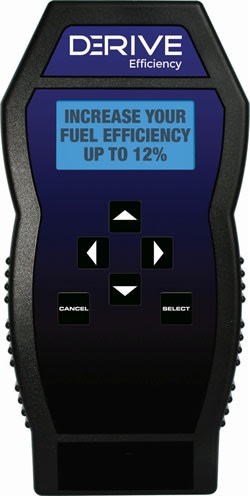
Derive's engine calibration technology can reduce fuel usage by lowering a vehicle's speed and decreasing idling time. Photo courtesy of Derive.
“We have been using Derive Systems for about a year and have already seen a decrease in fuel use,” says White.
White feels more at ease knowing that his drivers can’t go above 67 mph in his vehicles.
“We get complaints from our drivers about the set driving speed,” says White. “But most of them don’t realize the speed limit is for their own good. I don’t want my technicians speeding and getting speeding tickets. I want them to keep a clean driving record and want them to be safe.”
Additionally, the software provides a setting for idle RPM reduction. White says he sets each of his vans to maximum for idle reduction, which helps reduce fuel consumption during idling events when vehicles are stopped.
According to Derive, its engine calibration technology can reduce fuel usage by 10% while decreasing carbon emissions by 16%.
A technician installs the Derive software through a vehicle’s OBD-II port to recalibrate the on-board computer, according to Charlie Mahoney, Derive’s business development manager. Mahoney compares it to updating the software on your cellphone.
“We sent Derive devices to Loring and they can make changes to the vehicle’s top speeds, shifting parameters, and idling,” says Mahoney. “It takes about 17 minutes to plug the device into a vehicle and program it.”
Once the recalibration is complete, the device is removed. The software license is good for that vehicle until you sell it, says Mahoney.
Service Vans
Because White tries to sell his vans between 75,000 and 85,000 miles, he needed a service that would allow him to reset the vehicle’s calibrations before he resold it. Derive’s product allows him to do this.
“With Derive, we can reprogram the vans back to factory default when we get ready to resell them,” says White. “You could buy a similar product through General Motors, but once you change the settings on the vehicle, you can’t reset them. We went with Derive because we resell all of our vans ourselves.”
CBE technicians service and install point-of-sales systems and security camera systems at 25,000 to 27,000 petroleum convenience store locations nationwide, including Circle K.
Each van is outfitted the same with shelving, a ladder and rack, as well as an aluminum bin package by Masterack.
“We carry about $25,000 worth of electronic inventory in each van,” says White. “Each piece of equipment is numbered and assigned to a bin number.”
Originally posted on Work Truck Online
More Vehicle Research

EV Realty Names Henrik Holland President as Charging Platform Expands
The former Prologis Mobility and Shell executive will help expand EV Realty’s truck charging business and move its power-first infrastructure model into autonomous vehicle depots and other fleet sectors.
Read More →
Mercedes-Benz Introduces Electric GLC With Up to 350 Miles of Range
The GLC 400 4MATIC Electric features an 800-volt architecture, 330-kW DC fast charging and a 94-kWh battery, along with Mercedes-Benz's new MB.OS operating system.
Read More →
Fleet Has a Talent Pipeline Problem, not a Talent Problem
Where will the next generation of fleet leaders come from, and what does the industry need to do differently to find them?
Read More →
Fleet Hacks: What Are You Still Doing Manually?
From daily recaps to repeatable workflows, fleet professionals share how AI can cut through busywork while keeping human judgment at the center.
Read More →
How One Fleet Manager Put a New Spin on Safety Training
Joe Lewis turned a pre-trip inspection lesson into an AI-assisted song, then four safety albums. The experiment also revealed why human oversight matters when AI enters driver training.
Read More →
2027 Ram ProMaster City Starts Under $40K
Ram is returning to the smaller commercial van market with a new ProMaster City aimed at delivery, service, trade, and passenger applications. Starting at $39,995 with destination, the 2027 van offers up to 2,000 pounds of towing capacity, more than 2,000 pounds of payload, and multiple cargo and passenger configurations.
Read More →
New Tariff Threats & a Leadership Change at Wheels | AF News Recap
A new tariff threat is creating more uncertainty for fleet ordering, Wheels has named a new president, and we’re asking whether certification is really worth the investment.
Read More →
Certification: What’s in It for the Fleet Manager?
From smarter fleet decisions to stronger career credibility, certification can give fleet managers knowledge they may never gain inside a single operation.
Read More →
Wheels Names Matthew Cole President
Cole brings more than 30 years of automotive and technology experience to the fleet management company, including leadership roles at Aptiv, Visteon and Johnson Controls.
Read More →
AI is changing what fleet managers can build & 849,000 vehicles recalled | AF News Recap
Fleet managers are learning how to build their own AI-powered tools, Stellantis is recalling nearly 849,000 vehicles, and this year’s Fleet Manager of the Year finalists have been revealed. Additionally, we’re examining how to identify repairs that warrant a second look. Here’s what you need to know this week.
Read More →