




Propane Cleans Up Medium-Duty Trucks
Not only does propane offer lower capital costs than diesel power, but tax credits are also available for the resulting low-emission vehicles.

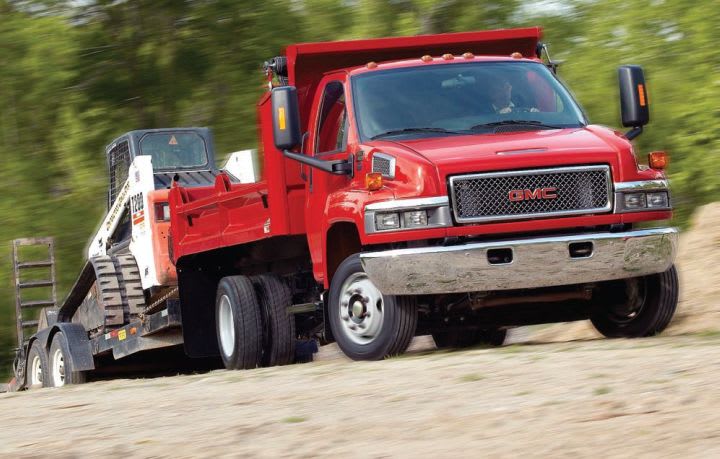
Medium-duty trucks such as this GMC Topkick can be ordered with the LPI fuel system.
Photo: GMC
CleanFUEL USA has teamed with two other companies to develop and market propane-powered versions of trucks with General Motors (GM) 8.1L V-8 Vortec gasoline engine.
The Kodiak and GMC Topkick 3500-7500 series trucks use a liquid propane injection (LPI) fuel system developed by the Italian propane engineering company, ICOM, in conjunction with CleanFUEL USA. GM supplies engines compatible with gaseous fuels and vehicle bodies. The ICOM-developed system is installed, the vehicle control module (VCM) is reprogrammed, and the truck is shipped to the dealer for buyer pick up.
The LPI system used in the vehicles replaces the gasoline fuel tank, fuel pump, and fuel injector rails with a pressurized system that delivers propane to the engine ports as a liquid. The engine’s VCM is reprogrammed to run on liquid propane instead of gasoline to operate in the trucks. The LPI system controls fuel mixing and keeps the propane from vaporizing before injection.
Responding to Demand
In 2004, according to the CleanFUEL USA Web site, they responded to a demand by medium-duty truck and bus operators for a propane engine alternative. In conjunction with ICOM of Cisterna, Italy, the company developed an LPI system using its proprietary JTG-Common Rail technology for the GM 8100 Vortec engine. Based on European technology with more than 27,000 systems already in use, the LPI system delivers propane to the cylinders in liquid form, resulting in improved fuel economy and superior performance with lower emissions. The emissions meet estimated EPA requirements through the 2009 production year for both EPA 49 State and the California Air Resource Board (CARB) certification.
LPI is not just a liquefied petroleum gas (LPG) propane fuel system. It is an integrated system, designed specifically for the OEM engine. Using the GM P-59 engine computer with a dedicated calibration specifically for propane, the LPI system replaces the gasoline fuel tank, fuel pump, and injector rails with a propane fuel tank, pump, and injector rails. LPI is a direct replacement for the OEM gasoline injection system.
Cost Advantages
The LPI vehicles cost about $10,000 more than their gasoline counterparts but represent a $6,000 savings from a comparable diesel-powered truck. Taxable entities are eligible for a tax credit that equals 50% of the incremental cost of the vehicle, plus an additional 30% of the incremental cost for vehicles with near-zero emissions under the EPAct 2005’s Alternative Fuel Motor Credit. The LPI system on GM 3500-7500 series trucks is eligible for an 80% incremental cost credit. The propane used in the vehicles is also eligible for a 50-cent per gallon credit, regardless of tax status under the SAFETEA-LU Volumetric Excise Tax Exemption program.
For additional sustainability tips and information, check out Clean Fuels.
Originally posted on Work Truck Online
More Global Fleet
GeoFencing Adds to Your Truck Security Arsenal
Geofencing is a familiar fleet tool today, but its early adoption marked a major shift in vehicle tracking, route monitoring, and the debate over employee privacy.
Read More →
Holman Takes Full Ownership of ARIZA in Mexico
Holman is bringing its Mexican fleet management operation fully under its own brand after more than 30 years as a joint venture. The change gives multinational fleet customers a single Holman operation across the U.S., Canada, and Mexico.
Read More →
5 Tire Maintenance Tips to Help Prevent Work Truck Downtime
Regular tire checks can do more than extend tread life. These five maintenance practices can help work truck fleets catch problems early, reduce costs, and prevent downtime.
Read More →

Proven Ways to Reduce Work Truck Downtime
The age-old problem of downtime will always be a reality, but with new strategies at hand, fleets have more ways to keep trucks on the road longer.
Read More →


Cameras, Safety and Insurance: From Reactive Claims to Real-Time Prevention (Part 2 of 2)
Part Two: Commercial auto remains one of the most challenging and costly lines of coverage for fleet operators and insurers alike. Continue learning more about how to effectively address these issues from Onur Aksan, Enterprise Business Development Executive, Geotab
Read More →
Cameras, Safety and Insurance: From Reactive Claims to Real-time Prevention
Commercial auto remains one of the most challenging and costly lines of coverage for fleet operators and insurers alike. Learn more about how to effectively address these issues from Onur Aksan, Enterprise Business Development Executive, Geotab.
Read More →
Fleet Costs Are Rising: Here’s How Leaders Are Responding
Fleet leaders are under pressure to reduce costs, adapt to economic uncertainty, and make smarter decisions. See how peers across North America are responding with real data, proven strategies, and forward-looking insights. Download the 2026 Market Pulse Report to benchmark your strategy and uncover where you can gain an edge.
Read More →
Enterprise Fleet Management Surpasses 900,000 Vehicles in U.S. & Canada
Enterprise Mobility connects with mobility solutions around the globe
Read More →