




Proactively Preventing Food Contamination
As the final piece of the FDA’s Food Safety Modernization Act (FSMA) is set to take effect, small fleets are assessing ways to switch from a manual recording of temperature inside refrigerated units to an automated process.
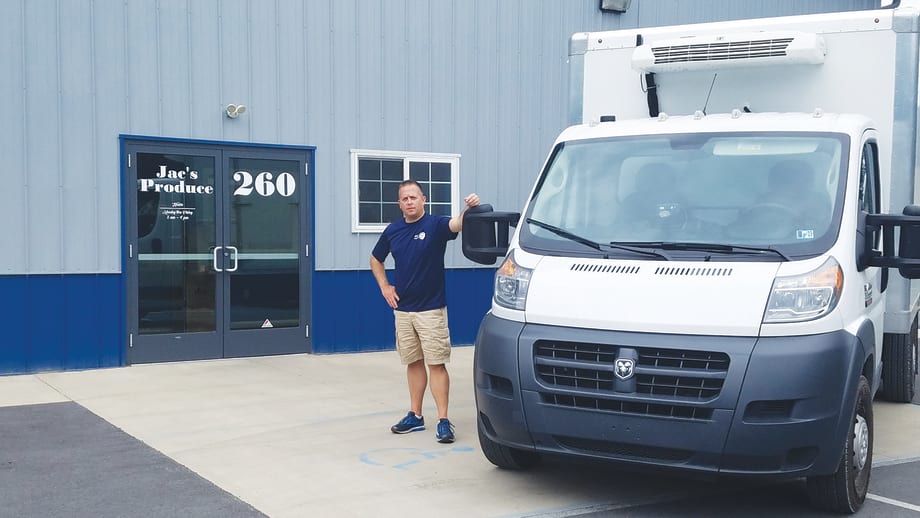
Gregory Anthony, owner of Jac’s Produce of South Williamsport, Penn., stands with one of his refrigerated box trucks built on a Ram ProMaster chassis. With the onset of FSMA regulations, Anthony says the company decided to get rid of manual temperature logs and automate the process using a telematics-enabled temperature monitoring product.
Photo courtesy of Gregory Anthony.
In September 2018, the final piece of the U.S. Food and Drug Administration’s (FDA) Food Safety Modernization Act (FSMA) will be enacted, affecting businesses with less than $1 million in annual revenue. Originally signed into law in 2011, FSMA represented the largest reform to food safety in more than 70 years.
The regulation is designed to ensure that food is transported safely to its destination and codifies processes that were previously considered best practices, but were not enforceable under a law.
The ruling was initialized in April 2017 for companies with $27 million or more in annual revenue. It went into effect for companies with less than $27 million in April 2018. The final piece of the ruling will include many small fleets.
For fleets, a central component of the regulation is to monitor and report on the temperatures inside their refrigerated vehicles and demonstrate accurate temperature readings at any given time. In response, fleet operators are looking for new tools to automate this process and stay compliant.
FSMA Origins
The FSMA is the result of several incidents, including the 2011 salmonella outbreak, which highlighted the need for change.
“You can talk to just about any road officer and they could tell you about the time they pulled over a dry van in 100-degree heat that was hauling perishable food that shouldn’t have been transported over 35 degrees. There was a lot of that going on,” says Tom Bray, industry consultant for JJ Keller & Associates Inc.
Prior to the ruling, the FDA did not act in an enforcement capacity for rules violations. According to Bray, shippers are now taking extra steps to avoid a situation in which a load goes bad and the FDA comes knocking on their door.
“There are many compliance issues, including contamination, cross contamination, and ensuring that food is segregated,” Bray says. “Shippers are now adding language to their agreements with the carriers that previously weren’t there but have always been considered a best practice.”
Case Study: Jac’s Produce
With five 12-ft. refrigerated box trucks, Jac’s Produce is a broadline distributor that makes multiple deliveries per day to schools, restaurants, hotels, and hospitals within a 30-mile radius of its South Williamsport, Penn., location.
Due to the FSMA, the company decided to get rid of manual temperature logs and automate the process instead.
Though customers have spot-checked the temperatures of deliveries, Jac’s Produce owner Gregory Anthony says he’s never had an issue with spoiled produce. “We run a pretty efficient operation; we know if there is a temperature problem right away,” he says.
But when it came to compliance, “The issue came down to how to track it without it being a paperwork nightmare,” Anthony says. “It’s a lot easier to be able to read temperatures automatically than to rely on a person to do it and do it right.”
To capture product-level temperature, Jac’s Produce uses Cooltrax’s wireless wedge, which fits between products on the trucks. Temperatures inside the trucks vary throughout the day, as pallets get removed and truck doors are opened and closed. For Anthony, measuring the temperature at the pallet level provides greater peace of mind that the food is safe.
The wedge is a wireless deviceand connected to a telematics unit that in addition to temperature reports location in real time and other events such as length of time trailer doors are open.
Anthony is taking advantage of the telematics components of the Cooltrax system. For planning purposes, he can more easily measure the average lengths of each stop. “If a customer calls asking when his order will arrive, I know where the driver is,” he says. “I do trust my drivers, but (the system) also allows me to watch new employees.”
Carriers may also have to abide by more extensive and specific requirements put in place by shippers, such as requiring that units show up precooled before picking up shipments. Shippers may require that the carrier document that it was precooled prior to arrival.
The obligations under the FSMA outlined above are nothing new for many reputable shippers and carriers who have previously adopted these practices.
“Most shippers already had policies in place prior to the ruling, where carriers that didn’t meet the shipper’s requirements based on their agreement couldn’t haul for them,” says Bray. “This rule made it official and it now has the power of law and regulation behind it.”
Keeping Electronic Records
The FSMA does not define the frequency or method carriers must use to record their temperatures. Although shippers may require their carriers to implement real-time temperature monitoring systems, other methods include having drivers manually record the box temperatures at certain intervals or using telematics to communicate back to the carrier or shipper.
The main advantage to remote refrigeration unit monitoring through telematics is that in the event of a unit failure, the system can send an alert in real time even if the driver hasn’t caught it yet.
“Shippers are more comfortable with electronic records because there’s no fudging them, and they can be produced in a matter of seconds,” says Chris Mulvey, vice president of business development for Cooltrax, a temperature control monitoring and reporting products provider. “As a carrier, you don’t want to have one of those ‘oops’ moments where it was your fault in the handling of the product. You want to have the ability to react to it in real-time.”
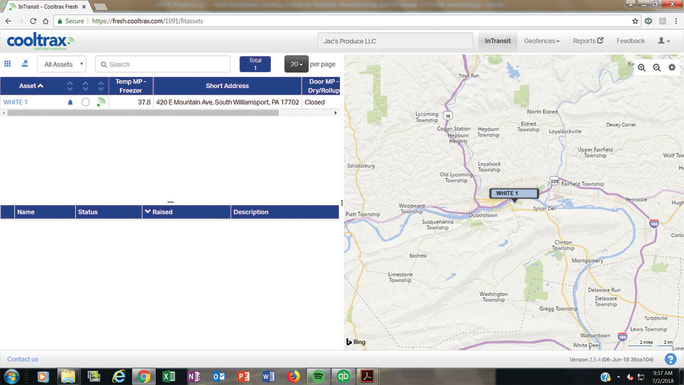
Cooltrax, a telematics-enabled temperature monitoring product, also allows fleet operators to track and monitor vehicle activity.
Screenshot courtesy of Gregory Anthony.
Manual temperature recordkeeping is less accurate and takes much longer, particularly if something goes wrong and the records need to be produced. According to Mulvey, having an electronic record of temperature takes away the guessing or finger pointing by showing the real temperature in the trailer at the exact time requested.
FSMA Compliance Challenges
Many challenges exist for smaller fleets to ensure they are in compliance. In regard to training, drivers must be made aware of the potential for food safety problems and what can cause food to go bad.
Drivers should also be reminded of the basics of sanitary food transportation practices; for instance, cleaning out, washing, and sanitizing trucks and trailers, keeping their hair covered, and washing their hands. Follow the shipper’s instructions; keep a temperature log if you’ve got a refrigerated unit and take basic steps to ensure food stays safe.
Smaller fleets also tend to run their vehicles and equipment longer and may not have the resources to constantly update and replace them.
“If you’ve got an older refrigerated unit, the shipper can tell you that you need to buy a newer one if you want to keep hauling for them under their agreement,” Bray says. “Suddenly you’re faced with the dilemma of having to spend a ton of money that you may not have.”
Because of the FSMA, carriers now have a solid paper trail in the event a bad load is delivered to the end user. They can prove if a unit was precooled when it was loaded and if it was kept at proper temperature during transit.
Originally posted on Work Truck Online
More Safety

Nexar-Nauto Merger Aims to Give Fleets Better Safety Intelligence Through Larger Driving Dataset
Stefan Heck tells Automotive Fleet that combining more than 10 billion miles of driving history with Nexar's AI models will give fleets deeper insights into driver risk and roadway conditions than either company could provide independently.
Read More →
Don't Wait for a Crisis: 5 Ways to Build Mental Health Into Your Fleet Safety Program
For Suicide Prevention Month, fleet and safety leaders have an opportunity to put mental health where it belongs: at the center of workplace safety.
Read More →
How Camera Data Can Strengthen a Fleet’s Insurance Renewal
Insights from a commercial insurance carrier and a broker show how fleets can turn video telematic data, driver coaching, and improved claims results into a stronger case at insurance renewal.
Read More →
The Safest Fleets Aren’t the Ones with the Most Technology
You’ve made the telematics investment. Here’s how to capture the other half of its value and build the safest fleet on the road.
Read More →
Hidden in Plain Sight: Fleet Compliance Risks
Fleet compliance isn't just about having policies — it's about consistently enforcing them. This practical guide reveals six hidden compliance risks common in public sector and shared fleet operations and outlines proven strategies to improve visibility, accountability, and audit readiness
Read More →
NETS Sets 2026 Fleet Safety Benchmark Conference for Indianapolis
The Sept. 15–17 program will feature fleet benchmarking data, case studies, emerging technologies, and implementation strategies while running alongside the NSC Safety Congress & Expo.
Read More →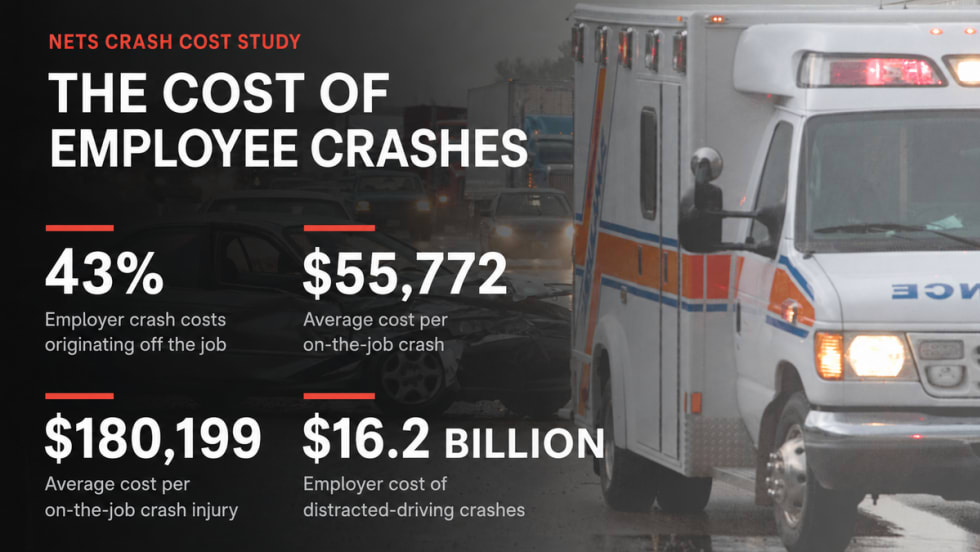
Off-the-Job Crashes Account for 43% of Employers’ $61.7 Billion Crash Burden
NETS quantifies costs dispersed across fleet, risk, HR, and other departments while providing new per-crash benchmarks for employers.
Read More →
Ram Recalls More Than 1.27 Million 1500 Pickups for Seat Belt Anchor Issue
The recall affects certain 2019-2026 Ram 1500 pickups that may have improperly attached second-row seat belt buckle anchors.
Read More →
How Better Visibility Cut Speeding Violations by 48%
Fleet leaders don't need more data, they need clearer visibility into what the data is saying. This case study explores how one utility replaced speeding-event counts with a single metric — miles driven in violation — to strengthen safety and significantly reduce speeding violations.
Read More →
Operation Safe Driver Week: Why the Industry's Oldest Safety Campaign Still Matters to Fleets
A look at how a 2007 enforcement initiative became one of the most consequential weeks on the fleet safety calendar, and what it means for your drivers in 2026.
Read More →