




Personal-Use Charges Trending Upward
Average personal use charges industry-wide were flat year over year, but more fleets have been increasing charges the past few years.


While 76% of the respondents in the latest survey said that personal use charges stayed the same, the second largest percentage group (17%) said that personal use charges increased
Photo courtesy of Welcomia via iStockphoto.com
Personal use charges were flat for the second year in a row but are continuing to trend upward, according to data retrieved from Automotive Fleet’s annual Personal Use survey. The average amount this year was $134, which was also observed in the 2017 survey.
Indeed, while 76% of the respondents in the latest survey said that personal use charges stayed the same, the second largest percentage group (17%) said that personal use charges increased. Meanwhile 7% reported that personal use charges decreased.
Kathy Evans, senior business consultant, Element Fleet Management, had observed that personal use charges were stagnant, overall, but also noted subtle increases for some.
“A handful of our clients have made minimal increases – ranging from $10-$35 per month,” said Evans. “These organizations have chosen to do it immediately because vehicles are getting costlier. The increase is used to offset the higher prices but also reflects added value that the clients/drivers are getting, such as
updated safety features or fuel efficiency.”
Other fleet experts have also observed subtle increases in personal use charges.
Data courtesy of Automotive Fleet.
“There have been a few customers increasing the personal use charges, but I think the trend is first to implement a charge and then do increases over time,” observed Michael Singer, strategic consultant, Merchants Fleet Management. “The other thing I’m seeing is customers reaching out to us and asking if they should have personal use charges if they don’t already, and if they do, what should the dollar amount be. They seem to be wanting to do what other like fleets are doing.”
Are Fleet Managers Charging Enough?
The latest percentages found that a majority of fleets managers charge less than $130 for personal use charges.
This was offset by a third of respondents stating that they charged more than $130 for personal use per month. Of this third, more than half said they charged more than $160 per month. The overwhelming majority of fleets who charged less than $130 kept the numbers even this year.
Data courtesy of Automotive Fleet.
However, the personal use charges for fleets can vary depending on the vehicle type.
For example, certain fleets may charge $100 a month for personal use of front-wheel drive (FWD) vehicles, though these charges can go up if drivers qualify for an all-wheel drive (AWD) vehicle.
In these instances, for example, the driver has an option of driving vehicles that have the same personal use per month charge as the FWD they qualify for (based on the AWD TCO being comparable to the FWD), or they can elect a vehicle that has an increased personal use per month of $150.
For these drivers, the $50 increase is applied if the AWD vehicle chosen has a TCO higher than the comparable FWD vehicle.
Restricting Who Drives the Fleet Vehicle
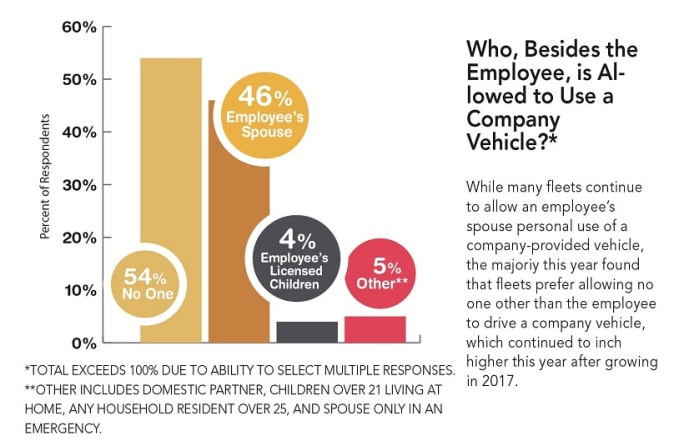
Another shift that was observed this year were more fleets reporting that no one, other than the employee, was allowed to use a company vehicle for personal use.
The 2017 survey found that a majority (53%), had at least allowed the employee’s spouse use of a company vehicle for personal use. The study this year; however, found that 53% only granted the employee use of a personal vehicle. Though employee spouses were not far behind at 46%.
Data courtesy of Automotive Fleet.
Liability concerns have detered many fleets from granting personal use beyond the company employee it is provided for. However, some fleets noted that appropriate insurance coverage provided by the company has helped reduce these liability concerns.
Indeed, due to this, the survey found that more than half of fleets also require MVR checks of persons, other than the company employee, who are allowed to drive the company vehicle.
Conversely, 16% said they didn’t require MVR checks for this group of people, while 30% said this was not applicable, likely because they don’t grant personal use beyond the employee.
Conditions Remain the Same
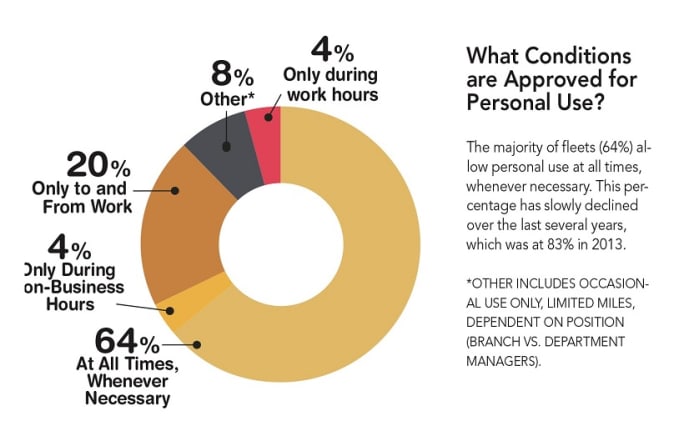
The conditions for approved personal use remained mostly the same, year over year, though more fleets reported only granting personal use of vehicles to and from work, according to data obtained this year.
Data courtesy of Automotive Fleet.
However, a majority (64%) said use of the vehicle was permitted at all times whenever necessary.
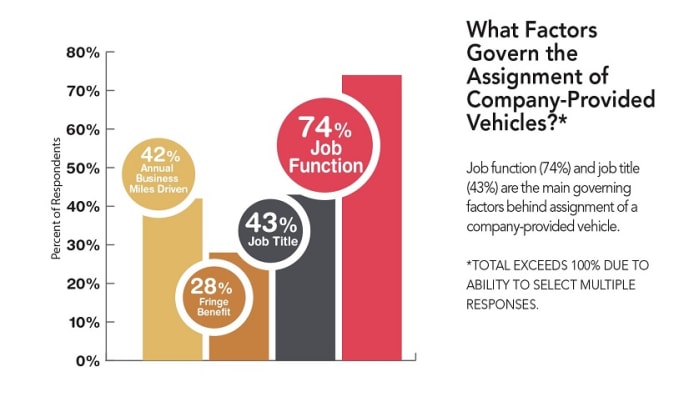
Also similar to last year, job function remained the No. 1 reason that governs assignment of fleet-provided vehicles. Job title was the second biggest reason, which was followed by annual business miles driven; the positioning of these two switched this year, though the percentages of both have remained consistently close when comparing the data over the last few years.
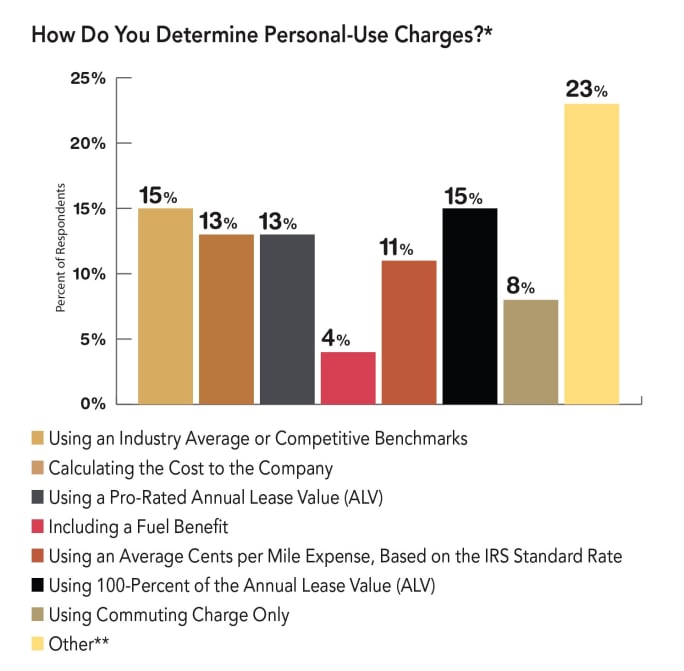
When observing how to determine personal-use charges, using an industry average of competitive benchmarks and considering 100% of the annual lease value (ALV) both ranked the highest in the 2018 survey.
Some fleets who participated in the survey said they used the ALV methodology due to the ease of calculations, reporting, and that it was readily supported by their fleet management company.
Using an industry average remained the lead method of determining personal use charges in the last few AF personal use surveys, though the ALV methodology tied with it this year.
Fleet managers in the survey also observed that the personal use charges of a company vehicle depends on the type of vehicle. One fleet manager mentioned passenger vehicle use is granted any time, while cargo vans are only allowed for commuting and with a different personal use fee.
Data courtesy of Automotive Fleet.
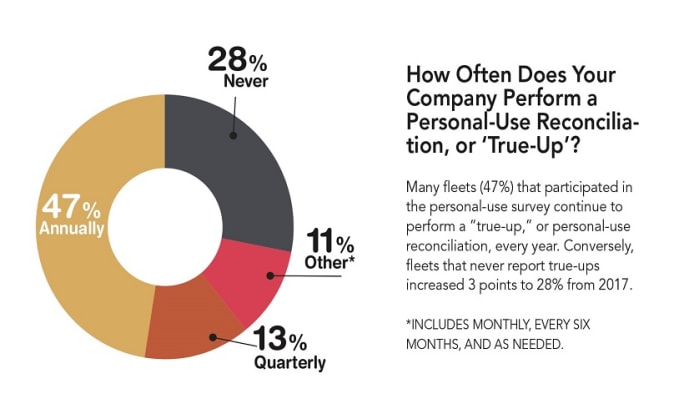
Meanwhile, the latest survey also found that most companies (47%) perform a personal-use reconciliation, or “true-up”, at least once a year. A “true up” is the process of bringing personal-use costs into alignment with predetermined criteria or processes.
More Operations

How Fleets Can Recruit and Train Veterans for Technician Roles
Here's how the technician shortage has affected uptime for fleets, and what to do about it.
Read More →
Avis Budget Group Deploys Neology Toll Management Technology Across Major Brands
Neology’s neoFleet platform will manage toll transactions and toll-authority operations for vehicles across Avis, Budget, Payless, Budget Truck and Zipcar.
Read More →
Fleet Personal-Use Charges Edge Higher in 2026
Nearly eight in 10 surveyed fleets allow personal use of company vehicles, while just over half of respondents report charging employees for the privilege.
Read More →
The Future of Fleet + What’s Changing Right Now | AF News Recap
Could developments overseas offer a preview of what’s coming for U.S. fleets? This week, we’re looking at the future of AI, autonomy, and electrification, plus Ford Pro’s new certified pre-owned program, smarter vehicle offboarding, and a new way for fleets to manage toll expenses.
Read More →
How to Handle Vehicle Offboarding
What do fleet managers need to do when a driver leaves?
Read More →
Fleet Manager’s Ultimate Playbook: Navigating the New Standard in OEM Connectivity
Rising operating costs, driver safety concerns, and unplanned downtime are putting unprecedented pressure on modern fleets. Discover how fleet managers use embedded OEM connectivity and real-time vehicle data to cut TCO, prevent downtime, and protect drivers without aftermarket telematics hardware.
Read More →
U.S. Bank Adds Verra Mobility Toll Management to Voyager Fleet Platform
The integration allows U.S. Bank Voyager fleet customers to manage toll payments and violations alongside fuel, EV charging and maintenance expenses.
Read More →
ADAS Prevents Crashes. But Repairs Cost More | AF News Recap
ADAS-equipped vehicles may crash less often, but they can cost more when they do. This week, we’re breaking down what that tradeoff means for fleets, plus Subaru’s first Forester Wilderness Hybrid, Nissan’s new e-POWER Rogue, and why Calstart has become Catalyst Mobility.
Read More →
Moventum Fleet Management Names Mark Iorillo Head of Sales
Iorillo brings nearly 20 years of fleet management and sales experience to the role, including previous positions at Element Fleet Management, CEI, Donlen and Ryder.
Read More →
Fleet Has a Talent Pipeline Problem. What Comes Next? | AF News Recap
Where will fleet’s next generation of leaders come from? This week, we’re looking at the industry’s talent pipeline, what certification can add to a fleet career, how to build an award-worthy track record, and the return of Automotive Fleet’s Personal Use Survey.
Read More →