The largest majority of crashes for fleets in 2016 was the result of accidents that occurred while the vehicle was parked. Distracted driving may be a major contributor for this type of incident.
Andy Lundin・Former Senior Editor
August 1, 2017
Graphic courtesy of istockphoto.com
4 min to read
Graphic courtesy of istockphoto.com
With transportation-related accidents recently reported as accounting for 41% of work-related fatalities in 2015, it’s easy to understand why fleets have continued to take driver safety seriously.
Ad Loading...
Further still, data reported by the National Safety Council found that preventable deaths in the U.S. reached an all-time high in 2015, with motor vehicle crashes being a contributor to this.
Ad Loading...
However grim, this data doesn’t tell the entire story of the current state of driver safety.
Indeed, in regards to fleet safety, additional data gathered by fleet safety professionals at The CEI Group, Element Fleet Management, and Fleet Response, has revealed other telling facts as to how fleet safety has evolved over the last several years. The data may shine an optimistic light on the future of fleet and driver safety.
At a Glance
The results of the 2017 Fleet Accident Survey have remained relatively consistent when compared with data reported in 2016. Some big takeways this year include:
Drivers aged between 18 and 45 who were involved in a crash has continued to decline, year over year.
Damaged while parked was the top accident description for 2016.
Telling Data
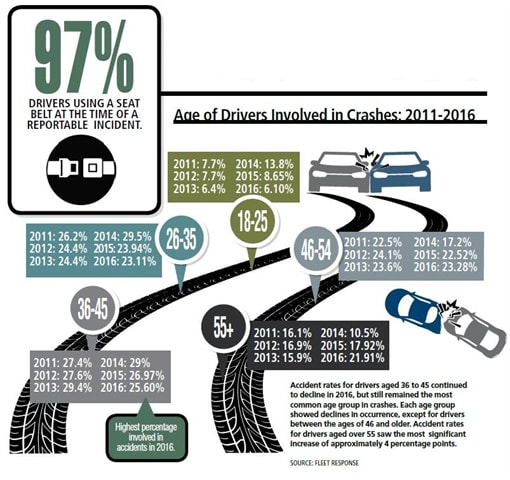
One of the most noteworthy takeaways in this year’s data survey has been the gradual decline for drivers involved in crashes who are aged anywhere between 18 and 45 years old.
For 2016, the age brackets surveyed which showed the declines were grouped as 18 to 25, 26 to 35, and 36 to 45. While these groups remained relatively stable to what was reported the prior year, the most notable drop of these three groups was the 18 to 25 bracket which dropped over 2% from what was reported last year, going from 8.65% to 6.10%.
Meanwhile, drivers aged 46 and older saw an increase in the percentage of crashes that occurred. The most significant age bracket that saw an increase in crashes were drivers aged 55 and older.
Ad Loading...
The percentage of accidents reported by this group went from 17.92% in 2015 to 21.91% for 2016. This percentage in 2016 was also over 6% higher than the average for this age group in the previous 5 years.
“While we don’t have any data to prove the actual reason for change, a likely assumption is that in today’s workforce we continue to have a large population of the oldest age range continuing to work,” said Jerry Veres, certified director of safety for Fleet Response. “The increase of drivers in this group may be correlated to a slight increase of accidents in this area, compared to the other age ranges remaining the same,”
Distracted Driving
One of the largest contributors to vehicle crashes is distracted driving. In an effort to crack down on this, several states have recently worked on legislation to curb distracted driving.
Joe Kinniry, manager of data analytics and reporting at The CEI Group, said that multitasking with a cellphone while driving is an inexcusable behavior for a fleet driver. When looking at data of drivers involved in accidents while using a cellphone, he said the organization will also take into account if the driver was using a hands-free device to speak on the phone, as this has also proven to be a dangerous behavior.
“Your mental capacity goes down, in terms of what you’re going to take in from the road when you’re having a conversation with someone on the phone or in the car,” said Kinniry. “We at The CEI Group recommend that when you have to do anything with your phone, pull over and take care of it then.”
Ad Loading...
Top Crash Incidents
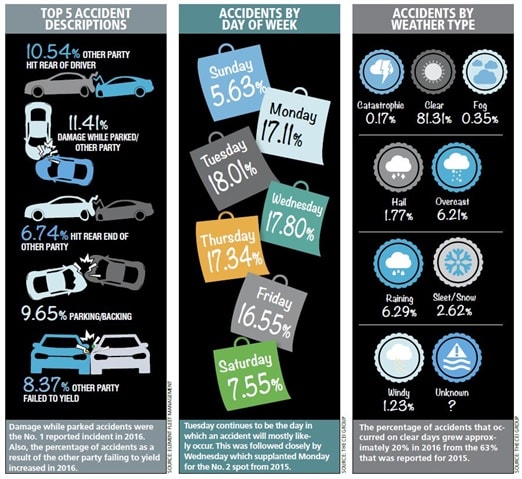
Other data compiled for this survey included Element Fleet Management’s assessment of the top five accident descriptions.
For what was reported in 2016, the largest majority of crashes was damage that occurred while the vehicle was parked, which was at 11.41%. This was followed by 10.54% of another party hitting the rear for the driver, and 9.65% of crashes resulting due to parking/backing up.
However, the way this data is reported may result in a slight fluctuation of what is reported year over year, due to the contingent nature which accidents are reported. Indeed, the way one individual classifies a crash may be different from how someone else does.
“We classify the parking/backing, specifically, if you are parking by moving forward or ‘unparking’ by backing up,” said Kim Hickey, an accident management consultant for Element Fleet Management. “Where as a driver failed to observe clearance would be classified more along the lines of drivers damaging their vehicles by hitting infrastructure.”
When considering the overall top five types of crashes, Element will use this information as a benchmark for the industry which helps them assess safety trends in the industry, allowing them to offer recommendations to their clients based on their own top trending accidents.
Ad Loading...
The company also noted that there has been an increase in drivers being hit from behind by another vehicle, which is most likely due to distracted driving on cellphones.
“I think driver inattention as a whole seems to be a trend,” said Hickey. Echoing Kinniry of CEI, she also noted that even in this day and age, hands-free cellphone usage is just as dangerous as handling a device.
Kinniry of CEI said that one of the main reasons the data is compiled is to track any outstanding spikes in data which may reveal something telling about fleet and driver safety in general.
New crash-avoidance ratings from the Insurance Institute for Highway Safety reveal inconsistent performance among commercial vehicles, with several popular cargo vans and heavy-duty pickups struggling to avoid collisions with other vehicles and pedestrians.
Could your company's culture be encouraging distracted driving? This week, we're exploring how workplace expectations affect driver safety, what AI, EVs, and autonomous vehicles could mean for the future of fleet management, and how fleet professionals can strengthen their award nominations.
What happens when the people responsible for enforcing safety rules are the ones setting the wrong example? The answer may reveal why some of the biggest risks to fleet drivers have little to do with what's written in the employee handbook.
Rising operating costs, driver safety concerns, and unplanned downtime are putting unprecedented pressure on modern fleets. Discover how fleet managers use embedded OEM connectivity and real-time vehicle data to cut TCO, prevent downtime, and protect drivers without aftermarket telematics hardware.
Mental health belongs in the fleet safety conversation. This week, we’re looking at five ways fleets can support employee well-being before a crisis, plus Holman’s expansion in Mexico, new one-day Fleet Forward passes, and why EV charging demand is outpacing infrastructure growth.
Stefan Heck tells Automotive Fleet that combining more than 10 billion miles of driving history with Nexar's AI models will give fleets deeper insights into driver risk and roadway conditions than either company could provide independently.
Insights from a commercial insurance carrier and a broker show how fleets can turn video telematic data, driver coaching, and improved claims results into a stronger case at insurance renewal.
Fleet compliance isn't just about having policies — it's about consistently enforcing them. This practical guide reveals six hidden compliance risks common in public sector and shared fleet operations and outlines proven strategies to improve visibility, accountability, and audit readiness