





Fisher: ‘Don’t Be Afraid of Change’
Meet Kimberly Fisher: 2023 Professional Fleet Manager of the Year
For Fisher, the 2023 Edward J. Bobit Professional Fleet Manager of the Year honoree, communication, listening skills, and humility are key qualities of sound fleet management.
October 5, 2023
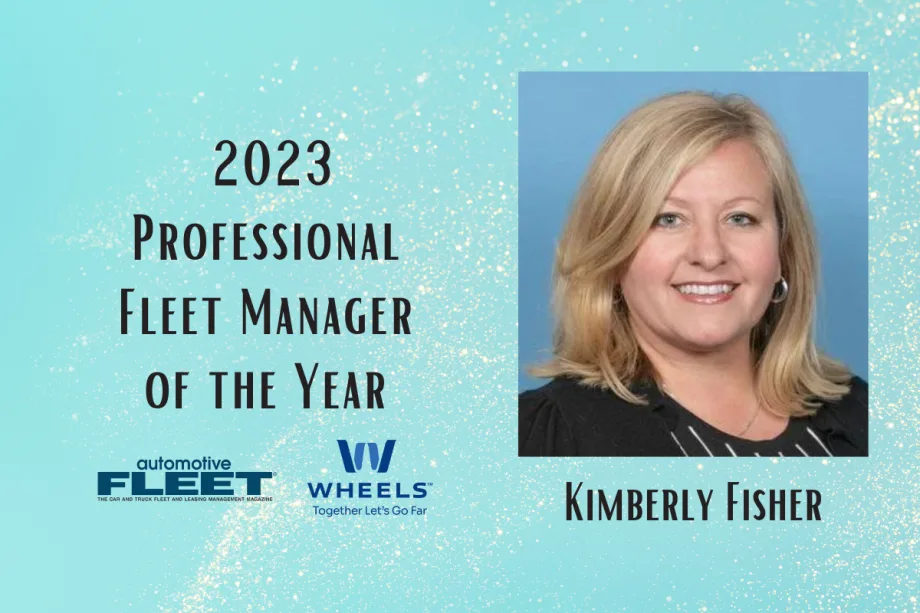
Kimberly Fisher, director of global fleet and travel for NOV Inc., was selected as the 2023 Edward J. Bobit Professional Fleet Manager of the Year.
Photo: Automotive Fleet
7 min to read
“I am thrilled. I’ve known several of the recent award winners, and they are just really good people, and they’re really good at their job!” said Kimberly Fisher in response to the news she had been selected as the 2023 Edward J. Bobit Professional Fleet Manager of the Year.
Fisher added with a smile, “They are the people who I want to be like when I grow up.”
Director of global fleet and travel for NOV Inc., Fisher was presented the award at the recent Automotive Fleet & Leasing Association (AFLA) corporate fleet conference in Palm Springs, Calif.
Sponsored by Wheels and AFLA, the annual award recognizes a “proficient fleet manager who has demonstrated special business acumen in developing and executing key management policies in all areas.”
Fisher is the 39th award recipient since the first Fleet Manager of the Year was named in 1985.
Crash Course in Fleet 101
Fisher began in the fleet industry nearly by happenstance, answering a newspaper ad for a fleet administrator for Cardinal Health in Atlanta. “I had no idea what [fleet] meant,” Fisher admits. “But I learned very quickly!”
And she learned quickly when Cardinal Health’s 260-unit fleet grew to 1,200 nearly overnight through a company acquisition. She credits industry partners, including fleet management company staff, industry leaders, and other fleet managers, with providing her with a “crash course in Fleet 101.”
Fisher joined NOV (formerly National Oilwell Varco) in 2011. A global company with a presence in 63 countries, the oil and gas services company develops oil drilling technology and products.
While the NOV fleet numbers up to 7,000 vehicles and equipment globally, Fisher and her six-member team primarily manage the 5,000-vehicle fleet in the U.S., Canada, and the United Kingdom. The fleet includes cars, tractor-trailers, ¾- and ½-ton trucks, cranes, trailers, and rolling forklifts.
Fisher’s responsibilities expanded in 2015 when she was unexpectedly assigned to the company’s travel program. She directs the program’s policies and compliance and negotiates contracts with airlines, hotels, and rental car companies.
Once again, colleagues’ generosity in sharing knowledge quickly brought her up to speed with the new assignment.
“They would throw around an alphabet of acronyms, and I’d have no idea what they were talking about,” she recalled.
Her strength, though, is asking questions. “I will ask. I feel it does a disservice to my organization if I am too reluctant to ask the question when I don’t understand.”
Visionary Initiative: Recycled Service Bodies
One of Fisher’s singular initiatives, for which she was awarded the 2021 Global Fleet Visionary honor, is recycling service bodies.
In 2017, service bodies were becoming significantly more expensive, Fisher explained. Historically viewed as part of the truck, the service body was a throwaway item. When the truck chassis lifecycle was finished, so was the service body.
However, when new service body costs began to double and triple, Fisher explored potential options, asking, “Can I get a second life out of one service body?”
With input from industry partners and NOV field techs, Fisher and her team developed a larger, closed service body with special features to provide a more efficient field workspace.
They determined the initiative would produce $2 million in cost savings by 2024.
Today, the recycling is on track for the promised savings, and Fisher and her team are considering recycling the service bodies for a second time on a third truck chassis.
‘You Did the Work, You Get the Acknowledgement’
In reflecting on the people who have helped shape her fleet career, Fisher recalled a vice president at her previous company who left a valuable impression.
He asked Fisher to develop a fleet data presentation for senior leadership early on. When completed, she was surprised when he told her she would give the presentation “since she had done all the work.”
It was a lesson learned, said Fisher. “Here was a vice-president humble enough” to give her the recognition of a job well done, as well as promoting the fleet program.
“That’s key,” Fisher said. “leadership needs to know what you do.”
A lesson learned from her since-retired NOV boss is the importance of a champion within the organization.
“You knew beyond a shadow of a doubt that he would support you, champion you,” said Fisher. “That’s not to say he didn’t challenge me, as my current boss also does, but having colleagues like them who have enough faith in you to back you to the organization is critical. Because the organization needs to know what worth you bring.”
To find such a champion, Fisher advises developing listening skills and forgoing the “need to be right.”
She explained,” Even if you are 100% right if you dig in and are not willing to meet halfway, you will be seen as someone who is not a collaborator, who is not willing to meet people in the middle.”
Building Relationships is Foundational
Fisher’s management approach is founded on building and maintaining relationships within fleet as well as “the many departments fleet touches.”
“Relationships are a big part of this industry,” she pointed out. “If you can build good relationships with your vendors, internal customers, and peers, it tends to make life easier all the way around.”
For example, she points to the fleet's close connection with NOV’s Health, Safety, and Environmental department on the company’s telematics program.
“I think it’s the right thing to do. So when the director of that group was rolling out the telematics program and asked if I would be a part of it, I said, ‘Absolutely, I’m onboard. How can I help push this past the finish line?’”
Communication is a Big Piece
Fisher believes open lines of communication are key to sustaining good relationships, particularly in today’s tough business environment.
“We’ve been open with our leadership,” she revealed. Meeting with company leaders, she outlines the challenges fleet faces and actions she and her team are taking to mitigate the situations.
Fisher encourages not only communicating within the organization but also with vendors.
“And not just ‘How can you help us with this, but how can we help you?’” she explained. “Are we being realistic? Do we need to adjust our expectations? Having that open line of communication with vendors is just as important as having an open line of communication with internal customers.”
For Fisher, transparency, listening, and accountability are paramount in communicating with employees. Speak respectfully and in a way they can receive it, she advises.
Importantly, too, she said, “You can’t ask your employees to do something you’re unwilling to do yourself.”
For example, she cited, “Being humble enough to say I was wrong when I’ve made a mistake. We all make mistakes, and it’s not the end of the world. I own my mistake; I correct it so we can move on. If I’m unwilling to do that, how can I expect my team to do it?”
When the employee makes a mistake, Fisher urges the same openness.
“I tell my team I can’t help if I don’t know about it. In practice, I do the same thing with my boss. If something is going to escalate to her, I let her know. I never want someone to walk into her office and say, ‘What is your fleet group doing?’ I want her to be aware of what’s going on so she can at least direct it.
Tackle Problems by Listening First
The first step in solving problems is to listen and listen to everyone involved, Fisher advocates.
“You have to ask good questions and work collaboratively with others. Someone directly affiliated with what you’re trying to do may be able to suggest a solution because they come at it from a different perspective.”
The ability to see connections is also important, Fisher said.
“Not everyone can connect the dots. For example, how will this action affect X, Y, and Z? I must make sure X, Y, and Z are taken care of, too. You have to look at the whole picture. holistically.”
‘It's a Fun Industry’
Fisher is excited about the younger people entering the fleet industry. Based on her experience, she “would love for them to understand, especially if they are new to the industry, that it’s a fun industry.
“For all the challenges, it’s never the same. It’s always shifting. There’s always something new. It’s a great industry to build a network in. It will cause you stress. It causes you anxiety, but it really is a fun industry, and it’s never boring. There’s just always something on," she concluded.
Subscribe to Our Newsletter
More Operations
Company Vehicle or Reimbursement? How Fleets Are Rethinking Assignments
As fleet costs and insurance pressures rise, fleet managers are taking a closer look at which employees need company-provided vehicles and when a reimbursement program may make more sense.

Fleetio, ASE Launch Scholarship Program for Automotive Technicians
The second annual program will award 15 scholarships totaling $35,000 to support ASE certification, testing fees, and equipment costs.

Reading the Global Signals: What AI and the Energy Transition Mean for Fleets Now
In this opening keynote of the 2026 Fleet Forward Conference, John Rossant, founder of CoMotion, How can fleet managers navigate a never-ending, changing industry landscape?

90% Use Telematics. Are Fleets Getting Safer? | AF News Recap
This week, we're breaking down which industries have the highest rates, how Jamie McKay manages 2,400 vehicles, what's happening with the 2027 fleet awards, and why software-defined vehicles could introduce new costs.

What's Best Handled by an FMC, and What's Better Done Directly?
Fleet managers continue to rely on FMCs for essential services but are taking a closer look at where working directly with suppliers can improve efficiency and responsiveness.

Fleet Meets: Erin Gilchrist
Meet Erin Gilchrist, the inaugural Mike Antich Spirit of Fleet Award winner, as she shares insights on leadership, mentorship, the power of industry connections, and why people remain at the heart of fleet's future.

How 2026 Fleet Visionary Jamie McKay Manages 2,400 Vehicles Across 37 States
How do you keep 2,400 vehicles running across 37 states? Fleet Visionary Award winner Jamie McKay shares how collaboration, flexibility, and a few simple strategies help her tackle fleet management challenges at Aptive Pest Control.

Managing Fleet Costs in an Era of Permanent Volatility
Fleet operating costs have risen more than 20% since 2020, raising a key question: When does extending a vehicle's service life stop making financial sense?

The Next Evolution of Fleet Management: Autonomous Operations
This opening keynote session at the Fleet Forward Conference highlights the future of autonomous driving for fleets.

How to Reduce the Total Cost of Risk From Catalytic Converter Theft
A stolen catalytic converter can cost fleets far more in downtime and lost productivity than in repairs. A total-cost-of-risk approach can help fleet managers quantify their exposure and prioritize theft prevention.