




Measuring Corporate Attitudes Toward Distracted Driving
Mobile phones are a part of every employee’s daily life. Corporate attitudes toward cell-phone use and policies are changing with the times.
Cell-phone use continues to proliferate, and is fast becoming a necessary tool of any trade. Fleet managers are making a marked effort to enforce cell phone policies and become more proactive in dealing with potential liability issues.
With responses from more than 900 professionals, ZoomSafer’s second annual distracted driving survey was designed to gauge corporate fleet operators’ perspectives and attitudes toward employee use of mobile devices while driving, and how these attitudes have changed in the 12 months since its inaugural survey in May 2011.
According to the survey results:
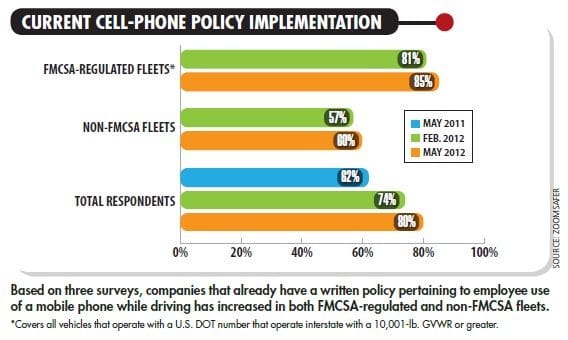
Cell phone use policies continue to proliferate. The survey showed a trending increase in the deployment of corporate policies to manage employee mobile-phone use. Of the survey participants, 80 percent reported that their employers have a cell-phone use policy in place, up 29 percent from the 62 percent of respondents in 2011. The survey also showed the percentage of companies without policies that have plans to put one in place has not changed since a February 2012 survey, holding steady at 52 percent.
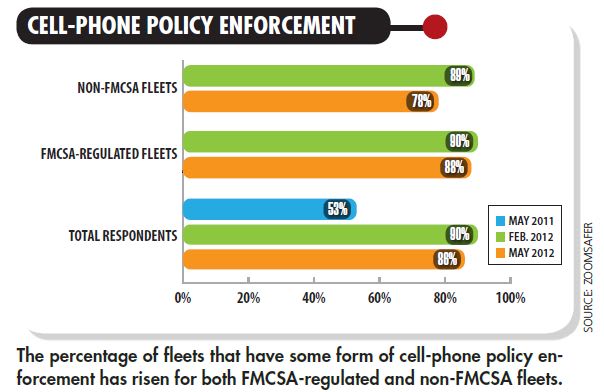
Efforts to enforce cell phone use policies have markedly increased over the past year. The majority of companies with cell-phone use policies in place now take steps to enforce them, with 86 percent of total respondents reporting that their companies enforce their written policies — a 62-percent increase from the 53 percent of companies in 2011.
Confidence in “reactive” enforcement methods are plummeting. While more companies are taking steps to enforce written cell-phone use policies, confidence in the most common “reactive” enforcement methods is dropping. Only a little more than a quarter (26 percent) of total respondents report they are “very confident” that their companies’ current policy enforcement methods are sufficient to modify driver behavior.
Interest in cell-phone policy technology continues to grow. More than 80 percent of all respondents consider cell-phone policy technology to be more or just as important as more traditional driver management solutions, including hard braking/accelerating reports, speeding reports, and real-time driver performance feedback.
Further, more than a quarter (26 percent) of all respondents report their companies plan to evaluate phone-based software, cell-phone use analytics, or in-vehicle cameras within the next 12 months.
Android and iPhone smartphones are the fastest-growing company-provided mobile phones. Twenty-three percent of companies that equip employees with mobile phones issue Android smartphones, up from 13 percent in February 2012, while 26 percent issue company-provided iPhones, up from 12 percent. BlackBerry smartphones and feature phones (mobile phones, which, at the time of manufacture are not considered a smartphone, but have additional features and functions of a smartphone) are still the most prevalent company-provided mobile phones; 33 percent of companies equip employees with BlackBerry smartphones, while 32 percent issue feature phones.
The survey results are shown in comparison with results from a May 2011 employee distracted driving survey and from a February 2012 Federal Motor Carrier Safety Administration (FMCSA) cell-phone rule survey. For most results, this analysis provides a comparison between all respondents, respondents from fleets, which are subject to regulation by the FMCSA, and respondents from fleets that are not subject to FMCSA regulation.
Click the photo below to see a slide-show of all the charts included in the story.
More Safety

Fleet Manager’s Ultimate Playbook: Navigating the New Standard in OEM Connectivity
Rising operating costs, driver safety concerns, and unplanned downtime are putting unprecedented pressure on modern fleets. Discover how fleet managers use embedded OEM connectivity and real-time vehicle data to cut TCO, prevent downtime, and protect drivers without aftermarket telematics hardware.
Read More →
From Driver Well-Being to EV Charging | AF News Recap
Mental health belongs in the fleet safety conversation. This week, we’re looking at five ways fleets can support employee well-being before a crisis, plus Holman’s expansion in Mexico, new one-day Fleet Forward passes, and why EV charging demand is outpacing infrastructure growth.
Read More →
Nexar-Nauto Merger Aims to Give Fleets Better Safety Intelligence Through Larger Driving Dataset
Stefan Heck tells Automotive Fleet that combining more than 10 billion miles of driving history with Nexar's AI models will give fleets deeper insights into driver risk and roadway conditions than either company could provide independently.
Read More →
Don't Wait for a Crisis: 5 Ways to Build Mental Health Into Your Fleet Safety Program
For Suicide Prevention Month, fleet and safety leaders have an opportunity to put mental health where it belongs: at the center of workplace safety.
Read More →
How Camera Data Can Strengthen a Fleet’s Insurance Renewal
Insights from a commercial insurance carrier and a broker show how fleets can turn video telematic data, driver coaching, and improved claims results into a stronger case at insurance renewal.
Read More →
The Safest Fleets Aren’t the Ones with the Most Technology
You’ve made the telematics investment. Here’s how to capture the other half of its value and build the safest fleet on the road.
Read More →
Hidden in Plain Sight: Fleet Compliance Risks
Fleet compliance isn't just about having policies — it's about consistently enforcing them. This practical guide reveals six hidden compliance risks common in public sector and shared fleet operations and outlines proven strategies to improve visibility, accountability, and audit readiness
Read More →
NETS Sets 2026 Fleet Safety Benchmark Conference for Indianapolis
The Sept. 15–17 program will feature fleet benchmarking data, case studies, emerging technologies, and implementation strategies while running alongside the NSC Safety Congress & Expo.
Read More →
Off-the-Job Crashes Account for 43% of Employers’ $61.7 Billion Crash Burden
NETS quantifies costs dispersed across fleet, risk, HR, and other departments while providing new per-crash benchmarks for employers.
Read More →
Ram Recalls More Than 1.27 Million 1500 Pickups for Seat Belt Anchor Issue
The recall affects certain 2019-2026 Ram 1500 pickups that may have improperly attached second-row seat belt buckle anchors.
Read More →