




Make it Personal: Extending the Safety Message
For those companies that permit personal use of company vehicles, a safety culture should extend beyond working hours. Here’s how to make the safety message a 24/7 one, both for employees and their families.

Communicating safety within a company takes many forms. Make communication interesting and interactive. It’s often the repetition of the safety message, not the message itself, that makes an impact.

Communicating safety within a company takes many forms. Make communication interesting and interactive. It’s often the repetition of the safety message, not the message itself, that makes an impact.
You’ve no doubt heard it said that fleet managers should work toward creating a “culture of safety” among drivers. There is no question that this is an important part of any company fleet safety program. Creating a culture of safety means making safety something that drivers think about, and strive towards, as part of their working day.
However, sometimes such a culture doesn’t quite “take,” that is, while it may be there from 9 to 5, it’s left at the office. Why should a fleet manager be concerned? Aside from the desire to see employees remain safe all the time, many companies permit personal use of company vehicles, which means driving on weekends and at night, often by a spouse, with passengers including children — and the company’s potential liability doesn’t end with the working day.
Establishing a Policy
A corporate fleet policy that prohibits personal use might seem to be the answer to whether safety should be emphasized beyond working hours. But even that is inadequate. There are instances of “de minimis” personal use, such as commuting, driving to and from an airport, or briefly stopping for personal errands. The IRS “commuting rule” may provide for the accounting of such use, but the fact is that any mileage driven by an employee, whether for business or personal purposes, brings with it the possibility of an accident.
Companies that permit personal use sometimes limit it to the employee; others extend the privilege to licensed spouses or other direct family members. In the former case, family members are often passengers, in the latter, they drive the vehicle. Once again, either instance can create safety issues.
Thus, policy alone doesn’t alleviate the need to extend the safety issue beyond just business use by the driver to personal use and the driver’s family.
Using MVRs
The first step in making safety personal begins at the recruiting and hiring level. Before any prospective employee is hired, if the assignment of a company vehicle is part of the job, the driver’s motor vehicle report (MVR) should be accessed and reviewed. First, to make certain the candidate does indeed have a valid driver’s license, and, second to review the record for violations. Fleet policy should include some means by which an otherwise qualified candidate who may have a less than stellar record can be hired. For example, a probationary period, during which the new hire drives a personal vehicle and is reimbursed, or a period during which personal use is prohibited.
Next, if that policy permits personal use by other licensed family members (spouse, adult children, etc.) an MVR should be accessed for them as well, with the same rules for the employee. Even if personal use is limited only to the employee, at the very least family members should know of the company seatbelt use policy. In general, family members should know first that the company is concerned for their safety, and it is expected they will comply with company fleet safety policy.
Getting the Message Out
Establishing the company focus on safety at hire is a good first step. Next, it is important to continue to communicate the message beyond the workplace.
Communicating safety within the company takes many forms. Some companies still use newsletters. Others send safety messages via e-mail. Still others communicate via the company website or Intranet, and some use more than one venue. Suffice it to say, it is the communication of the message that keeps safety at the forefront.
But certainly, family members don’t see intercompany e-mails, don’t spend much time on the website, and are usually not party to newsletters. The question becomes — why not? With the myriad technologies available today, keeping family members in the communication loop can be fast and easy. Ways to do so include:
A “family section” on the company website, which can communicate a number of items, including that safety message. Safe driving tips, contests (with prizes), and personal stories and messages posted by spouses and children can all help keep safety at the fore.
Mail a hard copy of company newsletters to spouses. It costs pennies, and much of the above can be part of the message.
Social media is increasingly the communication venue of choice. You’d be hard-pressed to find a spouse or child of an employee without a Facebook page or a Twitter account. Safety messages can be sent quickly and easily to hundreds, if not thousands, of people; even a “Company X Safety” account can be set up.
As is often said of drivers, most family members know full well what they should and should not be doing when they drive: don’t speed, don’t tailgate, buckle that seatbelt, signal when turning. It is the repetition of those messages that work, not simply the message itself. No matter how it’s done, consistent emphasis on the safe driving message is the best way to bring safety home from the job.
[PAGEBREAK]
But Make It Interesting
“Drive Safely!” While true enough, it’s not the most compelling message and certainly not one that will register, even if repeated. Ensure the communication is interesting as well as interactive.
Encourage drivers and their families to contribute stories about driving — not just, “And, if I didn’t have my seatbelt on, I would have been killed!” stories, but funny or interesting stories of the road. A favorite drive, a scenic or historic route, a funny trip on vacation with the small kids, all can be fun and hold the attention of the reader.
What about contests? Safe driving contests are among the most effective incentives among drivers — on the job. How about a contest for family members or for drivers outside of work? Have a safe driving contest for spouses: Those that complete one, two, or five years without a violation or an accident win a prize. Increase the value of prizes as the time mounts. Offer dinner for two at a favorite restaurant, or perhaps the company’s product or service for free. However it’s done, it will keep that safety message going all day, every day. (Spouses’ MVR reports, if the policy requires it, can be used to track progress, with permission given.)
Interesting, compelling, funny, and interactive messages keep families and drivers involved in the safety message.
It’s Worth the Effort
Drivers, even those who work long hours, spend more time off the job than they do working. Personal use mileage may well be much lower than business mileage, but the risk of damage and injury is very much there. Companies are interested in the safety of employees and their families for personal reasons, as well as financial ones.
If your company permits personal use of a company vehicle, and personal mileage is 20 percent of total mileage driven, the risk of accident or injury is thus increased by 20 percent.
For a 1,000 vehicle fleet, with an accident rate of 15 percent, a fleet manager can expect to see 150 accidents per year. Increasing that number by 20 percent amounts to an additional 30 accidents.
Whatever the average cost per accident, it is clear how the costs of “leaving safety at the office” can mount. So make sure that safety is made personal, for both drivers and their families:
Start with policy. Review MVRs not only for drivers but for any family members that are permitted to drive the company vehicle.
Get the message out. Communicate safety as often as possible, and make it interesting. Use all the communication methods available: e-mail, newsletters, and social media. Encourage participation.
Include family members in safe driving contests, or conduct one for them alone.
Don’t just see to it that drivers drive safely on the job; make sure they, and their families, know that the company cares about their safety as well.
Including family members in communication is just one way to make the safety message “personal.” Ways to do so include:
A family section on the company website or Intranet.
Mail hard copies of company newsletters to spouses.
Utilize social media to communicate with spouses or children.
Create a contest to encourage safe driving for family members.
More Safety

Nexar-Nauto Merger Aims to Give Fleets Better Safety Intelligence Through Larger Driving Dataset
Stefan Heck tells Automotive Fleet that combining more than 10 billion miles of driving history with Nexar's AI models will give fleets deeper insights into driver risk and roadway conditions than either company could provide independently.
Read More →
Don't Wait for a Crisis: 5 Ways to Build Mental Health Into Your Fleet Safety Program
For Suicide Prevention Month, fleet and safety leaders have an opportunity to put mental health where it belongs: at the center of workplace safety.
Read More →
How Camera Data Can Strengthen a Fleet’s Insurance Renewal
Insights from a commercial insurance carrier and a broker show how fleets can turn video telematic data, driver coaching, and improved claims results into a stronger case at insurance renewal.
Read More →
The Safest Fleets Aren’t the Ones with the Most Technology
You’ve made the telematics investment. Here’s how to capture the other half of its value and build the safest fleet on the road.
Read More →
Hidden in Plain Sight: Fleet Compliance Risks
Fleet compliance isn't just about having policies — it's about consistently enforcing them. This practical guide reveals six hidden compliance risks common in public sector and shared fleet operations and outlines proven strategies to improve visibility, accountability, and audit readiness
Read More →
NETS Sets 2026 Fleet Safety Benchmark Conference for Indianapolis
The Sept. 15–17 program will feature fleet benchmarking data, case studies, emerging technologies, and implementation strategies while running alongside the NSC Safety Congress & Expo.
Read More →
Off-the-Job Crashes Account for 43% of Employers’ $61.7 Billion Crash Burden
NETS quantifies costs dispersed across fleet, risk, HR, and other departments while providing new per-crash benchmarks for employers.
Read More →
Ram Recalls More Than 1.27 Million 1500 Pickups for Seat Belt Anchor Issue
The recall affects certain 2019-2026 Ram 1500 pickups that may have improperly attached second-row seat belt buckle anchors.
Read More →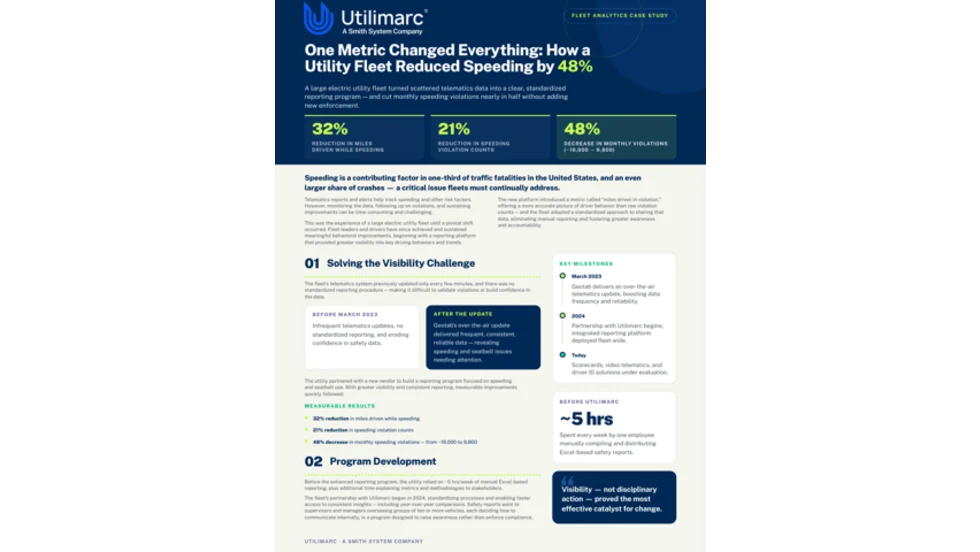
How Better Visibility Cut Speeding Violations by 48%
Fleet leaders don't need more data, they need clearer visibility into what the data is saying. This case study explores how one utility replaced speeding-event counts with a single metric — miles driven in violation — to strengthen safety and significantly reduce speeding violations.
Read More →
Operation Safe Driver Week: Why the Industry's Oldest Safety Campaign Still Matters to Fleets
A look at how a 2007 enforcement initiative became one of the most consequential weeks on the fleet safety calendar, and what it means for your drivers in 2026.
Read More →