




Joy Global Defies Conventional Wisdom
When the recession hit in 2008, instead of increasing the lifecycle of its medium- and heavy-duty trucks, Joy Global began shortcycling.

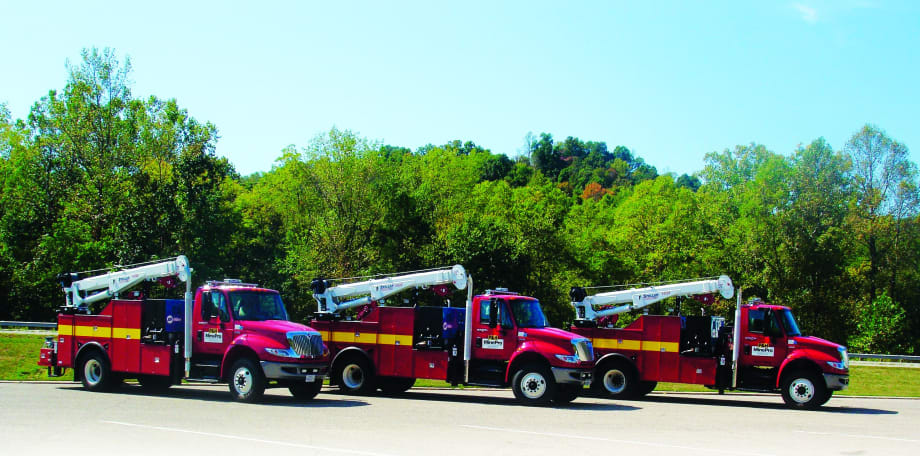
Contrary to conventional wisdom, Joy Global began shortcycling its vehicles during the economic downturn. The company’s vehicles are primarily International Chassis with a GVWR from 25,900 lbs. to 53,000 lbs.
Photo: Joy Global
During an economic downturn, conventional wisdom states that fleets should hold onto their vehicles, extending replacement cycles by months or even longer, to reduce capital expenditures and preserve cash until the “storm” blows over.
But, some companies, such as Joy Global Inc., a Milwaukee-based firm that manufactures and services heavy machinery used in underground and surface mining worldwide, are taking the exact opposite tack in the face of economic headwinds. Since 2008, when the economy began to slide, Joy Global has been aggressively pulling forward vehicle replacements for its medium- to heavy-duty trucks, from a typical cycle of six to eight years to as short as 24 months.
This shortcycling strategy has slashed Joy Global’s depreciation costs (a fleet’s largest expense) to as low as 0.9- to 1.4-percent per month and has reduced maintenance expenses by 30 percent.
“When you look at service trucks such as ours, whether medium- or heavy-duty, 2- to 4-percent depreciation is normal. So, we managed to cut that depreciation number by about half,” said Mike Butsch, director global fleet operations for Joy Global.
The trucks included in Joy Global’s shortcycling program are primarily International chassis, ranging from 25,900-lb. to 53,000-lb. GVWR, equipped with either flatbeds or mechanics bodies with expensive welders and 14,000-lb. cranes. Vehicles fully upfitted can cost as much as $150,000 to $300,000 if new. The fleet also operates some Ford F-750s.
The down economy created the unique conditions that have made shortcycling a smart move for Joy Global, according to Butsch.
“After the downturn in 2008 and 2009, everybody stopped buying new trucks and was holding onto their vehicles longer. There were few or no used trucks being put back into the market, which has driven up used-truck values,” he said.
Depreciation is defined as acquisition cost minus resale proceeds (plus any expenses associated with resale). So, the higher the resale value, the lower the depreciation — a formula reaping dividends for Joy Global.
“Because there is such a short supply of late-model used equipment, we’re seeing 15- to 30-percent better recovery than what we would have expected prior to 2008,” Butsch said.
Partnering with Upfitters
It also helps that specialty equipment upfitters, such as Ace Truck and Equipment Upfitters LLC, have agreed to buy back Joy Global’s trucks at a guaranteed price. “What we do is offer the truck to the upfitter for book value, which is what we owe to the leasing company, or fair-market value, which is the estimated wholesale value. The upfitter pays the greater of the two in order to get a supply of the trucks,” Butsch said.
Again, conventional wisdom would suggest that this seemingly too-good-to-be-true move by the upfitters would be risky for them. Not so.
Brian Baskett, owner of Equipment Upfitters LLC, which supplies mechanics trucks and crane bodies to mining and exploration companies, said the truck buy-back program actually creates a “triple-win” that mitigates risk for all parties involved.
Joy Global gains the highest possible resale value for each truck; the upfitter expands its inventory of well-maintained used trucks the secondary market customers want; and those customers can acquire low-mileage, nicely equipped trucks at a substantial discount compared to a new vehicle.
“We have a strong customer base that is looking for quality used equipment,” Baskett said. “These customers are getting a discount (anywhere from $60,000 to $80,000) on a product that is well maintained by Joy Global. To be able to purchase a vehicle upfitted with the type of equipment these trucks have — at a lower price point than a new vehicle — and with the low miles these have with maintenance records, is a bargain for these customers. And, we know we could take the trucks to auction if we had to, but it’s going to be rare that we’ll have to do that.”
Spec’ing with Resale in Mind
A key reason why Baskett and other upfitters have been willing to commit to buying back Joy Global’s trucks is that they work closely with Butsch in designing an equipment spec that strikes the right balance between fitting Joy Global’s application, while also making the truck useful for a broader market.
“Ask the equipment manufacturer what specs you should consider to give you the best returns from a resale perspective. Get their input on what they see as the best value,” Butsch advised. “Even though our focus is mining, we’ve worked with our upfitters to spec trucks that can be used in a wider range of other applications, such as farming and construction.”
According to Baskett, one example of spec’ing for resale in Joy Global’s case is setting up the truck’s auxiliary lighting, power, and heater to work off the welder system, not the engine. “This eliminates some of Joy Global’s engine idle time on the chassis, reducing the truck’s fuel and overall operating costs. So, when the truck goes out to resale, we can use that as a marketing tool on our end, so the next customer can use that feature to lower their costs, as well, he said.”
The same approach also goes for chassis specifications.
“All of our trucks are spec’d with Allison [automatic] transmissions, which has really helped add to resale value,” Butsch said. “When you think about the changing nature of drivers and those who are coming up through the ranks, most of these drivers have never really had to deal with manual transmissions. With the Allisons, just about anybody can drive them, which makes the truck more attractive from a resale perspective.”
For engine selection, Butsch has opted for higher horsepower engines. “We use some of the units out West where they need sufficient power for mountainous terrain. So, we don’t want these trucks underpowered. Also, the bigger engine gives our trucks better resale because it expands the pool of potential buyers. It pays to spend a little extra upfront to give you a little room with engine capacity to grow and gives you some flexibility on the resale side of things,” he said.
Finding the Best Shortcycle
How does one identify the best time to replace vehicles?
Butsch offered this tip: “On a quarterly basis, we work with our upfitters and leasing company, PHH Arval, and take a look at what the market trends are. If a bunch of these trucks are going through the auction line at any given time, that may not be the best time to sell. So, it requires a little bit of market timing. There is such a shortfall of good used equipment right now that we’ve been able to look at cycling out our vehicles at the 30-month and even 24-month time frames.”
And, chances are, Butsch won’t be changing this shortcycling strategy anytime soon. “I think this will continue for a number of years because most of the people buying new equipment in this category typically hold onto those vehicles for eight to 10 years. So, there are not a lot of fleets that have adopted this aggressive shortcycling, which translates into continued higher demand for our used trucks.”
Curious about tips for reducing work truck fleet costs and increasing uptime? We have you covered.
Originally posted on Work Truck Online
More Operations

A buyer's guide to fleet management software in 2027
Buying fleet management software in 2027 means looking beyond features and price. As fleet operations, technology and expectations evolve, this guide explores what today’s fleet professionals should consider when choosing a system that can deliver value now and adapt to what comes next.
Read More →
What Will Shape the Next Era of Fleet Management?
EVs, AI, and autonomous vehicles are reshaping fleet management. Discover what’s ahead—and how fleet leaders can prepare for the next era.
Read More →
How Fleets Can Recruit and Train Veterans for Technician Roles
Here's how the technician shortage has affected uptime for fleets, and what to do about it.
Read More →

Avis Budget Group Deploys Neology Toll Management Technology Across Major Brands
Neology’s neoFleet platform will manage toll transactions and toll-authority operations for vehicles across Avis, Budget, Payless, Budget Truck and Zipcar.
Read More →
Fleet Personal-Use Charges Edge Higher in 2026
Nearly eight in 10 surveyed fleets allow personal use of company vehicles, while just over half of respondents report charging employees for the privilege.
Read More →
The Future of Fleet + What’s Changing Right Now | AF News Recap
Could developments overseas offer a preview of what’s coming for U.S. fleets? This week, we’re looking at the future of AI, autonomy, and electrification, plus Ford Pro’s new certified pre-owned program, smarter vehicle offboarding, and a new way for fleets to manage toll expenses.
Read More →
How to Handle Vehicle Offboarding
What do fleet managers need to do when a driver leaves?
Read More →
Fleet Manager’s Ultimate Playbook: Navigating the New Standard in OEM Connectivity
Rising operating costs, driver safety concerns, and unplanned downtime are putting unprecedented pressure on modern fleets. Discover how fleet managers use embedded OEM connectivity and real-time vehicle data to cut TCO, prevent downtime, and protect drivers without aftermarket telematics hardware.
Read More →
U.S. Bank Adds Verra Mobility Toll Management to Voyager Fleet Platform
The integration allows U.S. Bank Voyager fleet customers to manage toll payments and violations alongside fuel, EV charging and maintenance expenses.
Read More →
ADAS Prevents Crashes. But Repairs Cost More | AF News Recap
ADAS-equipped vehicles may crash less often, but they can cost more when they do. This week, we’re breaking down what that tradeoff means for fleets, plus Subaru’s first Forester Wilderness Hybrid, Nissan’s new e-POWER Rogue, and why Calstart has become Catalyst Mobility.
Read More →