




How You Can Minimize Distracted Driver Liability Exposure
Implementing and enforcing clear policies, as well as using common sense, are some ways to minimize driver distraction.
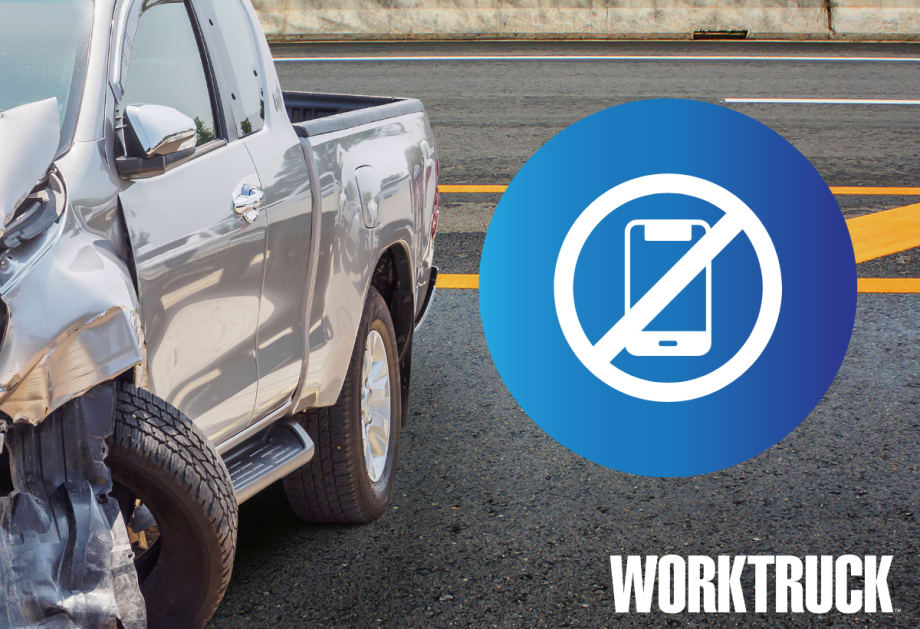
Having a policy to reduce risk, but not training on it can lead to increased risk and problems.
Photo: Work Truck
The main principle of tort law and liability is that one party has the right to prove the other party had a duty to act and breached that duty (by action or inaction). Generally, the duty to act and the breach are based on the actions of a "reasonable person" or a regulatory or legitimate standard.
With distracted driving of company vehicles, it is not a long reach to say a company has a duty to act (i.e., to protect the public). Looking at many of the state laws passed in relation to distracted driving, it becomes clear the public could easily believe companies have a "duty to act."
Minimizing fleet exposure to an incident involving distracted driving by a company driver depends on fleet policies, the company's willingness to follow the policies, and policy enforcement. Being proactive with policies shows management takes the duty to act seriously. This approach also minimizes the chance company vehicles will be involved in a crash due to driver distraction.
Implement a Policy
The first step in minimizing risks associated with distracted driving is implementing a policy (or series of policies) stating employees are to concentrate on driving and distractions are not allowed.
When writing the policy (or policies), remember the following key points:
A "distraction" is any activity that takes a driver's attention away from driving.
Driving distractions of any kind or type will not be allowed in company vehicles, and violations of this policy will lead to immediate disciplinary action.
The next step is to ensure policies are included in initial and ongoing training. Having a policy to reduce risk, but not training on it can lead to increased risk and problems. Imagine an employee claiming, "No one ever told us about such a policy," during a deposition. Keeping policies updated and included in a regular safety training and communications program drives home the company is serious about distracted driving.
Many people equate "distracted driving" with "electronic devices." However, the concept is that a driver distraction is anything that takes the driver's attention away from the driving task, including "low-tech" distractions. Reading maps or files, writing down "important information," eating a meal, and attempting to retrieve an item from a briefcase or back seat are all forms of distraction that must be discussed in the policy and subsequent training.
During training and other communication opportunities, it is important to explain to drivers the hazards involved in distracted driving and the reason for the policy. This training and communication allow management to develop driver buy-in to the policy.
Explain that a driver using a cell phone, texting, or entering data into a GPS device is not paying attention to the road for anywhere from four to six seconds. These four to six seconds convert to driving at least the length of a football field with one's eyes closed. That point usually gets the drivers' attention.
Finally, be aware of the "lesser evil" argument with regard to communications systems, and plan accordingly. This argument often starts with a driver stating, "It was safer to talk on the phone while driving than stop where I was." This argument happens when the company neglects to put the provision into the policy that "the vehicle must be parked off the road and in a safe location before the driver is allowed to use a communications system."
As with any significant policy, be sure policy related to driver distraction is cleared by a legal expert. Why is this considered a significant policy?
There are several reasons:
Potential impact on crash liability, a major exposure.
Operations - giving up instant contact with drivers can lead to friction and problems between dispatchers and drivers.
Human resources - if a driver needs to be disciplined for either violating the policy or not communicating with dispatch at the appropriate time, it becomes a human resources matter.
Follow the Policy
Next, ensure policies are followed by everyone in the fleet. Does management call or text drivers while they are driving? If a company does not take the policy seriously, drivers will not either.
Be wary of the "emergency" loophole that is written into many such policies. If the definition of an emergency is vague, it can create problems later. What happens when a driver considers an event an emergency, but it does not match what management (or a jury) considers an emergency?
Worse, what happens if a dispatcher considers "the need to tell a driver of a schedule change" an emergency that overrides the policy, and the driver is involved in an incident while communicating with that dispatcher?
The key here is to make sure there is a clearly written definition of an emergency, and that everyone is using the emergency provision correctly.
Also, be aware of the "once-in-a-while" tendency found at some operations. A dispatcher stating, "But it is only once in a while," ends up being the perfect excuse for a driver. "If it is okay for dispatch to 'waive' the policy once in a while, why is it not okay for drivers to 'waive' it once in a while?" To prove management is serious about the policy, make sure:
Supervisory personnel do not violate the policy.
Supervisory personnel do not allow drivers to violate the policy.
A problem area for many companies regarding distracted driving policy is company-issued communications devices (company-issued, text-enabled cell phones, onboard e-mail, or text-based communications systems, etc.).
Many drivers look at such devices and decide the company is not serious about distracted driving: "If the company was concerned about this, why did they provide a device that allows it?"
Enforcing a firm policy on driver distraction or using onboard communications systems that can be disabled when the vehicle is in motion usually solves this problem.
Remember 'Low-Tech' Distractions
Does management require a driver to read or write while driving? Reviewing company communications and the work assignment process could shine some light on this. The "worst-case scenario" would be a dispatcher calling a driver and giving the driver complex instructions. The company may be putting the driver in a position where he or she is talking on a cell phone while driving (a driver distraction) and writing down instructions while driving (another driver distraction) at the same time.
Another consideration is meals. Does the company ensure drivers are not eating while driving? In other words, does the policy require drivers to stop and take meal breaks? Many drivers will make and eat sandwiches (or even full meals) as they are rolling down the road at 70 miles per hour. Clearly stating drivers are to take meal breaks away from the vehicle is how the company shows it is serious about eliminating this distraction.
Enforce the Policy
Policies alone are many times not enough to elicit the required behavior. If employees have no fear of being caught and punished, many will ignore the policy. This is because employees in such cases either do not believe their employer is serious or don't believe what they are doing is dangerous. In extreme cases, the employee may actually believe he or she is doing what the company wants him or her to do when violating the policy.
Tracking driving complaints, using a program of road observations, and comparing phone and text records to travel times are methods used to locate policy violators. The bottom line is to ensure drivers and operational personnel understand upfront that they can - and will - be disciplined for policy violations.
Use Common Sense
The key to operating a vehicle fleet and maintaining necessary communication is applying old-fashioned common sense. Possibly the best "common sense" approach is to explain to drivers and operational personnel that old-fashioned planning and taking care of required communications before driving can eliminate many distractions.
Common sense approaches include:
Having a voicemail option on all company-issued cell phones provides an alternative to answering the phone while driving.
Requiring drivers to stop when reading, writing, or eating.
Choosing an onboard communications system that turns off when the vehicle is in motion.
The key to minimizing liability exposure when it comes to distracted driving is to prevent drivers from operating vehicles when they are distracted. This is done by making sure the company has a solid, well-thought-out policy (or set of policies) that is well known, understood, and followed by drivers and operational personnel.
About the Author: Thomas Bray is an editor of transportation management for J.J. Keller & Associates Inc. He can be reached at transporteditors@jjkeller.com.
Originally posted on Work Truck Online
More Safety

Tips for Driving Safely on Halloween Night
This video features a reminder from the Connecticut Department of Transportation (DOT) and the Connecticut Police Chiefs Association, urging drivers to prioritize safety this Halloween.
Read More →
IIHS Crash Avoidance Tests Reveal Safety Gaps in Cargo Vans and Work Trucks
New crash-avoidance ratings from the Insurance Institute for Highway Safety reveal inconsistent performance among commercial vehicles, with several popular cargo vans and heavy-duty pickups struggling to avoid collisions with other vehicles and pedestrians.
Read More →
What’s Next for Fleet? Safety, AI & Industry Recognition | AF News Recap
Could your company's culture be encouraging distracted driving? This week, we're exploring how workplace expectations affect driver safety, what AI, EVs, and autonomous vehicles could mean for the future of fleet management, and how fleet professionals can strengthen their award nominations.
Read More →
Does Your Fleet's Culture Encourage Distracted Driving?
What happens when the people responsible for enforcing safety rules are the ones setting the wrong example? The answer may reveal why some of the biggest risks to fleet drivers have little to do with what's written in the employee handbook.
Read More →
Fleet Manager’s Ultimate Playbook: Navigating the New Standard in OEM Connectivity
Rising operating costs, driver safety concerns, and unplanned downtime are putting unprecedented pressure on modern fleets. Discover how fleet managers use embedded OEM connectivity and real-time vehicle data to cut TCO, prevent downtime, and protect drivers without aftermarket telematics hardware.
Read More →
From Driver Well-Being to EV Charging | AF News Recap
Mental health belongs in the fleet safety conversation. This week, we’re looking at five ways fleets can support employee well-being before a crisis, plus Holman’s expansion in Mexico, new one-day Fleet Forward passes, and why EV charging demand is outpacing infrastructure growth.
Read More →
Nexar-Nauto Merger Aims to Give Fleets Better Safety Intelligence Through Larger Driving Dataset
Stefan Heck tells Automotive Fleet that combining more than 10 billion miles of driving history with Nexar's AI models will give fleets deeper insights into driver risk and roadway conditions than either company could provide independently.
Read More →
Don't Wait for a Crisis: 5 Ways to Build Mental Health Into Your Fleet Safety Program
For Suicide Prevention Month, fleet and safety leaders have an opportunity to put mental health where it belongs: at the center of workplace safety.
Read More →
How Camera Data Can Strengthen a Fleet’s Insurance Renewal
Insights from a commercial insurance carrier and a broker show how fleets can turn video telematic data, driver coaching, and improved claims results into a stronger case at insurance renewal.
Read More →
The Safest Fleets Aren’t the Ones with the Most Technology
You’ve made the telematics investment. Here’s how to capture the other half of its value and build the safest fleet on the road.
Read More →