




How to Overcome Major Fleet Management Obstacles
A fleet manager can have all the degrees, training, and innate skills there are; but a diploma from the school of hard knocks is often the best education.

Photo courtesy of Getty Images.
A long time veteran of the fleet industry tells the story of a time when he had to bring some bad news to his supervisor. He studied the problem and was prepared with his best take on a solution. Nonetheless, he was awfully nervous as he walked into the meeting.
After outlining the problem, and his proposed solution, his supervisor, a grizzled veteran of the company, told him ‘Son, you don’t prove your mettle as a manager when things are going smoothly; you prove it when they aren’t. Go ahead and fix it.’
Truer words have seldom been spoken. Successful managers, fleet or otherwise, will often say that they “earned their stripes” when handling crises, solving problems, and figuring out ways to address the day-to-day issues that arise. Like a manager with a team of all-stars, when all is well and you’ve got the goods, managing is a whole lot easier than it is when you have a team of rookies and has-beens. The school of hard knocks doesn’t hand out degrees easily.
Major Fleet Challenges
There are all manner of examples of hard knocks in most every profession. Some are far more serious than others: the Marine platoon leader whose men are ambushed; a coal miner in the middle of a cave in; an innocent driver faced with a carjacker. Handling these kinds of crises takes a great deal of focus, of fast thinking, and in many cases, leadership; the kind of leadership that a veteran manager sought when he told that fleet manager to “go ahead and fix it.”
That said, not many fleet managers find their staff ambushed, or in a mine cave in. What, then, are the kinds of hard knocks that fleet managers face?
Early build-out. You’re looking at placing your spring orders, and you find out at the last minute that your bread-and butter model is built out for the current model year, and new orders won’t be built and delivered until the fourth quarter.
Executive fleets. You get the MVR for your company’s senior VP of finance, and find out he’s got a speeding violation and a DUI. Company policy demands serious action.
The Booted Car. The eastern region’s best saleswoman has accumulated a number of parking tickets, which remain unpaid. She leaves a meeting and finds her company car has been booted; she has a major prospect meeting that afternoon, and no time to pay the fines and get her car back on the road.
Related: How to Avoid Becoming a Prisoner of ‘Legacy Behavior’
Recalls. Your company has hundreds of service vehicles, and your customers depend upon fast service when your product is on the fritz. You get a recall notice; the vehicles have a safety issue, and should not be driven until the repair is completed.
Budgets. Your budget contains a number of cost reduction items, which will address your management’s demand for bottom line dollars. But circumstances have put roadblocks in place that will bring you substantially up short in your projections.
These are just a few of the kinds of crises that fleet managers deal with every year. Certainly, not all issues that come up are quite as dire as those above. Sometimes it’s simply a driver with an expired registration, or a flat tire. Whatever the problem is, handling it face on, thinking fast and creatively, and proposing a solution, is the kind of management chops senior management is looking for. Let’s take a look at each of these.
Planning Around Early Build-Out
Planning orders has become far more difficult in recent years than it was “back in the day,” so to speak. For a long time, OEMs would build out sometime in the mid/late spring, and the new model-year intros were sometime in the very early fall.
Not anymore. Now production can end and new models introduced just about any time after the new year; add to this the sometimes surprise build-outs that can really throw a monkey wrench into the ordering process. Talk about hard knocks!
So what does a fleet manager do? Here are some ideas:
It’s no secret that this does happen; orders get placed, and the fleet manager learns that only a few of them will be built in the current model-year. Have a backup plan. Know which units can ride the build out into the next model-year. Which units will only be a few thousand miles beyond normal replacement. For the others, it may be necessary to buy from dealer stock. Whatever will cost less, don’t be surprised. Expect that this may happen, develop that plan, and put it in motion when it does.
Use any surplus inventory. Depending upon the size of your fleet, there may be some units whose drivers have left the company, and transfer them to drivers whose units are already up against replacement time and/or mileage. You also may have pool vehicles; if any of them are within reasonable mileage, transfer those to the drivers to drive until the next model-year production begins.
The key is to have a plan in place, a backup that you can put in motion quickly as soon as the bad news comes.
Executive Fleet Safety
Most fleet managers dread it when there is an issue with a senior manager’s vehicle; but when one of them violates established fleet policy, it can really be a problem. Here’s what to do:
First of all, when putting together a fleet policy, or one is inherited, try to get written approval from as high up in the organization as possible: the CEO, president, or very high up VP, preferably where that executive charges the fleet manager with responsibility to enforce it consistently.
Next, make certain that everyone in the organization remotely touching fleet knows not only the policy, but that it’s been endorsed by the CEO (for example), and that you are responsible for enforcement.
If, or when, an executive violates that policy (e.g., by having serious violations on an MVR), don’t hesitate to bring the policy consequences to bear. Do so in writing, and include the policy violated and as importantly the memo or email endorsement from the CEO, highlighting where you’ve been held responsible to enforce it.
An executive vehicle is a cherished part of any executive’s compensation plan; if the enforcement of the policy calls for serious measures, loss of use, or even a probationary period where another violation triggers such loss — do it. Don’t hesitate, as you have by your careful planning provided ample justification for holding the executive responsible.
Using Alternate Transportation
This one demands fast action, but is, relative to the others, a fairly simple one to handle.
Before anything like this happens — a driver needs transportation quickly — have an account set up with a ride-hailing company such as Uber or Lyft.
Get the driver on the phone; find out what his or her schedule is (how long he or she has before that key meeting).
If time permits, get a rental delivered to the driver. If not, have the driver call the ride-hailing company and get a car there quickly.
If there is public transportation available, such as subways, buses, or taxis, advise the driver to use it.In 2018, alternative transportation options are plentiful, compared to back as little as 15 or 20 years ago. Use them. The driver will no doubt be aware of what her options are, but be ready to help.
Vehicle Recalls
Recalls happen all the time, with nearly all OEMs makes and models. Some are simple; a trunk latch that isn’t working properly, a floor mat that interferes with the pedals.
Others aren’t: an electrical issue that can cause a fire. Pedal linkage that can lock the accelerator down, a malfunctioning master brake cylinder, etc.
When it’s the latter, when the recall is a serious safety issue, and it’s your company’s primary vehicle, it can nearly bring your fleet to a halt. There is no simple solution, but again, you need to be ready.
Develop a close relationship with your OEM fleet rep. If a recall hits, contact him or her immediately, and make certain that the person knows the seriousness of your situation.
Learn how long the recall will take, once the vehicle is brought to the dealer.
Determine if dealers will have the right parts needed for the repair, if parts are necessary.
Find out if the manufacturer will reimburse their dealers for the provision of a loaner vehicle when the driver brings it in for the fix.
Notify drivers that, if there is a day when they aren’t out in the field, to schedule that day for the recall; if they need transportation they can rent or use that ride-hailing service for travel if there isn’t a loaner provided or available.
The key here is to be ready to find out everything you can about the recall; what the problem is, which vehicles are involved (they often are limited to certain model years), will dealers have any parts needed to complete the recall, and if there is any alternative transportation provided. If not, as with the booted car, have drivers use alternatives such as ride-hailing, personal vehicles (with reimbursement), or public transportation. Information, anything related to the recall, is critical for fast action.
Assessing Budgets
While the previous crises and problems primarily involve drivers, budgets hit fleet managers right in the career. Every year, fleet managers are asked to do more with less; resources — money, staff, time — become more and more precious, less and less available. But management inevitably will judge performance in no small part by how much cost a fleet manager can cut.
There are only two ways that a company can increase the bottom line. They can increase sales, whereby every dollar increases the company profit only by the percentage of their after tax profit (e.g., if the margin is say 10%, those dollars will return 10 cents). Alternatively, they can reduce cost, where every dollar of reduced cost will drop entirely to the bottom line.
Fleet management is a cost, not a sales, function. Vehicles may be necessary, but on the income statement they’re a cost, and thus management is always looking for reductions. When fleet managers do their annual budgets, some plan for cost reduction is a part.
But as a boxer once said, every fighter has a plan until they get punched in the face. And cost reduction efforts can often suffer such punches.
Know your numbers. Know where your costs are, how they impact total cost of ownership, and understand their components.
Understand What Impacts Costs
Focus on where the money is; the two primary cost categories in any fleet operation are depreciation/funding costs on the fixed cost side, and fuel on the variable cost side.
Be realistic; don’t over promise, but don’t set your cost reduction bar too low. Either way, your management will see through it.
Too many managers take the easy road when budgeting; take last years’ costs and increase them all by some minor inflationary factor. Don’t do it. When budgeting, take each category individually, and build next years’ budget based upon realistic projections based in part on the real factors that will impact those costs.
The one category that can be the most volatile, and thus can throw a budget out of whack, is fuel. Fuel costs are nearly entirely dependent upon pump prices, which, for fleet managers who can remember the wild ride prices took in 2008, is all too real. Here is where a fleet manager can use an asterisk in their savings list, indicating such volatility but also indicating the source for their projections.
Related: How to Avoid Stagnating as a Fleet Manager
There are changes in fleet that can bring cost savings, such as downsizing, alternative fueled vehicles, and changes in replacement policy that will usually be realized. Examine fleet makeup carefully, and show plans to implement these type of changes.
It cannot be emphasized enough to first, know those numbers, and second to know — and show in a budget — what can impact planned savings.
And don’t forget, when the end of the fiscal year reckoning happens, that sometimes in the face of unforeseen circumstances that limiting cost increases can often be rewarding, if things such as a sharp spike in fuel prices kills the budget and any savings therein. If prices double, or increase by some major percentage, keeping cost increases below that increase will be recognized.
The Commonalities
Learning and dealing with the hard knocks a fleet manager will inevitably face some commonalities:
Planning: Always have a backup plan to implement when things go awry.
Options: Know what your options are when faced with serious crises that require fast action
Don’t hesitate: If you’ve done your homework, be confident in your decisions, and act.
Preparation: When you must bring bad news to management, don’t do so without a solution, or a plan of action to deal with it.
Address Problems: Don’t ever try to hide bad news. Face it, let management know, and act to solve the problem
The school of hard knocks can test a fleet manager’s mettle. But once you’ve graduated, you’ll face the job with renewed confidence, and management will have confidence in you.
Related: Avoid Being the 'Dirty Harry' of Fleet Enforcement
More Operations
How to Manage Conflict for Your Fleet Operations
Conflict management is becoming a core leadership skill. Here are five strategies fleet leaders should know.
Read More →
Turning Connected Vehicle Data Into Decisions That Matter
Fleet leaders have more data than ever, but turning that data into clear, actionable decisions remains a challenge. This white paper shows how leading organizations are using connected vehicle data to improve safety, reduce costs, and optimize fleet performance. Learn how to turn insight into action across your fleet.
Read More →
Cameras, Safety and Insurance: From Reactive Claims to Real-time Prevention
Commercial auto remains one of the most challenging and costly lines of coverage for fleet operators and insurers alike. Learn more about how to effectively address these issues from Onur Aksan, Enterprise Business Development Executive, Geotab.
Read More →

Are You Tracking Your Fleet's True Total Cost of Ownership?
Bobit Business Media surveyed 190 fleet professionals and found that while most fleets are tracking costs, fragmented systems and data gaps are keeping true TCO visibility out of reach. With rising pressure to control spend in an increasingly volatile environment, the gap between what fleets think they know and what the data actually shows is wider than you might expect. See how your peers are managing costs today and where the industry still has room to improve.
Read More →
Turn Fleet Data Into Smarter Decisions
Fleet leaders have access to more operational data than ever, but disconnected systems and unclear metrics often slow decision-making instead of improving it. This whitepaper outlines five practical steps fleets can take to transform fragmented data into actionable insights that improve planning, safety, utilization, and long-term performance.
Read More →
Hybrids: Electrification Without the Challenges
For fleet managers, fuel is one of the biggest line items in the budget — and it's one hybrids can shrink without changing how your people work. Download the eBook to see the numbers, understand the technology, and get a step-by-step guide to making the switch.
Read More →
How NOV Uses Telematics to Improve Fleet Safety Across 160 Locations
James Victory of NOV discusses how the company manages fleet safety, maintenance, and telematics across more than 150 locations supporting oilfield operations throughout the U.S.
Read More →
Fleet Meets: Steven Santostasi
This edition of the Fleet Meets series features Steven Santostasi, the current TSP channel manager for Ford Pro.
Read More →
Why Fleet Managers Are Replacing Departmental Vehicles with Shared Motor Pools
Departmentally assigned vehicles often create hidden costs through underutilization, poor visibility, and increased administrative burden. This white paper explores how shared motor pool strategies help fleets reduce costs, improve accountability, and optimize vehicle utilization.
Read More →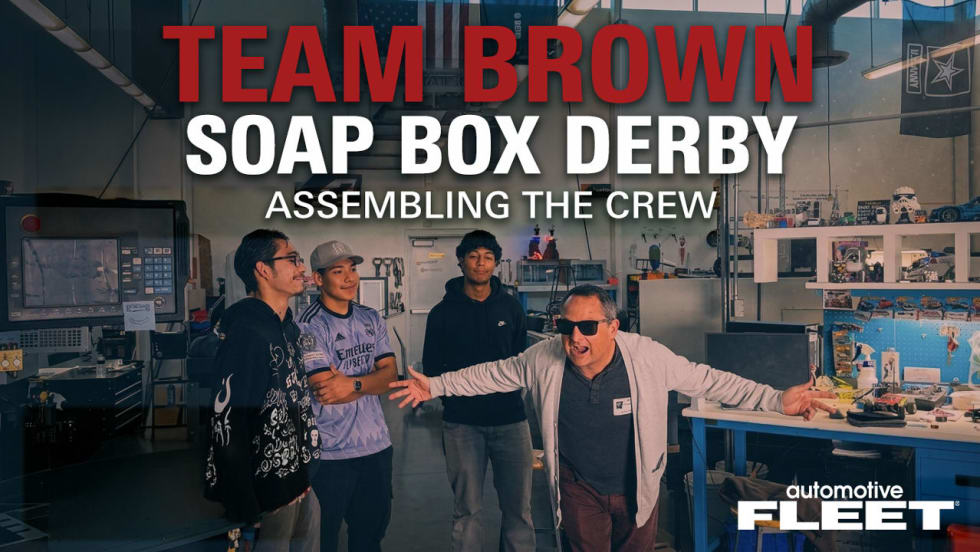
Soap Box Derby Challenge: Assembling the Crew
Meet Gabriel, Matthew, and Angel — the team helping bring this soap box derby build to life.
Read More →