




How to Lower EV Charging Infrastructure Costs
Why do electric vehicle charging station costs vary so widely, and how can you reduce your costs?

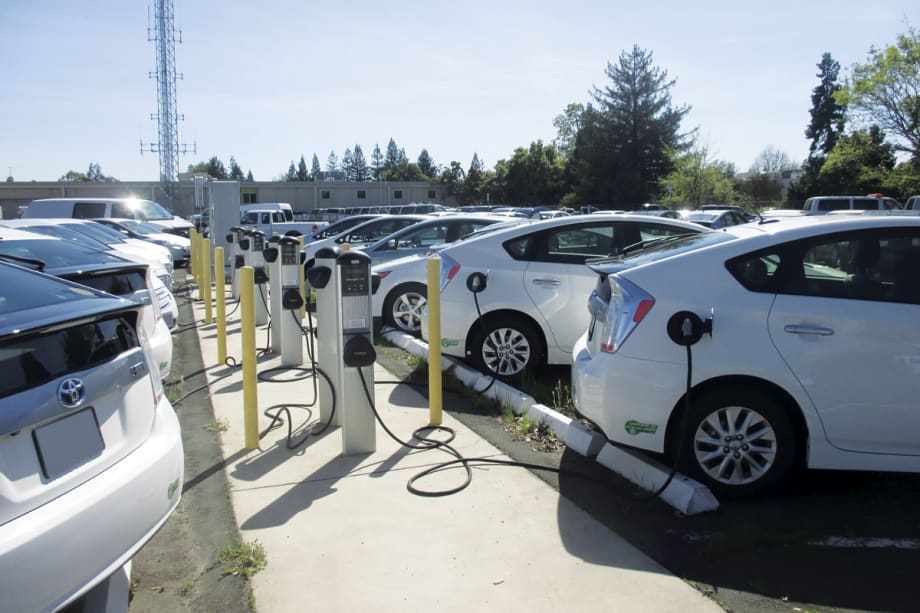
Building more than one charging unit in a single location can lower per-charger costs.
Photo courtesy of David Worthington
Electric vehicle charging infrastructure is expensive, and installing stations takes not just money, but also time, patience, expertise, and collaboration with others. Still, if the fleet includes one or more battery-electric vehicles, fleet managers will have to make sure their vehicles can be charged.
David Worthington, manager of fleet and construction support for the East Bay Municipal Utility District in California, helped install 76 charging stations as the previous fleet manager at Sonoma County, Calif. Here’s what he learned about EV charging station infrastructure costs.
Get Funding
There is no return on investment (ROI) on electric vehicle charging stations, not like there is with electric vehicles, Worthington warned. Instead, fleet managers should consider them like gas stations, where you might get an ROI after a decade or more.
Worthington explained that when he was installing charging stations, the infrastructure installation costs (construction, electrical panels, trenching, asphalt, concrete, engineering, permits, conduit, wiring, etc.) averaged between $18,000 to $21,000 per charging station, which excludes the charging hardware. He expects the same installations now would average $24,000 to $25,000.
National rates may be lower. A 2015 Clean Cities report showed that ballpark costs for installing a Level 2 charging station are $600 to $12,700, with a single port charging unit costing between $400 and $6,500.
There’s a big variance. Factors affecting cost include available power, how close the power panel is to where the station will be, trenching needs, whether the stations need to be ADA compliant, what kind of charging hardware is needed, and whether it’s necessary to upgrade or bring in a new electrical service to meet capacity.
“Funding is critical,” he said. This can either be an internal source or grant funding from the state, air districts, Clean Cities organizations, or with federal funds.
Choose Cheaper Locations
Location plays a big part in costs. Worthington said the cheapest installations were where there was already sufficient power in an electrical panel, the charging space was within 20 feet of the electrical panel, and they could run conduit on the outside of the wall and mount the charging stations to the walls. These conditions may be hard to find, but they’ll help fleet operations save money.
If the station is in a fenced-in location for fleet-only use, installing “dumb” stations can help save costs. The administrative workload of dumb chargers is also much lower, he added.
If trenching is needed, shorter distances are cheaper, and trenching through asphalt and vegetation is less costly than trenching through concrete.
And installing one station could be as pricey as installing four in one spot, so use that to your advantage. “The sweet spot that we found, in per-station installations, was between four and eight stations,” Worthington said. “That’s where it’s a reverse bell curve and the lowest average cost per charging station resides.”
Consider Level 1 Charging Stations
Fleet operations often focus on Level 2 charging, but they shouldn’t overlook Level 1 charging stations, Worthington mentioned (see the “How Fast Will It Charge?” sidebar for an overview of the differences).
“If it’s ‘behind the fence’ — in a secure location — and you don’t have any chance of somebody using the outlet for some nefarious reasons, and the vehicles are going to be parked for eight, 10, or 12 hours, depending on utilization, a Level 1 may be fine.” He added that it’s rare that an EV comes back fully depleted; in his experience, they usually come back with at least 25% remaining battery capacity.
“When you look at that, do you really need to plan for infrastructure that supports every time the vehicle comes back with batteries completely depleted? I don’t think you need to,” he explained.
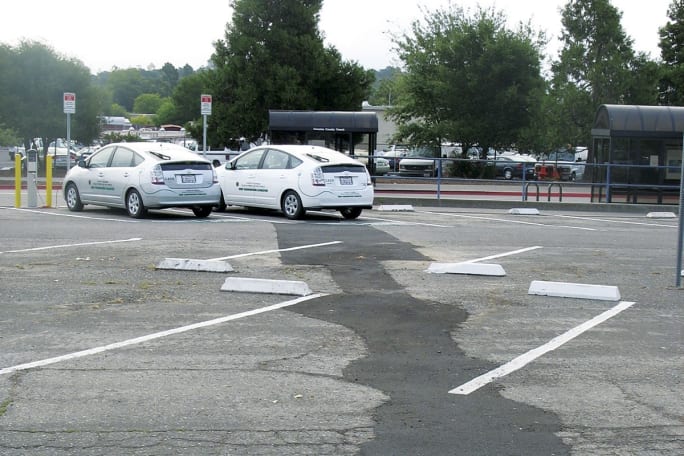
Long-distance trenching, like at this parking lot, can drive up the cost of an EV charging station installation.
Photo courtesy of David Worthington
Be Careful with Demand Charges
Demand charges can significantly increase your electricity costs, and many utility companies are charging them.
“You have a baseline amount that you’re given that you will be charged a certain rate for and once you exceed that level, then you pay demand charges,” he said.
Worthington recalled a city that provided public charging and was hit with a bill for a couple thousand dollars in demand charges when it had only collected a few hundred from users. Too many vehicles had been charging at the same time.
Now there’s technology to help control costs so that charging station owners don’t get hit with sky-high fees. Select “smart” chargers can handle load management, dispersing only a certain amount of voltage at a time. But when setting this up, fleet managers need to be aware of the duty cycles of vehicles, so drivers don’t get stranded. If a charger is limiting voltage for charging and a driver comes to drive the car, only to find it doesn’t have enough range to get her to where she needs to go, that’s a big problem.
Look on the Bright Side
Worthington admits that installing EV charging infrastructure can cause headaches, and there is a lot to learn as fleet managers go through the process. Some positives in the area of EVs: The vehicles have lower operating and maintenance costs than traditional gasoline vehicles, and their service lives could be doubled.
And if charging infrastructure improves or changes significantly, changing the hardware for a different design is much easier — and cheaper — than doing infrastructure installations all over again.
He’s studying vehicle duty cycles and utilization data for the utility where he works now, and if it looks good, Worthington may be recommending integrating more EVs into the fleet and installing more charging stations to support them soon.
Worthington added that in California, the move to EVs is inevitable.
“We’re moving toward only having choices in the future of either electric- or hydrogen-powered vehicles. So, the sooner fleets embrace electricity, the better,” he said.
Originally posted on Charged Fleet
More Global Fleet
GeoFencing Adds to Your Truck Security Arsenal
Geofencing is a familiar fleet tool today, but its early adoption marked a major shift in vehicle tracking, route monitoring, and the debate over employee privacy.
Read More →
Holman Takes Full Ownership of ARIZA in Mexico
Holman is bringing its Mexican fleet management operation fully under its own brand after more than 30 years as a joint venture. The change gives multinational fleet customers a single Holman operation across the U.S., Canada, and Mexico.
Read More →
5 Tire Maintenance Tips to Help Prevent Work Truck Downtime
Regular tire checks can do more than extend tread life. These five maintenance practices can help work truck fleets catch problems early, reduce costs, and prevent downtime.
Read More →

Proven Ways to Reduce Work Truck Downtime
The age-old problem of downtime will always be a reality, but with new strategies at hand, fleets have more ways to keep trucks on the road longer.
Read More →


Cameras, Safety and Insurance: From Reactive Claims to Real-Time Prevention (Part 2 of 2)
Part Two: Commercial auto remains one of the most challenging and costly lines of coverage for fleet operators and insurers alike. Continue learning more about how to effectively address these issues from Onur Aksan, Enterprise Business Development Executive, Geotab
Read More →
Cameras, Safety and Insurance: From Reactive Claims to Real-time Prevention
Commercial auto remains one of the most challenging and costly lines of coverage for fleet operators and insurers alike. Learn more about how to effectively address these issues from Onur Aksan, Enterprise Business Development Executive, Geotab.
Read More →
Fleet Costs Are Rising: Here’s How Leaders Are Responding
Fleet leaders are under pressure to reduce costs, adapt to economic uncertainty, and make smarter decisions. See how peers across North America are responding with real data, proven strategies, and forward-looking insights. Download the 2026 Market Pulse Report to benchmark your strategy and uncover where you can gain an edge.
Read More →
Enterprise Fleet Management Surpasses 900,000 Vehicles in U.S. & Canada
Enterprise Mobility connects with mobility solutions around the globe
Read More →