




How to Keep Higher-Mileage Vehicles in Service
These fleet managers regularly run their fleet to more than 200,000 miles using fanatical preventive maintenance, preemptive parts replacement, driver accountability and corporate pride.

Since the recession hit, Veit, a construction company headquartered in Rogers, Minn., now runs its vehicles to 200,000 miles.

Since the recession hit, Veit, a construction company headquartered in Rogers, Minn., now runs its vehicles to 200,000 miles.
In 2008 and 2009, when fleets were feeling the squeeze of the Great Recession, many companies had no choice but to keep their vehicles in service longer than they had before. This business decision brought closer attention to servicing and maintenance.
Over time, fleet managers realized they could comfortably keep higher-mileage vehicles in service, as long as they followed certain guidelines for maintenance and parts replacement.
These fleet managers regularly run their trucks and vans to more than 200,000 miles by incorporating fanatical preventive maintenance, preemptive parts replacement, driver accountability and corporate pride. And they make sure to stick to their plan.
Instilling Pride of Ownership
Veit, a construction company headquartered in Rogers, Minn., used to run its vehicles to 100,000 to 150,000 miles before retiring them, but when the recession hit, the company made the business choice to run to 200,000 miles.
“In doing that, the [maintenance] costs didn’t change much from 150,000 to 200,000 miles,” says Don Emmel, Veit’s fleet manager. Today, with few exceptions, “I won’t retire anything unless it gets to 200,000 miles,” he says, while a handful of vehicles have passed the 300,000-mile mark.
Emmel has found some fleets lose focus on maintenance once a vehicle reaches 100,000 miles because they think they might be ready to get rid of them. “Never change the focus,” Emmel says. “Plan on your vehicles making it to 300,000 miles and stay with the maintenance plan.”
Veit’s fleet consists mainly of half-ton, ¾-ton and one-ton pickups. About 80% of the fleet consists of General Motors vehicles (Silverado and Silverado HDs) while the rest are Fords. Emmel says that improvements in GM’s trucks with the 2010 model year have cut his unscheduled maintenance costs considerably.
Veit’s high-mileage strategy starts with strict preventive maintenance. Oil and filter changes are done at 5,000 miles instead of the manufacturer’s recommended intervals of 7,000 and 10,000 miles. While the full synthetic oil isn’t breaking down, Veit has found that the oil filters are reaching capacity with contamination due to heavy job site use.
Emmel extends this strict schedule to transmission service, which is performed at 30,000 miles and 50,000 miles instead of the recommended 70,000 miles and 100,000 miles. By cutting that interval in half, “I have not had one transmission failure in five years,” Emmel says.
Based on experience, Emmel changes some parts preemptively. For instance, if a one-wheel bearing fails at 70,000 miles, he’ll change the others. “If we skimp on putting on that $150 wheel bearing, the downtime and cost on the road can exceed $1,200 or more,” he says.
Working a service area covering five Midwestern states, Veit’s fleet does not return to a centralized base, so Emmel has to rely on his drivers to bring the vehicles in for maintenance. This makes the company’s top-down “pride of ownership” philosophy all the more important. “When I hand them the truck, I tell them you have to take care of it like it’s your own,” Emmel says.
The company approves ordering trucks with driver perks such as chrome packages, power seats and better stereos. Drivers have been known to post photos of their trucks to Facebook, as well as call out other drivers who keep a sloppy truck. “Let them know they’re being taken care of,” Emmel says, “and they’ll take care of the truck.”
Sampling Oil Predicts Failures
Serving the Southwest, Meadow Valley Contractors runs its fleet of ¾- and one-ton Dodge and Ford pickups as high as 250,000 to 300,000 miles. The trucks, from model years 2004 to 2008, rack up the miles at an average of 30,000 to 35,000 miles per year.
Fleet manager Voy Matheson has been impressed with the trucks’ performance, even with heavy-duty construction use. “The 2006 trucks were bought at the beginning of the [economic] crunch,” Matheson says. “The economy was a factor in running them for a longer time, but it was [also] cost-effective to keep running them, because we weren’t having many problems.”
[PAGEBREAK]
Matheson reports he’s had to replace transmissions at 100,000 miles on the trucks with heavy payload and trailering duties, though other transmissions have been fine at 260,000 miles. A lead foot will also affect transmission life, he says. “If we have someone who’s been abusing, we try to encourage them to be more considerate,” Matheson says.
While there have been few problems with the trucks in the fleet, Matheson has found that after 200,000 miles, fuel injection lines can crack and water pumps and clutch pans will need replacing. “But that’s normal wear,” he says. The most common problems at high miles involve injector failures that cause cylinder damage. Other problems can include worn front drive lines and tie rods and loosened wiring looms.
Oil changes are regularly scheduled every 4,000 miles or every 5,000 miles, depending on the vehicle, and oil samples are taken.
While the oil itself may still be good, the samples are checked for an increase of deposits such as aluminum, which would signal the beginning of a parts failure. “If a truck is getting close to 300,000 miles, and if the metal is starting to go up, it enables us to say, ‘we’ve got 300,000 miles on it, do we want to put in a new engine?’” Matheson says.
Usually, Matheson feels the company’s investment has been well realized by the time a truck has reached 300,000 miles, so at that point, the company turns some vehicles to job site-only duties or look for a replacement. “We’ve had good luck running the higher miles and keeping costs down,” Matheson says. “If it was costing us more, we wouldn’t do that.”
Avoiding the Stinker List
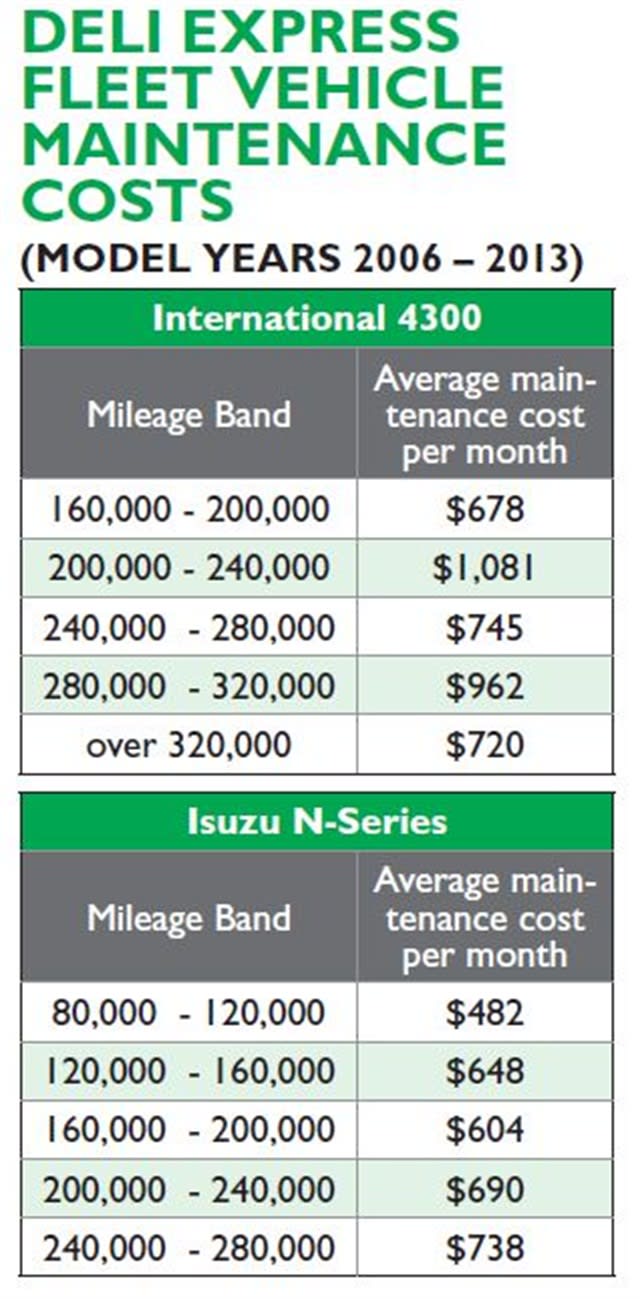
The Deli Express fleet delivers sandwiches to convenience stores across the country with its fleet of Isuzu N-Series cabover box trucks and larger International 4300 model straight trucks.
Most vehicles have accumulated 200,000 to 250,000 miles, while some are beyond 350,000 miles, says Gregg Hodgdon, director of fleet operations. Though those truck models are rated to handle the high miles, “We’re not running them [that high] by choice, but for budgetary reasons,” he says, adding that he’d like to de-fleet the Isuzus at 200,000 to 210,000 miles.
With a decentralized fleet, Hodgdon relies on his district managers to monitor maintenance. Each district manager is responsible for four or five trucks and must meet certain metrics called KRAs, or key responsibility areas.
Managers are held accountable for maintenance costs, compliance with DOT inspections, preventive maintenance schedules, accident costs, truck rentals, fuel economy per driver and cycle time for trucks in and out of fleet. Those that fall out of acceptable parameters will find themselves on a corporate “stinker list,” Hodgdon says.
With this data, Hodgdon is able to calculate the cost of maintenance at each mileage range (see chart). For both the Isuzus and the Internationals, maintenance costs increase steadily at high mileages, though maintenance costs take a dip in higher mileage bands before escalating to their highest points at the end of service life.
Hodgdon accounts for the dip by the fact that typical costlier maintenance issues have been rectified.
Hodgdon admits he’d like to be more proactive on replacing parts before they fail, though this is difficult with a decentralized fleet.
Deli Express requires oil changes more frequently than recommended — not necessarily because the oil needs changing, but to get the truck inspected by a professional. Hodgdon makes sure the trucks’ DPFs (diesel particulate filters) are cleaned at 90,000 miles instead of the recommended 100,000 miles. “We have learned that lesson,” Hodgdon says. “If we don’t clean it, we end up replacing it around $4,000 per filter.”
[PAGEBREAK]
Keeping them Going, and Going
Taxi fleets run high miles as part of the business model; for this reason, small commercial fleets might take a tip from their fanatical attention to preventive maintenance.
Total Transit, a taxi company serving Phoenix, regularly pushes its Toyota Prius taxis to 350,000 miles. “If you’re not looking at your vehicle on a preventive maintenance schedule, you’re setting yourself up for failure,” says Jay Crete, corporate fleet manager. “Set a preventive maintenance schedule and stick to it. Then you will not see cars for unscheduled maintenance.”
The Prius hybrids run 5,800 to 6,500 miles per month and more than 70,000 miles per year. Vehicles are serviced every 28 days. Mechanics check to see if components will last until the next scheduled maintenance, and if not, they’re changed then and there. The process takes about two hours, as mechanics have more than 100 items to check on a form tailored for each vehicle.
Crete found that the hybrid batteries for the second-generation Prius (model years 2004-2008) only started to malfunction starting at 250,000 miles. At one point, Crete replaced the bad cells, which gave the battery up to another 40,000 miles of life.
But when the third-generation Prius was released in 2010, the company decided to implement a standard “recovery maintenance” at 200,000 miles, which dictates preemptively replacing the hybrid battery with a new one and replacing the ABS module, along with minor maintenance and cosmetic refurbishments. While this service costs $6,400, it allows these newer Prius models to reach the 400,000 mile mark.
Ron Gephart, senior project manager for Assetworks, a fleet software provider, offers a few tips from other transportation sectors. Gephart says that some bus manufacturers actually provide buyers a list of parts that are known to be replaced within a given mileage or time frame. This allows bus fleets to stock up on spare parts at the time of acquisition, and work those costs into the budget.
This could work in some small fleet cases, Gephart says. “You could negotiate wholesale pricing if you buy [the spare parts] in bulk, and you have your spare parts on hand.”
Gephart also recommends putting standard maintenance on a contract and asking for bids from mechanics. This helps a fleet to budget more accurately and secure better pricing as well as preferred status for service bays. “A local vendor would jump on that,” he says.
Originally posted on Work Truck Online
More Global Fleet

Proven Ways to Reduce Work Truck Downtime
The age-old problem of downtime will always be a reality, but with new strategies at hand, fleets have more ways to keep trucks on the road longer.
Read More →
The Top 300 Commercial Fleets
The Top 300 Commercial Fleets: See the List
Read More →

Cameras, Safety and Insurance: From Reactive Claims to Real-Time Prevention (Part 2 of 2)
Part Two: Commercial auto remains one of the most challenging and costly lines of coverage for fleet operators and insurers alike. Continue learning more about how to effectively address these issues from Onur Aksan, Enterprise Business Development Executive, Geotab
Read More →
Cameras, Safety and Insurance: From Reactive Claims to Real-time Prevention
Commercial auto remains one of the most challenging and costly lines of coverage for fleet operators and insurers alike. Learn more about how to effectively address these issues from Onur Aksan, Enterprise Business Development Executive, Geotab.
Read More →
Why Fleet Managers Are Replacing Departmental Vehicles with Shared Motor Pools
Departmentally assigned vehicles often create hidden costs through underutilization, poor visibility, and increased administrative burden. This white paper explores how shared motor pool strategies help fleets reduce costs, improve accountability, and optimize vehicle utilization.
Read More →
Fleet Costs Are Rising: Here’s How Leaders Are Responding
Fleet leaders are under pressure to reduce costs, adapt to economic uncertainty, and make smarter decisions. See how peers across North America are responding with real data, proven strategies, and forward-looking insights. Download the 2026 Market Pulse Report to benchmark your strategy and uncover where you can gain an edge.
Read More →
Enterprise Fleet Management Surpasses 900,000 Vehicles in U.S. & Canada
Enterprise Mobility connects with mobility solutions around the globe
Read More →
Automotive Fleet's Guide to Fleet Electrification
Unlock the secrets to a successful transition to electric fleets with Automotive Fleet's comprehensive Fleet Electrification Guide!
Read More →
Sumitomo Rubber Industries to Acquire Viaduct
Viaduct will join Sumitomo as an independent subsidiary. Partnership strengthens global reach and accelerates AI-driven innovation for fleets and manufacturing.
Read More →