




How to Harmonize Multinational Fleet Policies
In managing a multinational fleet, it is important to work collaboratively with both internal and external stakeholders, so their policies and procedures are harmoniously aligned to successfully execute and fulfill a strategic fleet plan.

Photo: Gettyimages.com/Natee Meepian
Throughout my journey in managing a multinational fleet, I realized early on the importance of working collaboratively with both internal and external stakeholders who are aligned on a solid strategic plan and committed to delivering top-tier results. I am a firm believer in the approach that this is like the hub and spoke of a wheel.
In this model, the global fleet manager represents the hub and the stakeholders, and the strategic planners are the spokes. In order for the wheel to move harmoniously, the hub and spokes must work together and to travel in the same direction. While it is a clear concept to grasp in theory, given there are so many stakeholders (and personalities involved) the global fleet manager must remain steadfast in ensuring all the pieces are working together for the betterment of the business.
Supplier Consolidation
The selection of a global partner starts with the global footprint of the preferred supplier. At a base level, their global reach must overlay with the countries you conduct business in. Today, there is a strong selection of multinational suppliers available within our industry either by the formation of alliances or a standalone global organization.
Through my global experience, I discovered both segments work well; however, their approach in global consultancy, regional expertise, proactive best practice sharing, continuous improvement projects, and safety solution may vary slightly, but, overall, they are all capable of delivering on all these attributes.
Supplier consolidation provides an opportunity to simplify operations globally. A consolidation supplier strategy also provides an opportunity to allow a multinational fleet to make the most of their purchasing power, which, in turn, provides further opportunities for savings – a financial benefit one cannot overlook.
When tasked with finding a fleet management company for a large international fleet with a global footprint in North America, Latin America, Europe, Asia, Middle East, and Africa, you can consolidate down to two or three FMCs, which represent anywhere from 75% to 90% of your global lease/service volume with one being the primary and the others being secondary supplier.

The hub and spoke approach comes to life in ‘The Wheel of Good Fortune’ showcasing how all of the pieces work together with the global fleet manager at the center driving the team forward.
The remaining 10%, based on my past experience, generally arises in the Asia region where regional players control the market; however, I have noticed a trend with the major FMCs forming alliances in the Asian markets. This is due to high-level growth trends for fleet leasing and management owing to rising use of company vehicles and increasing penetration of global players in this region with significant growth expected in next four to five years. India and China are key fleet markets in this region.
OEM consolidation for the same size and global footprint can require using four to six partners. This consolidation range allows a global fleet to secure incremental volume discounts and rebates, plus it keeps your drivers content on the choice of vehicle available to them.
Challenges in Sourcing Globally
When first implementing a consolidation approach, you will likely discover service capability gaps across countries. Often, no one supplier will be able to service the entire client footprint. There may also be challenges in understanding local service needs and vendor capabilities, overcoming local bias/preferences, and realizing the complexity of evaluating pricing across markets. Having an open mind and flexible approach to understanding these nuances will help in overcoming these challenges during this critical step.
Strategic Partnership Selection
Selecting the best strategic partner for your business is absolutely key as this relationship is foundational in achieving your strategic goal, which is best-in-class improvement throughout the global fleet footprint. The overall objective is to create value for both the first year of the partnership and beyond.
One Vehicle Segment Strategy
As you consider your strategy, there are some opportunities to lower your costs without impacting operations. I experienced this by adopting a one vehicle segment approach, which can consolidate 80% to 90% of vehicles into a single segment (compact, sedans, and/or SUV). When there are too many options within the fleet, it is a challenge to find the efficiencies and moving to a one vehicle segment strategy permits cost benefits to emerge, plus it allows for improved fleet benchmarks versus a multi-choice selector.
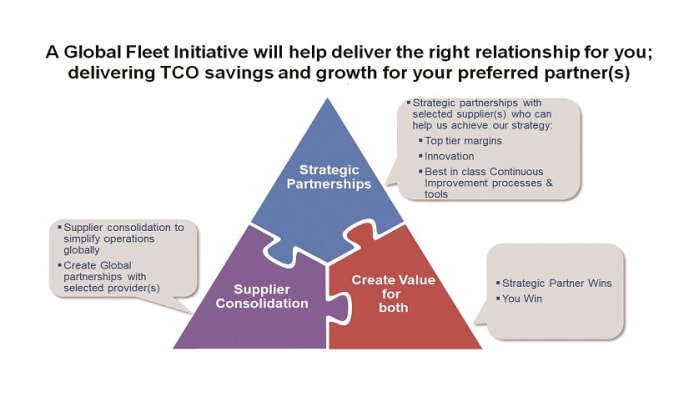
All the pieces of the puzzle must fit together in order to implement a solid global fleet strategy. In its simplest form strategic partnerships and supplier consolidation can lead to long term relationships and lasting value for both.
Drivers might be apprehensive at first; however, with new developments in the exterior design, interior capacity, and powertrain performance, ultimately drivers will see the value with a one vehicle segment shift. This strategy can work in a fleet where upfitting is not involved. I compare this to the trend of displacing private offices and cubicles to an open seating format. Multinational companies are moving to this format and it is reducing facility overheads and the majority of the employees seem to embrace this new workstation seating arrangement.
Continuous Improvement
With the amount of financial burden multinational fleets face today, fleet managers must leverage best practices and drive results for the business. Being dedicated to continuously improving the performance of your fleet and minimizing fleet spend secures strong and impactful results. Many fleet management companies have developed proven methodology, using proprietary tools, to help global fleets deliver sustainable cost savings. But in order to implement actionable cost-savings recommendations, your internal fleet stakeholders must support the suggestions from your FMC. This is where a governance team can help by steering the implementation of new cost improvement policies throughout the fleet and tracking compliance and by monitoring the associated actions, if required.
Accident Data & Action Focus
It is imperative that a safety-first culture is created throughout all segments of this journey. Why a safety-first culture? According to the World Health Organization, “Every year the lives of approximately 1.35 million people are cut short as a result of road traffic crashes.”
Keeping your drivers safe so they can return home to their families is all the incentive you need to justify a safety culture focus. Coming from safety culture surroundings, I believe that all accidents and injuries are unacceptable, and we must strive to eliminate all such occurrences. It is crucial that we recognize, prevent, and report all safety-related issues and incidents.
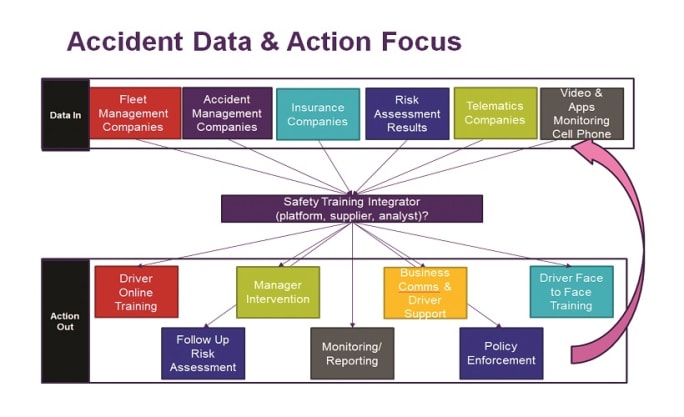
When it comes to accident and driver behavior data there is a significant level of information coming in from multiple sources and fleet managers must be able to respond quickly with the best information available. Working with a safety training integrator can help streamline and distribute this information to the manager and ultimately to key stakeholders. This is an on-going and continuous process, but critical for success as this process is repeated daily.
A fleet that embraces this safety culture focus on providing safe vehicles and educational resources to enhance safe driving skills. Reliable data coming from fleet management, accident management, insurance, risk assessment, telematics, videos, and apps monitoring cell phone use providers feed data to their fleet clients every day. This data is stored by what I will call an integrator and then the data is sent out to end users who are responsible to take corrective action.
This process repeats itself daily and hopefully there will be no disruption with the data. The challenge here is that disruption does occur with the data coming in and the data going out as it can get delayed or lost. Thankfully, there are tools available today that work to help mitigate these issues and keep drivers safe, yet there is still an opportunity to simplify this process within our industry. I know companies are looking to address this and I look forward to seeing the solutions that will address our current challenges.
Refocus on CO2 Emission Cap
Companies are increasingly adopting sustainable fleet management practices to reduce their carbon footprint, gain economic incentives, and comply with emission regulations. Regulations pertaining to CO2 emissions are contributing to an increase in the selection of vehicles with smaller displacement engines.
Other factors around CO2 emission are the growing discussion around the use of diesel engines in Europe and the future of electric vehicles. These disruptors are requiring multinational fleets to act today to be ready for adoption down the road. Trials in a few select countries where public and government incentives are present, such as Norway, UK, France, and Germany, should be happening today.
Multinational fleets must unite with fleet management service providers that engage in sustainable fleet practices to reduce their carbon footprint in the long term. Organizations may look at using sustainable fleet management practices as a cost-saving strategy. The time invested in in refocusing your CO2 emission strategy will deliver a brighter future for our grandkids and our planet.
Value of a Governance Team
Having a top-to-bottom governance team is imperative for a successful global fleet strategy. The role of this team is to define long-term strategy, policy, and to lead by example to achieve top-tier benchmark status. The team takes ownership of results, resolves challenge, mitigates risks, and agrees to policy changes.
The governance team leads and support fleet operational deployment, which is a key ingredient for successful implementation in overcoming barriers. On a quarterly basis, they review dashboard and operational KPIs and identify and shares best practices among the regions. One of the important functions of this team is to celebrate success by recognizing those who have made an impact on the accomplishments achieve through-out this journey.
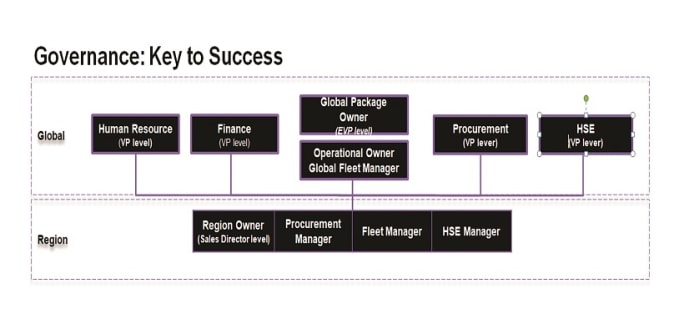
Provided is an example of the governance teams and how key stakeholders work with one another through the process.
Overall, the central role that the fleet manager plays in the process of harmonizing a global fleet is absolutely critical. There are many challenges in working with the various parties, regional nuances, and lots and lots of processes; however, a growing number of multinational companies are implementing a global approach so they can help get to where they need to go faster and more efficiently.

Photo: Dmochowsky
Every organization is different, but with a clear vision, the right partners/stakeholders and understanding the nuances of the process will pave the way for finding success within a global fleet and that wheel (aka team) will drive smoothly down the road.
About the Author: As an award-winning fleet consultant and conference speaker, John Dmochowsky is a subject-matter expert in managing multinational fleets, which includes negotiating and implementing global sourcing agreements, and establishing global sustainability and safety policies. He can be reached via e-mail at dmochowskyjohn@gmail.com or by phone at (847) 915-5085.
More Global Fleet

GeoFencing Adds to Your Truck Security Arsenal
Geofencing is a familiar fleet tool today, but its early adoption marked a major shift in vehicle tracking, route monitoring, and the debate over employee privacy.
Read More →
Holman Takes Full Ownership of ARIZA in Mexico
Holman is bringing its Mexican fleet management operation fully under its own brand after more than 30 years as a joint venture. The change gives multinational fleet customers a single Holman operation across the U.S., Canada, and Mexico.
Read More →
5 Tire Maintenance Tips to Help Prevent Work Truck Downtime
Regular tire checks can do more than extend tread life. These five maintenance practices can help work truck fleets catch problems early, reduce costs, and prevent downtime.
Read More →

Proven Ways to Reduce Work Truck Downtime
The age-old problem of downtime will always be a reality, but with new strategies at hand, fleets have more ways to keep trucks on the road longer.
Read More →


Cameras, Safety and Insurance: From Reactive Claims to Real-Time Prevention (Part 2 of 2)
Part Two: Commercial auto remains one of the most challenging and costly lines of coverage for fleet operators and insurers alike. Continue learning more about how to effectively address these issues from Onur Aksan, Enterprise Business Development Executive, Geotab
Read More →
Cameras, Safety and Insurance: From Reactive Claims to Real-time Prevention
Commercial auto remains one of the most challenging and costly lines of coverage for fleet operators and insurers alike. Learn more about how to effectively address these issues from Onur Aksan, Enterprise Business Development Executive, Geotab.
Read More →
Fleet Costs Are Rising: Here’s How Leaders Are Responding
Fleet leaders are under pressure to reduce costs, adapt to economic uncertainty, and make smarter decisions. See how peers across North America are responding with real data, proven strategies, and forward-looking insights. Download the 2026 Market Pulse Report to benchmark your strategy and uncover where you can gain an edge.
Read More →
Enterprise Fleet Management Surpasses 900,000 Vehicles in U.S. & Canada
Enterprise Mobility connects with mobility solutions around the globe
Read More →