From hail to carelessness to simple scratches and dents to completely totaled vehicles, damage during vehicle transit does happen and can cost a company time and money. Can anything be done?
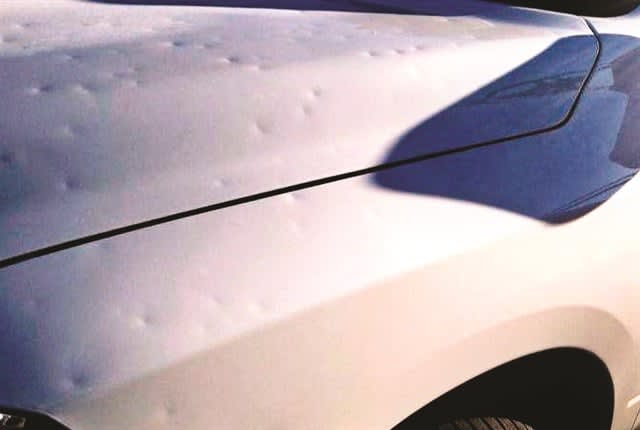
The top cause of weather-related damage is hail, which can cause hundreds of dings and dents in a vehicle in a short time period. Photo courtesy of ARI.
Fleet managers often depend on vehicle transport companies to deliver fleet vehicles to satellite locations or drivers from dealerships, pool locations, or upfitters. During this time on the road, be it via a transport truck, rail car, or ship, a lot can happen before a vehicle is even issued to a driver.
Ad Loading...
While viewed as a potentially smaller concern among the myriad issues fleet managers deal with daily, vehicles do get damaged in transit, and there may not be much fleet managers can do about it. Subject-matter experts weigh in on the issue and provide advice on actions that can be taken.
Ad Loading...
Damage Happens
While not a high-volume vehicle concern, every ding, dent, or fully totaled vehicle costs a company time and money, all while creating headaches for the fleet manager. Top causes for vehicle damage in transit include weather- and transport-related damage due to carelessness or accidents.
“Considering the amount of orders Donlen places annually, it is not often that vehicles are damaged in transit; however, when they are, it is frustrating and challenging for both Donlen and our customers,” said Cindy Gomez, director of vehicle acquisition services at Donlen.
Phil Schreiber, fleet manager North America, OTIS Service Center, noted that he sees about five to 10 vehicles damaged in transit each year. “However, I think it happens more often and is due to carelessness and a lack of knowledge with working equipment,” he said.
John Conte, supervisor – supply chain at ARI, noted that “from March 2014 through February 2015, there were 36 documented cases of new vehicle damage facilitated by ARI’s Vehicle Supply Chain team. Of those 36 situations, 18 — or half — were weather related, and the other 18 were transit related.”
Ad Loading...
At A Glance Damage happens to vehicles while in transit, be it weather related or transportation related. To help mitigate the potential expense and downtime, fleet managers can:
Ensure they have a plan in place for when damage happens.
Understand who is responsible for vehicle damage, whether it be the dealer or OEM, and know who to call.
Adjust vehicle spec'ing and upfitting to reduce potential costs of damaged vehicles.
Jan Freund, director of manufacturer relations at Wheels Inc., reported being notified of approximately three to four damaged vehicles per month across all manufacturers.
Weather is a top cause of vehicle damage, with hail being the prime culprit.
“Hail damage is the most common, and, unfortunately, the damage that can be sustained to a vehicle in a hail storm can quickly add up. In extreme cases, such damage could cause a total loss if the cost to repair the vehicle extends beyond what makes economic sense. Other situations that can result in damage include train derailments, accidents involving commuter vehicles, floods, and vandalism,” Conte said.
And, the amount of damage due to weather can vary by time of year, as well.
“There are certain times throughout the year — spring in the Midwest in particular — when hail storms are frequent and multiple damage incidents can occur within the same time frame,” Conte said. If vehicles remain in one outdoor location for long periods of time, they are further susceptible to increased damage.
Ad Loading...
“Weather is the primary cause of vehicle damage. We are seeing more vehicles on hold in a secure lot for quality control. So, when an act of nature, such as a hail storm, occurs, more vehicles are affected. Before this practice, damage would be a small chip from road debris; now, we are seeing more significant damage that can result in the totaling of vehicles,” said Elizabeth Kelly, director of operations, vehicle acquisition at LeasePlan USA.
In addition to hail, floods are also a major concern. “Flood damage has become more prevalent due to manufacturers moving production overseas,” Kelly said.
“We have seen roof damage to vehicles while en route to the dealer caused by carriers going through an underpass that does not meet the height clearance. Unloading vehicles carelessly at the dealership has also caused damage to bumpers of the vehicles and rail dust has caused damage to the exterior paint,” said Gomez of Donlen.
Extreme cases also occur. “We have also seen vehicles fall off rail cars or trucks, but this is rare,” Kelly said.
Ad Loading...
Handle the Unavoidable
Transportation-related vehicle damage is a perennial problem, and some do not see it improving. “This problem always existed and I do not see year-over-year improvement,” said Schreiber of OTIS. Some vehicles may wait longer for shipment, causing some increased damage as well.
“In 2014, we saw vehicles sitting waiting for shipment at ramps and at the assembly plants, so there were a few more damaged vehicles; however, it has not really been a problem this year,” said Freund of Wheels. Others are also seeing an improvement, noting an increased quality of communication regarding the vehicle transportation process.
“Damage to vehicles in transit is not necessarily on the rise. Instead, we are hearing more about the damage due to better communication from the manufacturers,” said Kelly of LeasePlan.
Conte of ARI agreed. “I do not believe that there is a ‘spike’ or upsurge in instances of damage correlated to transportation — there is just more visibility into the process and fleet managers are more cognizant of it than they have been in the past,” he said.
Ad Loading...
When Life Hands You Lemons…
What can fleet managers do about transit-related vehicle damage? For the most part, Schreiber of OTIS Service Center summed it up neatly: “Nothing.”
Freund of Wheels agreed, explaining that “this is an issue between the carrier and the manufacturer. Fleet managers cannot control this.”
This was seconded by Gomez of Donlen, who noted that “unfortunately, this is not avoidable and is completely out of the fleet managers’ and FMCs’ control.”
However, it may not be totally unavoidable.
Ad Loading...
“Partnering with reputable transportation vendors that have a proven track record of low damage is the best tool to mitigate the chances for damage to occur. The same applies for damage that occurs on a dealer’s lot. Having a strong partnership with the dealership will help expedite the repair and get the vehicle into the client’s hands as quickly as possible,” said Conte of ARI.
Additionally, adjusting vehicle spec’ing and upfitting options may help reduce the potential for transportation-related vehicle damage.
“Fleet managers should consider the upfit required for their vehicles. Any additions that change the height and/or width of the vehicle, such as rear-view mirrors, ladder racks, light bars, etc., could be impacted during rail or truck transport. It is best to request these items be stowed in the vehicle until it reaches its final destination,” said Laurie Hunter, CAFM, senior account manager at LeasePlan USA.
Hunter noted that many of these items can be installed by the delivering dealer or a local upfit vendor. “Make sure any upfit items, such as traffic pylons, fire extinguishers, etc., are secured by the installer prior to shipment,” she continued.
Fleet managers should also know who is financially responsible for the damage.
Ad Loading...
“Financial responsibility for the vehicle’s condition generally lies with the transit company while they have possession. Fleet managers should always be certain that all relevant parties have adequate coverage should damage occur during transit. If fleet managers need assistance with damaged vehicles, they should consult their fleet insurance expert,” said John Hayes, VP, fleet insurance services at LeasePlan USA.
Dealers are also required to inspect the vehicles for damage and file a damage report prior to the vehicle being delivered to the driver, according to Freund of Wheels.
“Typically, it is minor damage, scrapes, or small dents that the manufacturers will repair. Each manufacturer has a threshold for the cost of damage repairs. If the cost exceeds that threshold, the manufacturer will take the vehicle back. The customer can either re-order or purchase an out-of-stock unit if time is an issue,” she said.
OEMs have detailed, and specific, procedure documents that must be followed by carriers and dealers in the event of in-transit damage.
“When a carrier or dealer does not follow the procedures it can result in extensive repair delays and delivery of the vehicle,” Freund said.
Ad Loading...
While damage during vehicle transit is a less frequent problem than other situations that cause vehicle damage, such as accidents, fleet managers should be prepared, and have a plan in place in case of damaged vehicles.
“Having an internal process in place and understanding the policies of your FMC’s vendor partners are the two keys to identifying options and recourse. Most OEMs and their in-network transportation carriers request notice of damages to be reported within 24-48 hours of delivery,” said Conte of ARI.
Depending on the severity of the damage, OEMs will either repair or categorize it as a total loss and a new order can be placed, or a possible financial arrangement can be made for out-of-stock purchases.
“Each situation is unique. Third-party transportation companies use condition reports at the time of pick-up and delivery to document vehicle state to proactively limit the amount of damage claim situations,” Conte said. Additionally, this is one area where working with an FMC can help, saving time and paperwork.
“When a fleet manager utilizes an FMC to place orders, and, somewhere in the delivery process the vehicle is damaged, the FMC will work on behalf of the customer based on the type of damage and where it happened. Ultimately, the FMC is working directly with the manufacturer or dealership on behalf of the customer to remedy the situation,” said Candice Groth, factory order and vehicle information center manager at GE Capital Fleet Services.
Ad Loading...
Regardless, time is not on a fleet manager’s side if damage occurs. From repairs to replacement, downtime will be incurred.
“Depending on the extent of damage, if the vehicle is not declared a total loss, the fleet manager will typically have to wait until the repairs have been completed. Dealers will then submit a claim to be reimbursed for the repairs. If a vehicle is declared a total loss, OEMs will request FMCs submit a replacement order and they will do their best to produce and ship the vehicle as soon as possible,” said Gomez of Donlen. “Unfortunately, if a customer cannot wait for another factory order and we are required to purchase a vehicle out of dealer inventory, the majority of the time, OEMs will not compensate for the price difference between purchasing out of stock vs. factory pricing, which causes issues for our customers.”
Upfit vehicles may cause additional headaches.
“If there are vehicles with upfitting that cannot be placed back into manufacturing traffic due to not fitting on a rail car, we will coordinate delivery with a transport vendor or upfitter. FMCs and customers must be very careful when coordinating moves via an upfitter as they may outsource these moves to outside transport companies or move vehicles themselves, but they may not have the necessary insurance to perform the move. Not knowing who is moving your vehicle and understanding their insurance requirements is a big risk and could ultimately place the liability on FMCs or customers,” Gomez continued.
Neology’s neoFleet platform will manage toll transactions and toll-authority operations for vehicles across Avis, Budget, Payless, Budget Truck and Zipcar.
Nearly eight in 10 surveyed fleets allow personal use of company vehicles, while just over half of respondents report charging employees for the privilege.
Could developments overseas offer a preview of what’s coming for U.S. fleets? This week, we’re looking at the future of AI, autonomy, and electrification, plus Ford Pro’s new certified pre-owned program, smarter vehicle offboarding, and a new way for fleets to manage toll expenses.
Rising operating costs, driver safety concerns, and unplanned downtime are putting unprecedented pressure on modern fleets. Discover how fleet managers use embedded OEM connectivity and real-time vehicle data to cut TCO, prevent downtime, and protect drivers without aftermarket telematics hardware.
ADAS-equipped vehicles may crash less often, but they can cost more when they do. This week, we’re breaking down what that tradeoff means for fleets, plus Subaru’s first Forester Wilderness Hybrid, Nissan’s new e-POWER Rogue, and why Calstart has become Catalyst Mobility.
Iorillo brings nearly 20 years of fleet management and sales experience to the role, including previous positions at Element Fleet Management, CEI, Donlen and Ryder.