




How to Avoid Drowsy Driving
For some, going without a full eight hours of sleep is worn as a badge of honor. The consequences can be deadly, particularly for fleet drivers.

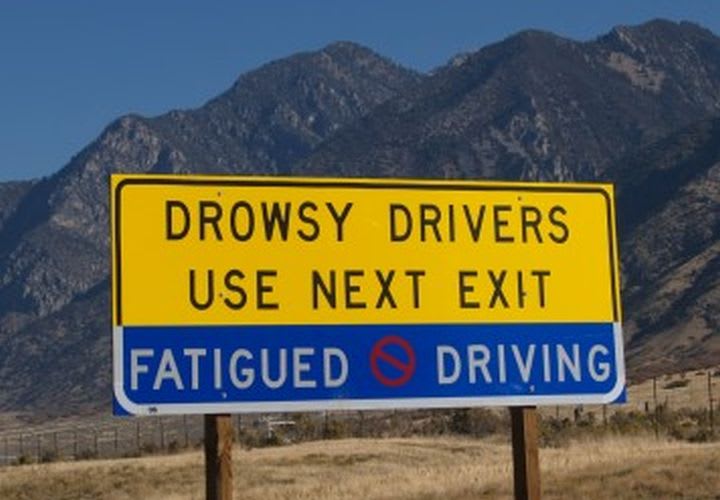
Photo via Wikimedia.
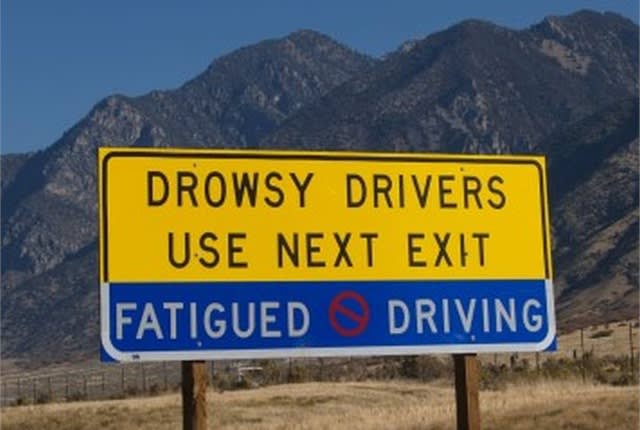
Photo via Wikimedia.
In today's 24/7 world, foregoing an hour or two of sleep every night isn't that uncommon. For some, going without a full eight hours of sleep is worn as a badge of honor. But, the consequences can be deadly, particularly for fleet drivers, according to Matt Uhles, R.PSGT, director, technology and operations for the Clayton Sleep Institute (CSI) Clinics and co-director of the CSI Research Center.
"You're more likely to die from drowsy driving than from texting while driving, distracted driving, or drunk driving combined," he said.
Underscoring his point, Uhles noted that one in two people involved in a drowsy driving accident will either be seriously injured or killed. In total, at least 4 percent of all fatal traffic accidents are attributable to sleepiness.
The problem is so endemic, St. Louis-based Uhles was recently told by investigators with the State of Missouri Crash Team, which investigates every fatality crash, that it has stopped investigating single-vehicle fatality accidents — an indicator of a drowsy driving — because there are "too many of them."
There are a number of reasons why drivers might not be getting enough sleep, ranging from simply foregoing sleep to having a sleep disorder, such as sleep apnea.
"We also have a biological clock that dictates when we're more likely to be alert and more likely to be sleeping," Uhles noted. "Not getting enough sleep and time of day will affect sleepiness. The worst time to drive is between 4 a.m. and 6 a.m. and between 2 p.m. and 4 p.m."
There are clear signs and symptoms associated with drowsy driving, which can include drifting from the lane, swerving or tailgating, yawning, and head snaps.
Uhles said there also are more subtle signs such as "zoning out." "What's going on physiologically when we zone out is that the part of our brain that is controlling our attention and focus has fallen asleep and the rest of the cortex and brain is going to catch up and the driver is going to have an accident," he said.
Uhles noted that, while there is no excusing distracted driving (e.g., texting and driving) or drunk driving, in some cases the distracted or drunk driver has an advantage over the drowsy driver, because these drivers still have the opportunity to react.
"When you're asleep, there is no chance to respond," Uhles said.
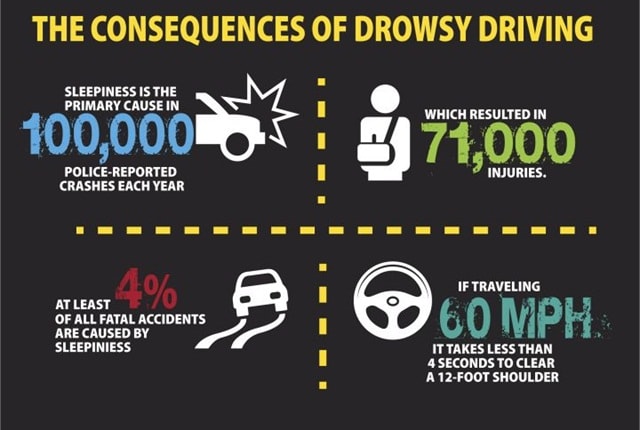
Illustration by Armie Bautista.
Educating drivers about the benefit of a good night's sleep is the No. 1 method fleet managers can use to combat drowsy driving.
"There's a general lack of awareness of what sleep does for us and what happens when we don't get enough sleep," Uhles said. "If you're driving and you're drowsy, it's only a matter of time before you'll be running off the shoulder or drifting out of your lane."
The National Sleep Foundation recommends that for every 100 miles or two hours of driving, the driver should take a short break.
If a driver does find that he or she is driving drowsy there are countermeasures that can be taken, Uhles said.
If driving with a partner, take frequent breaks or take turns or switch places; however, if the driver is alone, then he or she should stop driving immediately and take a nap. Drinking a cup of coffee can work, but it isn't an instant fix.
"Caffeine does work, but the problem is you have to drink lots of it, 200 mg, which is equivalent to two 8-ounce cups of coffee or four to six sodas, and it takes about 20 to 30 minutes to take effect," Uhles said. "One of the tips we recommend is that if you're driving and can't have another person drive, pull over, get a couple cups of coffee, take a nap for 20 to 30 minutes. This should be enough to restore you and get you to your destination safely. If you're still drowsy, stop driving and repeat."
However, the best medicine is still getting a good night's sleep.
More Safety

Fleet Manager’s Ultimate Playbook: Navigating the New Standard in OEM Connectivity
Rising operating costs, driver safety concerns, and unplanned downtime are putting unprecedented pressure on modern fleets. Discover how fleet managers use embedded OEM connectivity and real-time vehicle data to cut TCO, prevent downtime, and protect drivers without aftermarket telematics hardware.
Read More →
From Driver Well-Being to EV Charging | AF News Recap
Mental health belongs in the fleet safety conversation. This week, we’re looking at five ways fleets can support employee well-being before a crisis, plus Holman’s expansion in Mexico, new one-day Fleet Forward passes, and why EV charging demand is outpacing infrastructure growth.
Read More →
Nexar-Nauto Merger Aims to Give Fleets Better Safety Intelligence Through Larger Driving Dataset
Stefan Heck tells Automotive Fleet that combining more than 10 billion miles of driving history with Nexar's AI models will give fleets deeper insights into driver risk and roadway conditions than either company could provide independently.
Read More →
Don't Wait for a Crisis: 5 Ways to Build Mental Health Into Your Fleet Safety Program
For Suicide Prevention Month, fleet and safety leaders have an opportunity to put mental health where it belongs: at the center of workplace safety.
Read More →
How Camera Data Can Strengthen a Fleet’s Insurance Renewal
Insights from a commercial insurance carrier and a broker show how fleets can turn video telematic data, driver coaching, and improved claims results into a stronger case at insurance renewal.
Read More →
The Safest Fleets Aren’t the Ones with the Most Technology
You’ve made the telematics investment. Here’s how to capture the other half of its value and build the safest fleet on the road.
Read More →
Hidden in Plain Sight: Fleet Compliance Risks
Fleet compliance isn't just about having policies — it's about consistently enforcing them. This practical guide reveals six hidden compliance risks common in public sector and shared fleet operations and outlines proven strategies to improve visibility, accountability, and audit readiness
Read More →
NETS Sets 2026 Fleet Safety Benchmark Conference for Indianapolis
The Sept. 15–17 program will feature fleet benchmarking data, case studies, emerging technologies, and implementation strategies while running alongside the NSC Safety Congress & Expo.
Read More →
Off-the-Job Crashes Account for 43% of Employers’ $61.7 Billion Crash Burden
NETS quantifies costs dispersed across fleet, risk, HR, and other departments while providing new per-crash benchmarks for employers.
Read More →
Ram Recalls More Than 1.27 Million 1500 Pickups for Seat Belt Anchor Issue
The recall affects certain 2019-2026 Ram 1500 pickups that may have improperly attached second-row seat belt buckle anchors.
Read More →